Wednesday, February 6, 2019

Homo Credulus: "He'll Go Along With Almost Anything"

ORIGINAL LINK

Authored by Joel Bowman via InternationalMan.com,

Man: He’ll go along with just about anything.

Given the right circumstances... a little programing... and enough time for it all to marinate in his soft, mammalian brain... there is almost nothing Homo Credulus will not learn to embrace.

Don’t believe us?

Take a look at the historical record; you’ll soon wonder how we ever got this far.

Sure, you’ll discover gizmos and flying contraptions… art and agriculture… music and mathematics. You’ll witness spectacular scientific breakthroughs, the number “0” and a man’s footprint on the moon. You’ll also find automobiles with so many cup holders, you won’t know where to holster your oversized 7/11 Big Gulp.

But you’ll also scratch you head. Perhaps you’ll even weep. And if you think hard enough, you’ll put a few things to serious question…

“Central banks?” “Modern democracy?” “The Rosie O'Donnell Show?”

How has mankind survived such atrocities? Self inflicted, no less! And why, moreover, does he rush so earnestly to repeat and replay his worst mistakes?

Don’t be too hard on yourself, Dear Reader. After all, repetition is nothing new…

You’ll recall that it was the Greeks who first gave the world democracy – from the Greek, dēmokratía, literally “Rule by 'People'”. (And yes, it was those very same Greeks who put their own beloved Socrates to death… by a majority vote of 140-361.)

Today, democracy is a cherished tenet of “the West.” It is woven into the civic religion, sewn into the social fabric. Men march off eagerly to fight for it, to proselytize it … and to die in forgotten ditches defending it.

At least, that’s what they believe they’re doing. As usual, the poor saps have been duped. Herewith, a little historical context…

The phrase “Making the world safe for democracy” was actually a marketing slogan, coined back in the 1910s, as a way to sell “The Great War” to America. Weary from their own disastrous Civil War just a few decades earlier, in which hundreds of thousands gave up the ghost, Americans were mostly inward looking at the time. That is to say, they wanted little to do with what they largely saw as a “European affair.”

Polls might have indicated no appetite for battle… but the nation’s politicians were nonetheless starved for military misadventure. They sensed big profits abroad, both in manufacturing armaments and making onerous bank loans to foreign lands. Sure, “the nation” would have to fill tank and trench with warm young bodies… but very few soldiers would carry senatorial surnames along with their rifles.

And so, after a public relations campaign of truly epic proportions, America marched off to war… wrapped in the delusion they had freshly been sold.

Eddie Bernays, the man who coined the phrase and, thus, peddled the war to America, made a fortune for his efforts. He was even invited by Woodrow Wilson to attend the Paris Peace Conference, in 1919, as a show of gratitude for his services.

There, Bernays learned the full impact of his “democracy” slogan. An obviously bright fellow, the surreal experience caused him to think…

If people will line up to kill one another under influence of a mere marketing campaign… they could surely be convinced to do, say and buy just about anything!

Bernays was right. In fact, he wrote a series of books, detailing his insights. They included Crystallizing Public Opinion (1923), A Public Relations Counsel (1927) and a neat little number titled Propaganda(1928), in which Bernays laid out the blueprint for mass social and psychological manipulation.

The collected works went on to become a huge success… and the favorite of none other than Joseph Goebbles, Reich Minister for Propaganda in Nazi Germany between 1933-45.

Bernays himself, writing in his 1965 autobiography, recalls a dinner at home in 1933 where…

Karl von Wiegand, foreign correspondent of the Hearst newspapers, an old hand at interpreting Europe and just returned from Germany, was telling us about Goebbels and his propaganda plans to consolidate Nazi power. Goebbels had shown Wiegand his propaganda library, the best Wiegand had ever seen. Goebbels, said Wiegand, was using my book Crystallizing Public Opinion as a basis for his destructive campaign against the Jews of Germany. This shocked me. [...] Obviously the attack on the Jews of Germany was no emotional outburst of the Nazis, but a deliberate, planned campaign.

It is indeed chilling to think of such a heinous undertaking as being engineered, blueprinted, premeditated and carried out according to some kind of script. And yet, there it is… in Bernays’ own words, the “Father of Propaganda.”

Having acquired somewhat of a tainted reputation-by-association, propaganda, itself, underwent a “strategic rebranding” after WWII. But make no mistake, the very same métier thrives to this day, under the more socially palatable designation, “Public Relations.”

Still, a ruse by any other name…

“Could we be so stupid again?” wonders the gentle reader. “Might the mob still be swayed by what Charles Mackay termed ‘extraordinary popular delusions and the madness of crowds?’”

Why, of course! That’s the nature of the mob!

Whether in love, finance, politics or any other matter, man is ever wont to be convinced, assured, persuaded, often against his own best interests. Few are the absurdities in which he will not take refuge, invest his hard-earned capital or squander his morality.

All he needs is a good story, something to arrest his imagination and cauterize his capacity for reason. A distraction from his lonely, quotidian existence.

That, and a few crumbs to pass his lips.

The Roman poet, Juvenal, recognized as much when he mocked the panem et circenses (bread and circuses) stratagem almost two millennia ago. In his Satire X, he referred to the Annona (a kind of grain dole) and the famous circus games, held in the Colosseum and elsewhere, as designed to keep the unthinking population fed and happy.

Look around you today, Dear Reader. What do you see, two millennia later, in the Year of Their Lord, 2019 AD?

Stadium sports matches… food stamp programs… and of course, the greatest bread and circuses show ever, modern representative democracy…

Now, as then, the show goes on!

*  *  *

Clearly, there are many strange things afoot in the world. Distortions of markets, distortions of culture. It’s wise to wonder what’s going to happen, and to take advantage of growth while also being prepared for crisis. How will you protect yourself in the next crisis? See our PDF guide that will show you exactly how. Click here to download it now.


via IFTTT

The market’s last hope is faltering…

ORIGINAL LINK

By July of last year, just three stocks (Amazon, Netflix and Microsoft) were responsible for 71% of the S&P 500’s returns.

Through the third quarter, tech stocks were responsible for 95% of the S&P’s gains.

Amazon alone was responsible for about one-third of the index’s move.

And we long warned about the follies of blindly investing your capital into these incredibly popular and often overvalued firms (we also advised you to start raising cash).

Especially when a number of these companies were burning through cash at unprecedented rates…

Netflix LOST $3 billion in cash last year (and added another $4 billion in debt, bringing its total to over $10 billion). The company is currently trading at over 130x earnings.

Tesla – another market darling we questioned – was losing over $700 million in cash a quarter (though it recently turned cashflow positive). But the company recently had to lay off 10% of its workforce and cut the price of its Model 3 to attract demand.

Still, their share prices soared.

And that’s just the public markets. Venture capital investors were getting even wilder…

After a recent, $2 billion investment, WeWork, the shared office space company, is currently valued at $47 billion.

The company must be valued on “energy and spirituality” as Adam Neumann, the CEO said (he literally said that). Because the firm lost $723 million in the first half of 2018. And its bonds have already been downgraded to junk.

But it gets worse… news arose the company’s CEO was personally buying buildings and leasing them back to WeWork.

So while his investors are dumping billions into a cash-losing company, he’s buying real estate.

As if it wasn’t clear before, we know who Adam is looking out for – investors are not only footing the bill while he serves kombucha and free tequila to hipsters… they’re literally putting money in his pocket.

But in the fourth quarter of 2018, interest rates spiked. When you can earn more money in safer assets like cash and debt, blindly throwing cash at money-losing firms becomes less attractive.

And investors worried we may finally head towards a recession after a 10-year bull market in everything.

We saw the market’s growth engine (FAANG) tank…

It wasn’t just the high-flying floozies like Tesla and Netflix (which fell 24% and 44% from their peaks).

Huge, steady and profitable companies also plunged… Apple fell nearly 40% from its September highs. The company said it would stop publishing iPhone unit sales (it’s never reassuring when a company decides to get less transparent with investors).

And Facebook dropped by 43%.

Hundreds of billions of dollars in shareholder value were erased in just a few months.

The prices have recovered a bit from the recent lows. But the lesson is, these falls can happen faster and be more severe than anyone expects.

We saw some of the most popular and largest stocks in the world nearly get cut in half because the Federal Reserve raised interest rates by a few basis points.

What happens when we have a real reason to be worried?

Remember what happened in 2008. Millions of people got wiped out… they lost their retirement savings in a matter of months.

And the entire market could easily fall by 50% or more again. So you seriously need to ask yourself… what would you do in that scenario?

The key is to start thinking about this now, before the crash comes. Because in the heat of the moment, you’ll be panicked and emotional.

We believe things are in a general decline today. Nobody’s got a crystal ball, but last year, we predicted October would be the top. So far, that’s been the case.

Honestly, things could go up or down from here. So you’ve got to be well positioned no matter what does or doesn’t happen.

For now, you just need to be smarter and more conservative. If something’s not a screaming deal, then don’t do it.

In the meantime, look for some simple ways to safely earn more on your money.

If your cash is sitting in a bank and earning 0.05%, move it to Treasury bills and earn 2% more each year on your cash. There’s no downside to that.

I’ve also arranged several asset-backed loans for my Total Access members. We’re earning double-digit, annual interest on a loan backed by a piece of real estate worth multiples the loan amount.

Plus, I know the borrowers. They’re creditworthy and responsible.

But if they don’t pay, I already have custody of the asset, so there’s no legal process to taking the property over. That’s a pretty safe way to earn 12%.

I also invested in a startup a few years back… it was risky, but I knew the potential reward was massive.

The company, which is in the cannabis space, recently went public at about 50x where we initially invested. A number of our readers became millionaires…

Not bad for a 2.5 year investment period.

That’s why I like private companies. You can call up management on the phone and get the information you need to make a decision.

The point is, pay very close attention to your risks today – regardless of the investment. How much risk are you taking relative to the return?

Ten years in to the longest bull market in history, FAANG may not provide the best risk-adjusted returns.

But as individual investors, there’s a whole world of opportunities available to us that the larger, institutional players can’t access.

There are still deals out there. You just have to look a bit harder.

Source


via IFTTT

Brace For Impact

ORIGINAL LINK

Authored by Charles Hugh Smith via OfTwoMinds blog,

As credit-asset bubbles pop, the dominoes start falling.

The economy is far more precarious than the surface boom/bubble suggests. A great many households, enterprises and municipalities are in overloaded boats whose gunwales are just a few inches above the water; the slightest wave will swamp and sink them.

The cost structure of the economy is completely out of whack with what households and enterprises can afford. There are several dynamics in play:

1. Enterprises have already stripped out all the expenses they can: head count has been cut, quality has been gutted, quantity has been reduced, supply chains have been squeezed, inventory controls trimmed to just-in-time and so on. There are no easy, quick cost reductions available except laying off employees. Every other cost-cutting strategy has been milked dry.

2. Costs are soaring despite the low rate of officially measured inflation. I recently found some notes from 1995--a long time ago, 24 years. The dot-com bubble--the first of this era's three great asset bubbles--was inflating rapidly but official inflation was low, around 2.5% to 3% annually.

A slice of pizza was $1.50, a main dish in a Chinese restaurant was $4.50 and rent for a one-bedroom apartment in the S.F. Bay Area was $650/month. Now the pizza slice is $4.25 plus 9.25% tax, $4.65; the main dish is $11.95 plus 9.25% tax, $13.05, and rents for one-bedroom apartments far exceed $2,000/month in desirable neighborhoods.

Official inflation is $1 in 1995 equals $1.67 today. So a $1.50 slice of pizza in 1995 should cost $2.50 today, the $4.50 main dish should cost $7.50, and the $650 monthly rent should be $1,085. Real-world inflation has outstripped the bogus official rate in sector after sector. So TVs have dropped in price; big deal. How often do you buy a TV?

Costs have tripled in 24 years, but have wages tripled? No. In many cases, they haven't even kept pace with official inflation, much less real-world inflation. How many people earning $40,000 in 1995 are now earning $67,000, the minimum increase needed to match the rise in official inflation? Nobody I know. How many positions paying $40,000 in 1995 are now paying $120,000 for the same job? I think we can safely say none.

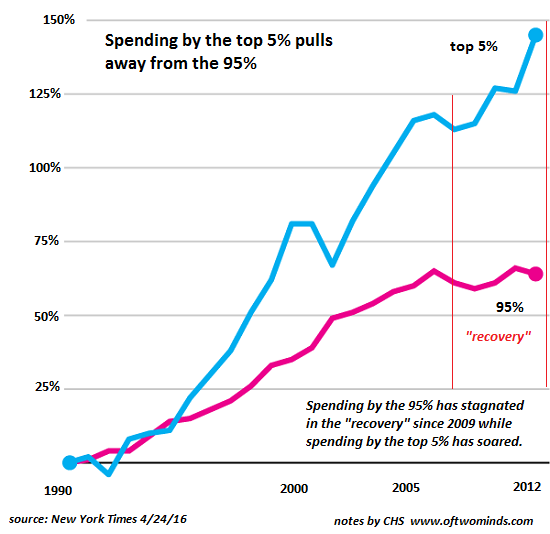
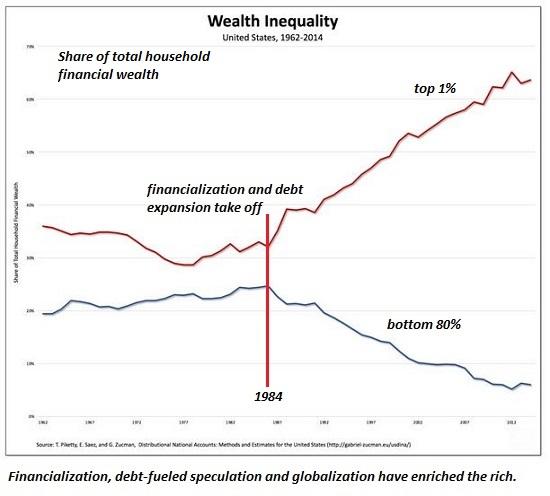
3. The majority of gains in income and wealth have flowed to the top 5%, and most of the gains in the top 5% have flowed to the apex of that income bracket. So when we read that average household wealth has increased or median wages have increased, the reality is these statistics mask the actual distribution of income and wealth gains, which are skewed heavily to the top 5% income/wealth brackets.

This chart is a few years old but the trend hasn't changed.

Long-term distribution of gains continues to favor the top 1%.

Enterprises are precarious because their costs are high and there's nothing left to cut. A relatively modest decline in revenues will cut profits / owners' incomes to less than zero.

Households in high-cost regions are barely above water. Any reduction in household income will push these households into insolvency.

As credit-asset bubbles pop, the dominoes start falling. As real estate rolls over, lending and construction activity decline, triggering layoffs. As household income takes a hit, the days of spending $15 for lunch every day plus a $5 coffee and $4 bagel go away. The only way for enterprises absorbing revenue declines to survive is to lay off employees, which reduces the pool of consumers with disposable income.

Relying on the free-spending top 5% is also a recipe for fragility. The highest paid employees are the last plum target left for corporate cost-cutters, and the biggest targets for software/AI/automation. The janitors making minimum wage ($15/hour now in many locales) are not that exposed to automation, and the gains would be modest any way. But reducing the head count of employees earning $120,000 and up makes a significant positive impact on the bottom line as revenues stagnate or plummet.

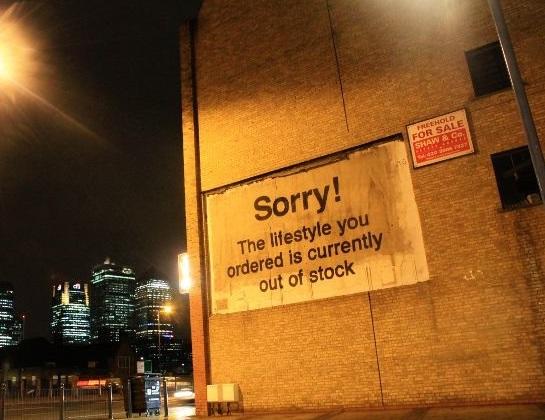
Sorry, boom-time America: the lifestyle you ordered in now out of stock and we have no indication it will be in stock again within the foreseeable future.

In summary: brace for impact.

*  *  *

Pathfinding our Destiny: Preventing the Final Fall of Our Democratic Republic ($6.95 ebook, $12 print): Read the first section for free in PDF format. My new mystery The Adventures of the Consulting Philosopher: The Disappearance of Drake is a ridiculously affordable $1.29 (Kindle) or $8.95 (print); read the first chapters for free (PDF). My book Money and Work Unchained is now $6.95 for the Kindle ebook and $15 for the print edition. Read the first section for free in PDF format. If you found value in this content, please join me in seeking solutions by becoming a $1/month patron of my work via patreon.com.


via IFTTT

Tuesday, February 5, 2019

Journalist Interrogated, Fired For Story Linking CIA And Syria Weapons Flights

ORIGINAL LINK

bg%201_0.jpg

A months-long investigation which tracked and exposed a massive covert weapons shipment network to terror groups in Syria via diplomatic flights originating in the Caucuses and Eastern Europe under the watch of the CIA and other intelligence agencies has resulted in the interrogation and firing of the Bulgarian journalist who first broke the story. This comes as the original report is finally breaking into mainstream international coverage.


via IFTTT

Robert F. Kennedy Jr Explains How Big Pharma Completely Owns Congress

ORIGINAL LINK

Robert F. Kennedy Jr, Chairman of the Board of Directors for Children’s Health Defence (a worthy cause if you’re looking for one to donate to) has been fighting against big corporations that have taken over and undermined American government health regulatory agencies for a number of years. One of the most recent examples is when Robert F. Kennedy Jr represented Dewayne Johnson, a school groundskeeper who successfully brought forward a lawsuit alleging glyphosate caused his cancer. That’s right, he won!


via IFTTT

Why The War On Conspiracy Theories Is Bad Public Policy

ORIGINAL LINK

Authored by Kevin Barrett via The Unz Review,

On January 25 2018 YouTube unleashed the latest salvo in the war on conspiracy theoriessaying “we’ll begin reducing recommendations of borderline content and content that could misinform users in harmful ways—such as videos promoting a phony miracle cure for a serious illness, claiming the earth is flat, or making blatantly false claims about historic events like 9/11.”

At first glance that sounds reasonable. Nobody wants YouTube or anyone else to recommend bad information. And almost everyone agrees that phony miracle cures, flat earthism, and blatantly false claims about 9/11 and other historical events are undesirable.

But if we stop and seriously consider those words, we notice a couple of problems.

First, the word “recommend” is not just misleading but mendacious. YouTube obviously doesn’t really recommend anything. When it says it does, it is lying.

When you watch YouTube videos, the YouTube search engine algorithm displays links to other videos that you are likely to be interested in. These obviously do not constitute “recommendations” by YouTube itself, which exercises no editorial oversight over content posted by users. (Or at least it didn’t until it joined the war on conspiracy theories.)

The second and larger problem is that while there may be near-universal agreement among reasonable people that flat-earthism is wrong, there is only modest agreement regarding which health approaches constitute “phony miracle cures” and which do not.

Far less is there any agreement on “claims about 9/11 and other historical events.” (Thus far the only real attempt to forge an informed consensus about 9/11 is the 9/11 Consensus Panel’s study—but it seems unlikely that YouTube will be using the Consensus Panel to determine which videos to “recommend”!)
YouTube’s policy shift is the latest symptom of a larger movement by Western elites to - as Obama’s Information Czar Cass Sunstein put it - “disable the purveyors of conspiracy theories.” Sunstein and co-author Adrian Vermeule’s 2008 paper “Conspiracy Theories,” critiqued by David Ray Griffin in 2010 and developed into a 2016 book, represents a panicked reaction to the success of the 9/11 truth movement. (By 2006, 36% of Americans thought it likely that 9/11 was an inside job designed to launch wars in the Middle East, according to a Scripps poll.)

Sunstein and Vermuele begin their abstract:

Many millions of people hold (sic) conspiracy theories; they believe that powerful people have worked together in order to withhold the truth about some important practice or some terrible event. A recent example is the belief, widespread in some parts of the world, that the attacks of 9/11 were carried out not by Al Qaeda, but by Israel or the United States. Those who subscribe to conspiracy theories may create serious risks, including risks of violence, and the existence of such theories raises significant challenges for policy and law.

Sunstein argues that conspiracy theories (i.e. the 9/11 truth movement) are so dangerous that some day they may have to be banned by law. While awaiting that day, or perhaps in preparation for it, the government should “disable the purveyors of conspiracy theories” through various techniques including “cognitive infiltration” of 9/11 truth groups. Such “cognitive infiltration,” Sunstein writes, could have various aims including the promotion of “beneficial cognitive diversity” within the truth movement.

What sort of “cognitive diversity” would Cass Sunstein consider “beneficial”? Perhaps 9/11 truth groups that had been “cognitively infiltrated” by spooks posing as flat-earthers would harbor that sort of “beneficial” diversity? That would explain the plethora of expensive, high-production-values flat earth videos that have been blasted at the 9/11 truth community since 2008.

Why does Sunstein think “conspiracy theories” are so dangerous they need to be suppressed by government infiltrators, and perhaps eventually outlawed—which would necessitate revoking the First Amendment? Obviously conspiracism must present some extraordinary threat. So what might that threat be? Oddly, he never explains. Instead he briefly mentions, in vapidly nebulous terms, about “serious risks including the risk of violence.” But he presents no serious evidence that 9/11 truth causes violence. Nor does he explain what the other “serious risks” could possibly be.

Why did such highly accomplished academicians as Sunstein and Vermuele produce such an unhinged, incoherent, poorly-supported screed? How could Harvard and the University of Chicago publish such nonsense? Why would it be deemed worthy of development into a book? Why did the authors identify an alleged problem, present no evidence that it even is a problem, yet advocate outrageously illegal and unconstitutional government action to solve the non-problem?

The too-obvious answer, of course, is that they must realize that 9/11 was in fact a US-Israeli false flag operation. The 9/11 truth movement, in that case, would be a threat not because it is wrong, but because it is right. To the extent that Americans know or suspect the truth, the US government will undoubtedly find it harder to pursue various “national security” objectives. Ergo, 9/11 “conspiracy theories” are a threat to national security, and extreme measures are required to combat them. But since we can’t just burn the First Amendment overnight, we must instead take a gradual and covert “boil the frog” approach, featuring plenty of cointelpro-style infiltration and misdirection. “Cognitive infiltration” of internet platforms to stop the conspiracy contagion would also fit the bill.

It is quite possible, perhaps even likely, that Sunstein and Vermeule are indeed well-informed and Machievellian. But it is also conceivable that they are, at least when it comes to 9/11 and “conspiracy theories,” as muddle-headed as they appear. Their irrational panic could be an example of the bad thinking that emerges from groups that reflexively reject dissent. (Another, larger example of this kind of bad thinking comes to mind: America’s disastrous post-9/11 policies.)

The counterintuitive truth is that embracing and carefully listening to radical dissenters is in fact good policy, whether you are a government, a corporation, or any other kind of group. Ignoring or suppressing dissent produces muddled, superficial thinking and bad decisions. Surprisingly, this turns out to be the case even when the dissenters are wrong.

Scientific evidence for the value of dissent is beautifully summarized in Charlan Nemeth’s In Defense of Troublemakers: The Power of Dissent in Life and Business (Basic Books, 2018). Nemeth, a psychology professor at UC-Berkeley, summarizes decades of research on group dynamics showing that groups that feature passionate, radical dissent deliberate better, reach better conclusions, and take better actions than those that do not—even when the dissenter is wrong.

Nemeth begins with a case where dissent would likely have saved lives: the crash of United Airlines Flight 173 in December, 1978. As the plane neared its Portland destination, the possibility of a problem with the landing gear arose. The captain focused on trying to determine the condition of the landing gear as the plane circled the airport. Typical air crew group dynamics, in which the whole crew defers to the captain, led to a groupthink bubble in which nobody spoke up as the needle on the fuel gauge approached “E.” Had the crew included even one natural “troublemaker”—the kind of aviator who joins Pilots for 9/11 truth—there almost certainly would have been more divergent thinking. Someone would have spoken up about the fuel issue, and a tragic crash would have been averted.

Since 9/11, American decision-making elites have entered the same kind of bubble and engaged in the same kind of groupthink. For them, no serious dissent on such issues as what really happened on 9/11, and whether a “war on terror” makes sense, is permitted. The predictable result has been bad thinking and worse decisions. From the vantage point of Sunstein and Vermeule, deep inside the bubble, the potentially bubble-popping, consensus-shredding threat of 9/11 truth must appear radically destabilizing. To even consider the possibility that the 9/11 truthers are right might set off a stampede of critical reflection that would radically undermine the entire set of policies pursued for the past 17 years. This prospect may so terrify Sunstein and Vermeule that it paralyzes their ability to think. Talk about “crippled epistemology”!

Do Sunstein and Vermeule really think their program for suppressing “conspiracy theories” will be beneficial? Do YouTube’s decision-makers really believe that tweaking their algorithms to support the official story will protect us from bad information? If so, they are all doubly wrong.

First, they are wrong in their unexamined assumption that 9/11 truth and “conspiracy theories” in general are “blatantly false.” No honest person with critical thinking skills who weighs the merits of the best work on both sides of the question can possibly avoid the realization that the 9/11 truth movement is right. The same is true regarding the serial assassinations of America’s best leaders during the 1960s. Many other “conspiracy theories,” perhaps the majority of the best-known ones, are also likely true, as readers of Ron Unz’s American Pravda series are discovering.

Second, and less obviously, those who would suppress conspiracy theories are wrong even in their belief that suppressing false conspiracy theories is good public policy. As Nemeth shows, social science is unambiguous in its finding that any group featuring at least one passionate, radical dissenter will deliberate better, reach sounder conclusions, and act more effectively than it would have without the dissenter. This holds even if the dissenter is wrong—even wildly wrong.

The overabundance of slick, hypnotic flat earth videos, if they are indeed weaponized cointelpro strikes against the truth movement, may be unfortunate. But the existence of the occasional flat earther may be more beneficial than harmful. The findings summarized by Nemeth suggest that a science study group with one flat earther among the students would probably learn geography and astronomy better than they would have without the madly passionate dissenter.

We could at least partially solve the real problem—bad groupthink—through promoting genuinely beneficial cognitive diversity. YouTube algorithms should indeed be tweaked to puncture the groupthink bubbles that emerge based on user preferences. Someone who watches lots of 9/11 truther videos should indeed be exposed to dissent, in the form of the best arguments on the other side of the issue—not that there are any very good ones, as I have discovered after spending 15 years searching for them!

But the same goes for those who watch videos that explicitly or implicitly accept the official story. Anyone who watches more than a few pro-official-story videos (and this would include almost all mainstream coverage of anything related to 9/11 and the “war on terror”) should get YouTube “suggestions” for such videos as September 11: The New Pearl Harbor9/11 Mysteries, and the work of Architects and Engineers for 9/11 Truth. Exposure to even those “truthers” who are more passionate than critical or well-informed would benefit people who believe the official story, according to Nemeth’s research, by stimulating them to deliberate more thoughtfully and to question facile assumptions.

The same goes for other issues and perspectives. Fox News viewers should get “suggestions” for good material, especially passionate dissent, from the left side of the political spectrum. MSNBC viewers should get “suggestions” for good material from the right. Both groups should get “suggestions” to look at genuinely independent, alternative media brimming with passionate dissidents—outlets like the Unz Review!

Unfortunately things are moving in the opposite direction. YouTube’s effort to make “conspiracy videos” invisible is being pushed by powerful lobbies, especially the Zionist lobby, which seems dedicated to singlehandedly destroying the Western tradition of freedom of expression.

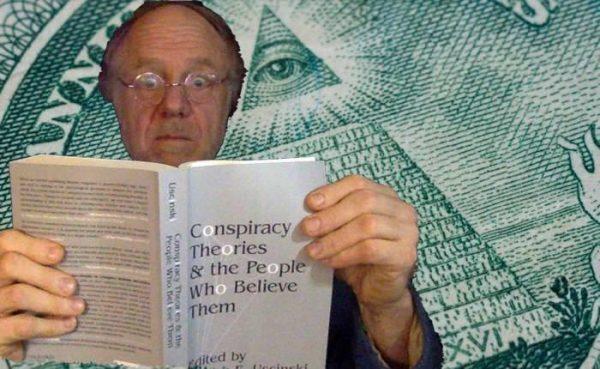
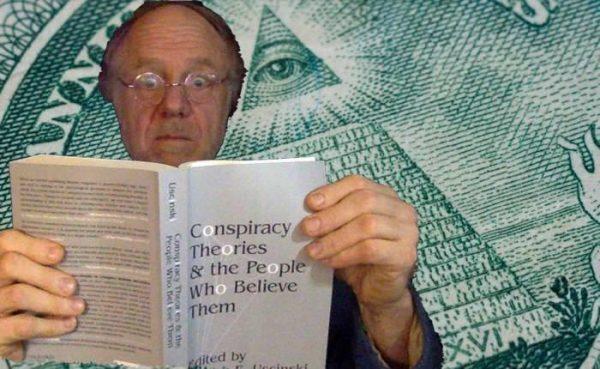
Nemeth and colleagues’ findings that “conspiracy theories” and other forms of passionate dissent are not just beneficial, but in fact an invaluable resource, are apparently unknown to the anti-conspiracy-theory cottage industry that has metastasized in the bowels of the Western academy. The brand-new bible of the academic anti-conspiracy-theory industry is Conspiracy Theories and the People Who Believe Them (Oxford University Press, 2019).

Editor Joseph Uscinski’s introduction begins by listing alleged dangers of conspiracism:

“In democracies, conspiracy theories can drive majorities to make horrible decisions backed by the use of legitimate force. Conspiracy beliefs can conversely encourage abstention. Those who believe the system is rigged will be less willing to take part in it. Conspiracy theories form the basis for some people’s medical decisions; this can be dangerous not only for them but for others as well. For a select few believers, conspiracy theories are instructions to use violence.”

Uscinski is certainly right that conspiracy theories can incite “horrible decisions” to use “legitimate force” and “violence.” Every major American foreign war since 1846 has been sold to the public by an official theory, backed by a frenetic media campaign, of a foreign conspiracy to attack the United States. And all of these Official Conspiracy Theories (OCTs)—including the theory that Mexico conspired to invade the United States in 1846, that Spain conspired to sink the USS Maine in 1898, that Germany conspired with Mexico to invade the United States in 1917, that Japan conspired unbeknownst to peace-seeking US leaders to attack Pearl Harbor in 1941, that North Vietnam conspired to attack the US Navy in the Gulf of Tonkin in 1964, and that 19 Arabs backed by Afghanistan, Iraq, Iran, and everybody else Israel doesn’t like conspired to attack the US in 2001—were false or deceptive.

Well over 100 million people have been killed in the violence unleashed by these and other Official Conspiracy Theories. Had the passionate dissenters been heeded, and the truths they told about who really conspires to create war-trigger public relations stunts been understood, none of those hundred-million-plus murders need have happened.

Though Conspiracy Theories and the People Who Believe Them generally pathologizes the conspiracy theories of dissidents while ignoring the vastly more harmful theories of official propagandists, its 31 essays include several that question that outlook. In “What We Mean When We Say ‘Conspiracy Theory’ Jesse Walker, books editor of Reason Magazine, exposes the bias that permeates the field, pointing out that many official conspiracy theories, including several about Osama Bin Laden and 9/11-anthrax, were at least as ludicrously false and delusional as anything believed by marginalized dissidents.

In “Media Marginalization of Racial Minorities: ‘Conspiracy Theorists’ in U.S. Ghettos and on the ‘Arab Street’” Martin Orr and Gina Husting go one step further: “The epithet ‘conspiracy theorist’ is used to tarnish those who challenge authority and power. Often, it is tinged with racial undertones: it is used to demean whole groups of people in the news and to silence, stigmatize, or belittle foreign and minority voices.” (p.82) Unfortunately, though Orr and Husting devote a whole section of their article to “Conspiracy Theories in the Muslim World” and defend Muslim conspiracists against the likes of Thomas Friedman, they never squarely face the fact that the reason roughly 80% of Muslims believe 9/11 was an inside job is because the preponderance of evidence supports that interpretation.

Another relatively sensible essay is M R.X. Dentith’s “Conspiracy Theories and Philosophy,” which ably deconstructs the most basic fallacy permeating the whole field of conspiracy theory research: the a priori assumption that a “conspiracy theory” must be false or at least dubious: “If certain scholars (i.e. the majority represented in this book! –KB) want to make a special case for conspiracy theories, then it is reasonable for the rest of us to ask whether we are playing fair with our terminology, or whether we have baked into our definitions the answers to our research programs.” (p.104). Unfortunately, a few pages later editor Joseph Uscinski sticks his fingers in his ears and plays deaf and dumb, claiming that “the establishment is right far more often than conspiracy theories, largely because their methods are reliable. When conspiracy theorists are right, it is by chance.” He adds that conspiracy theories will inevitably “occasionally lead to disaster” (whatever that means). (p.110).

I hope Uscinski finds the time to read Nemeth’s In Defense of Troublemakers and consider the evidence that passionate dissent is helpful, not harmful. And I hope he will look into the issues Ron Unz addresses in his American Pravda series.

Then again, if he does, he may find himself among those of us exiled from the academy and publishing in The Unz Review.


via IFTTT

Monday, February 4, 2019

The next recession will sweep the Socialists into power

ORIGINAL LINK

What I’m about to say may sound totally crazy at first. But keep reading, because I think you’ll agree that it’s dead-on accurate.

There’s a recession coming.

No, that’s not some Chicken Little “The Sky is Falling” statement. Far from it. It’s just a fact: economies and financial markets always go through boom and bust cycles.

There are good years and lean years, up years and down years.

(This is perhaps no different than life itself. Few people have the perfect day, every day. Sometimes it feels like we’re on top of the world. And sometimes it feels like the universe is conspiring against us.)

According to the National Bureau of Economic Research, in fact, the average length of the ‘good period’ in which the economy expands during this up/down cycle is 56 months.

That’s followed by an average 11 months of economic contraction, upon which the whole cycle starts again.

Well, it’s been TEN good years now.

After the worst crisis since the Great Depression wiped out trillions of dollars of wealth around the world, most developed economies hit bottom in March 2009… and then started slowly inching their way forward again.

So that’s technically 119 months of economic expansion… which means the world is way overdue for a significant correction.

Even if you ignore economic history, there are signs everywhere.

Nearly every major asset class around the world– stocks, bonds, real estate, etc.– is selling near an all-time high, and being priced at levels that just don’t make sense.

The US stock market’s Price-to-Earnings ratio, for example, which is a measure of how much investors are willing to pay for every dollar of a company’s profit, has rarely been higher.

Other stock market ratios, like Price-to-Revenue, Price-to-Book, Cyclically-Adjusted Price/Earnings, have rarely been higher.

Even Warren Buffett’s preferred metric, which measures the value of the entire stock market relative to the size of the economy, has only been this high one other time in history– just before the dot-com bubble burst in 2000.

Just about any way you slice it, the stock market is overvalued.

It’s the same with bonds, whose values rise when interest rates are low.

Well, interest rates were literally at their lowest levels in 5,000 years of human history for most of the last decade.

And even though rates have risen a bit in the last 2-3 years, there are still trillions of dollars worth of bonds in the world that have NEGATIVE yields.

Companies whose finances are sinking faster than Virginia Governor Ralph Northam’s approval ratings are still able to borrow billions of dollars at practically nothing percent.

Even bankrupt governments are able to borrow money at unbelievable terms.

Argentina notably borrowed billions of dollars back in 2017 by issuing a ONE HUNDRED YEAR bond. Bear in mind that the country had defaulted several times just in the previous few decades.

But countless investors with their goldfish memories still lined up, and there was far more demand for the bond than Argentina’s government could accommodate.

(Amazingly enough, just one year later the government was already having trouble making interest payments and had to request an IMF bailout. Who could have possibly seen that coming?!?!)

Over in the Land of the Free, the average checking account now pays just 0.06% interest, while the rate of inflation is hovering around 2%.

This means that anyone who tries to be responsible and save money for the future is WORSE OFF after adjusting for inflation.

Not that anyone has any savings anyhow.

According to Federal Reserve data, the median bank balance in the US is barely $3,000, while a recent survey from BankRate showed that 23% of Americans have almost no savings at all.

Meanwhile, debt levels continue to rise. Government debt is at an all-time high around the world, led by the US government’s prodigious $22 trillion debt, far larger than the size of the entire US economy.

Corporate debt is at an all-time high. Student debt is at an all-time high. Consumer debt is at an all-time high.

Mortgage debt is also at an all-time high, now totaling $15.3 trillion. And that’s because property prices have hit another all-time high. Housing affordability, meanwhile, is at its lowest point in a decade.

You get the idea. Just about everything is overheated. And the economy is overdue for a big correction.

This economic correction is inevitable. It’s only a question of when: this year? Next year?

This is what concerns me.

You may remember that the last financial crisis in 2008 hit just two months before the national election in the United States. The economy instantly became the ONLY election issue that mattered.

It’s entirely possible that this will happen– a big recession and market correction hits just before the 2020 election, catapulting a legion of socialists into office.

Bear in mind that an economic crisis is like any other crisis: an opportunity for politicians to capitalize on people’s fear to pass dangerously ambitious legislation that wouldn’t stand a chance under normal circumstances.

Think back to 9/11. People were so panicked and terrified that they didn’t notice or care that the government passed Orwellian legislation like the USA PATRIOT Act.

Well, this time around there are already countless socialists clamoring for 70% tax rates, wealth taxes, etc.

And if they’re swept into office by a major economic crisis, they’ll have free reign to pass their entire agenda– higher taxes, nationalized healthcare, debilitating business regulations, etc.

This is a very real possibility: we’re overdue for a recession and the socialist are already waiting in the wings to seize power.

It’s strange to say, but I’m HOPING that a recession starts soon; if there’s a recession this year (instead of next), then it would likely be over before it becomes a major election issue.

But as we used to say in the military, hope is not a course of action. And that’s why I’m preparing for what I think will be the greatest redistribution of wealth in modern history.

Source


via IFTTT

Sunday, February 3, 2019

NBC News Exposed 'Reporting' Pure Propaganda On Gabbard's Russia Links From Disinfo-Democrat

ORIGINAL LINK

Collusion, right under your nose...

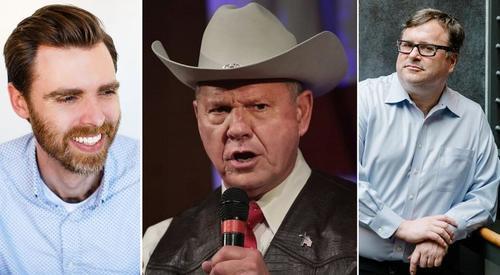
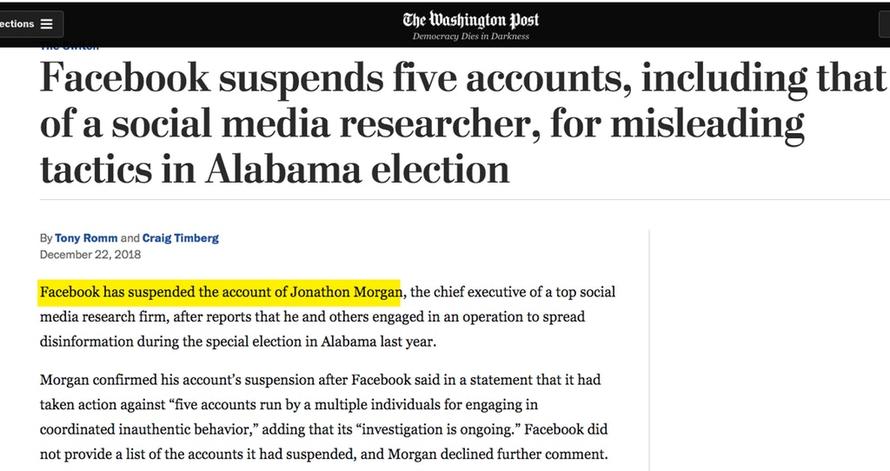
In December, a Democratic operative who hatched a Russian "false flag" scheme against Republican Roy Moore in last year's Alabama special election promoted his own propaganda on the dubious "Hamilton 68" website - which purports to track Russian "bot" activity, yet refuses to disclose how they do it. 

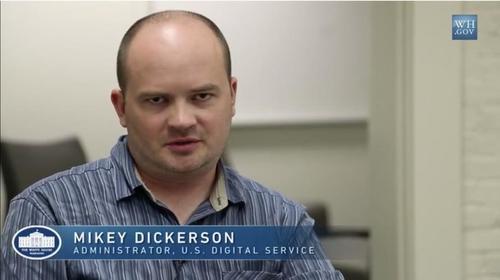
In January, an online disinformation campaign conducted by a former Obama administration official leading up to the 2018 midterm elections was bankrolled by left-wing tech billionaire Reid Hoffman, according to the Daily Caller's Peter Hasson. Hoffman, who co-founded LinkedIn, admitted in December to funding American Engagement Technologies (AET) - which is currently embroiled in a "false flag" scandal stemming from the 2017 Alabama special election. Now, AET and its founder Mickey Dickerson have come under fire for meddling in the 2018 midterm elections. 

And now, as the Democratic establishment faces an onslaught of potential presidential candidates that are not toeing-the-line of radicalism, The Intercept's Glenn Greenwald exposes  the pure propaganda that the liberal media will resort to, in order to please their Democratic, deep state overlords and keep to "The Plan."

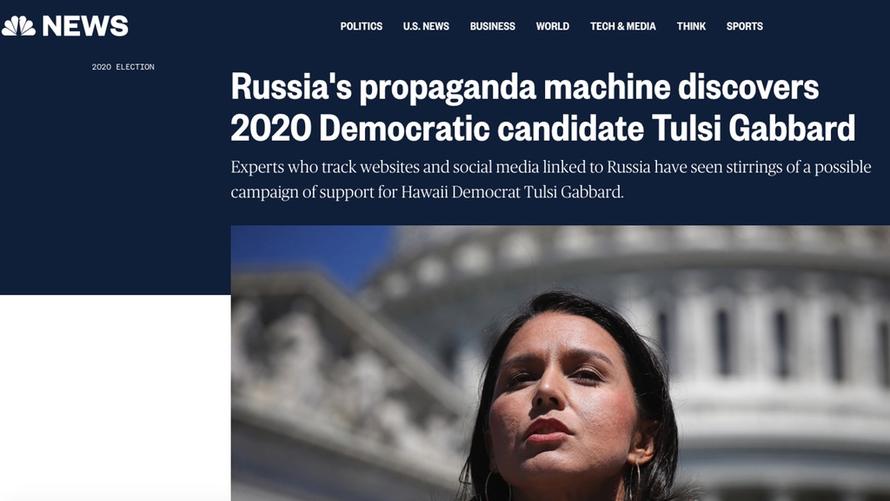
NBC News published a predictably viral story Friday, claiming that “experts who track websites and social media linked to Russia have seen stirrings of a possible campaign of support for Hawaii Democrat Tulsi Gabbard.”

But the whole story was a sham: the only “experts” cited by NBC in support of its key claim was the firm, New Knowledge, that just got caught by the New York Times fabricating Russian troll accounts on behalf of the Democratic Party in the Alabama Senate race to manufacture false accusations that the Kremlin was interfering in that election.

To justify its claim that Tulsi Gabbard is the Kremlin’s candidate, NBC stated:

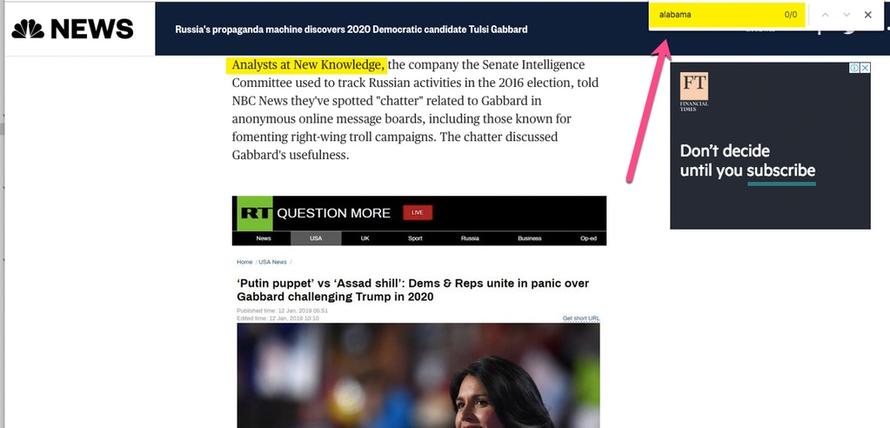
“analysts at New Knowledge, the company the Senate Intelligence Committee used to track Russian activities in the 2016 election, told NBC News they’ve spotted ‘chatter’ related to Gabbard in anonymous online message boards, including those known for fomenting right-wing troll campaigns.”

What NBC – amazingly – concealed is a fact that reveals its article to be a journalistic fraud: that same firm, New Knowledge, was caught just six weeks ago engaging in a massive scam to create fictitious Russian troll accounts on Facebook and Twitter in order to claim that the Kremlin was working to defeat Democratic Senate nominee Doug Jones in Alabama. The New York Times, when exposing the scam, quoted a New Knowledge report that boasted of its fabrications: “We orchestrated an elaborate ‘false flag’ operation that planted the idea that the [Roy] Moore campaign was amplified on social media by a Russian botnet.'”

At the same time that New Research’s CEO, Jonathan Morgan, was fabricating Russian troll accounts and using them to create a fraudulent appearance that Putin was trying to defeat the Democratic Senate candidate, he was exploiting his social media “expertise” to claim that Russians were interfering in the Alabama Senate election. In other words, Morgan used his own fake Russian accounts to lie to the public and deceive the national media into believing that Kremlin-linked accounts were trying to defeat the Democratic Senate candidate when, in fact, the accounts he was citing were ones he himself had fabricated and controlled.

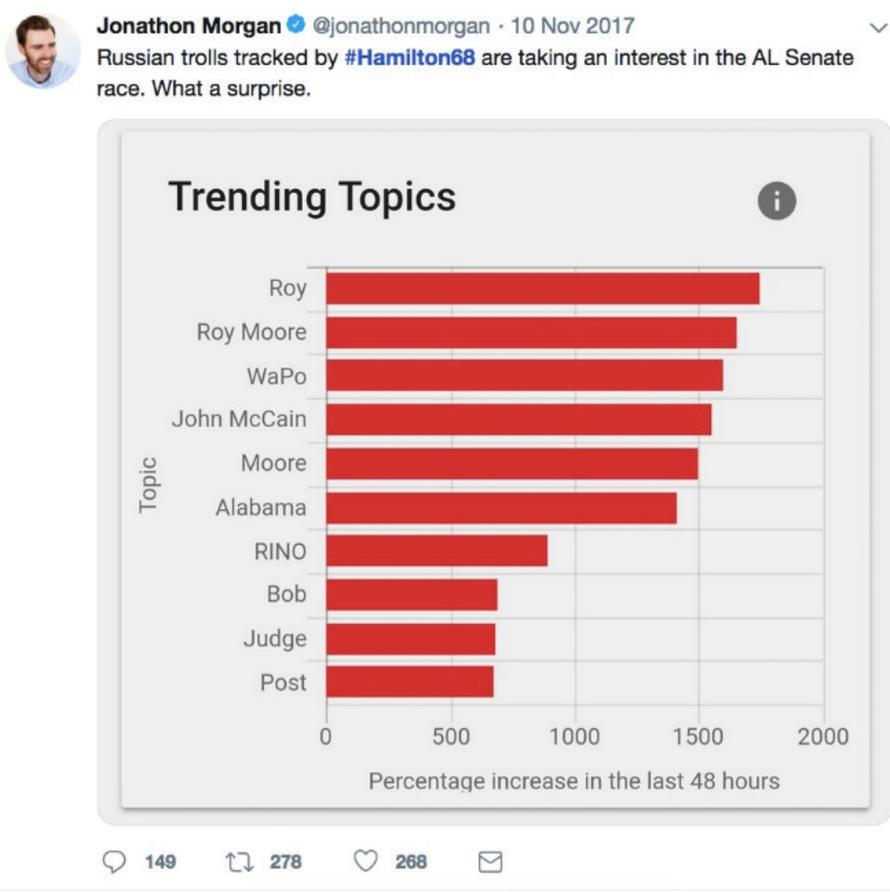
Even worse, Morgan’s firm is behind one of the recent Senate reports on Russian social media election interference as well as the creation of “Hamilton 68,” the pseudo-data-driven dashboard constantly used by U.S. media outlets to claim that its enemies are supported by the Kremlin (that tool has so been abused that even some of its designers urged the media to stop exaggerating its meaning). During the Alabama race, Morgan – in a tweet he deleted once his fraud was exposed – cited the #Hamilton68 data that he himself manipulated with his fake Russian accounts to claim that Russia was interfering in the Alabama Senate race:

In response to this scam being revealed, Facebook closed the accounts of five Americans who were responsible for this fraud, including Morgan himself, the “prominent social media researcher” who is the CEO of New Knowledge. He also touts himself as a “State Dept. advisor, computational propaganda researcher for DARPA, Brookings Institution.”

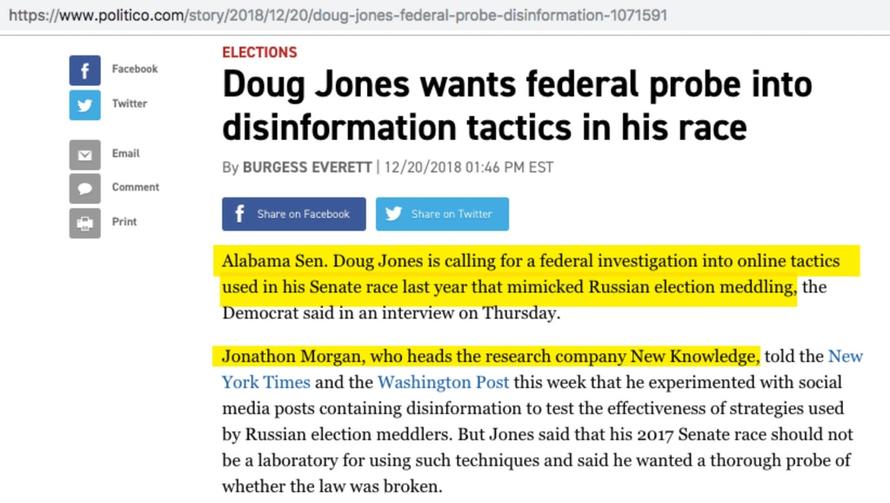
Beyond Morgan’s Facebook suspension, the billionaire funder and LinkedIn founder who provided the money for the New Knowledge project, Reid Hoffman, apologized and claimed he had no knowledge of the fraud. The victorious Democratic Senate candidate who won the Alabama Senate race and who repeatedly cited New Knowledge’s fake Russian accounts during the election to claim he was being attacked by Russian bots, Doug Jones, insisted he had no knowledge of the scheme and has now called for a federal investigation into New Knowledge.

This is the group of “experts” on which NBC News principally relied to spread its inflammatory, sensationalistic, McCarthyite storyline that Gabbard’s candidacy is supported by the Kremlin.

While NBC cited a slew of former FBI and other security state agents to speculate about why the Kremlin would like Gabbard, its claim that “experts” have detected the “stirrings” of such support came from this discredited, disgraced firm, one that just proved it specializes in issuing fictitious accusations against enemies of the Democratic Party that they are linked to Russia. Just marvel at how heavily NBC News relies on the disgraced New Knowledge to smear Gabbard as a favorite of Moscow:

Experts who track inauthentic social media accounts, however, have already found some extolling Gabbard’s positions since she declared.

Within a few days of Gabbard announcing her presidential bid, DisInfo 2018, part of the cybersecurity firm New Knowledge, found that three of the top 15 URLs shared by the 800 social media accounts affiliated with known and suspected Russian propaganda operations directed at U.S. citizens were about Gabbard.

Analysts at New Knowledge, the company the Senate Intelligence Committee used to track Russian activities in the 2016 election, told NBC News they’ve spotted “chatter” related to Gabbard in anonymous online message boards, including those known for fomenting right-wing troll campaigns. The chatter discussed Gabbard’s usefulness.

“A few of our analysts saw some chatter on 8chan saying she was a good ‘divider’ candidate to amplify,” said New Knowledge’s director of research Renee DiResta, director of research at New Knowledge.

What’s particularly unethical about the NBC report is that it tries to bolster the credentials of this group by touting it as “the company the Senate Intelligence Committee used to track Russian activities in the 2016 election,” while concealing from its audience the fraud that this firm’s CEO just got caught perpetrating on the public on behalf of the Democratic Party.

The only other so-called “expert” cited by NBC in support of its claim that Russian accounts are supporting Gabbard is someone named “Josh Russell,” who NBC identified as “Josh Russel.” Russell, or Russel, is touted by NBC as “a researcher and ‘troll hunter’ known for identifying fake accounts.” In reality, “Russel” is someone CNN last year touted as an “Indiana dad” and “amateur troll hunter” with a full-time job unrelated to Russia (he works as programmer at a college) and whose “hobby” is tracing online Russian accounts.

So beyond the firm that just got caught in a major fraudulent scam fabricating Russian support to help the Democratic Party, that’s NBC’s only other vaunted expert for its claim that the Kremlin is promoting Gabbard: someone CNN just last year called an “amateur” who traces Russian accounts as a “hobby.” And even there, NBC could only cite Russel (sic) as saying that “he recently spotted a few clusters of suspicious accounts that retweeted the same exact text about Gabbard, mostly neutral or slightly positive headlines.”

NBC also purported to rely on its own highly sophisticated analysis by counting the number of times Gabbard was mentioned by RT, Sputnik and Russia Insider, and then noting what it seems to regard as the highly incriminating fact that “Gabbard was mentioned on the three sites about twice as often as two of the best known Democratic possibilities for 2020, Joe Biden and Bernie Sanders, each with 10 stories.”

But in contrast to Gabbard, who announced her intent to run for President almost a month ago, neither Biden nor Sanders has done so. Perhaps that fact, rather than – as one of the NBC reporters adolescently gushed: “The Kremlin already has a crush on Tulsi Gabbard” – is what explains the greater amount of coverage?

The Kremlin already has a crush on Tulsi Gabbard https://t.co/bCpTdWG0Bo

— Ben Popken (@bpopken) February 2, 2019

In any event, NBC News, to smear Gabbard as a Kremlin favorite, relied on a group that it heralded as “experts” without telling its audience about the major fraud which this firm just got caught perpetrating in order – on behalf of the Democratic Party – to fabricate claims of Kremlin interference in the Alabama Senate race.

That’s because the playbook used by the axis of the Democratic Party, NBC/MSNBC, neocons and the intelligence community has been, is and will continue to be a very simple one: to smear any adversary of the establishment wing of the Democratic Party – whether on the left or the right – as a stooge or asset of the Kremlin (a key target will undoubtedly be, indeed already is, Bernie Sanders).

To accomplish this McCarthyite goal, this Democratic Party coalition of neocons, intelligence operatives and NBC stars will deceive, smear and even engage in outright journalistic deception, as NBC (once again) just proved with this report.

*  *  *
So which is it Democrats? Saul Alinsky or Cloward-Piven?


via IFTTT

Saturday, February 2, 2019

The Science Of Mind Control

https://www.sagaciousnewsnetwork.com/the-science-of-mind-control-and-how-we-learn-to-love-our-own-slavery/

Snopes & AP Suddenly Quit As Facebook Fact-Checkers

ORIGINAL LINK

Two of Facebook's four fact checkers, Snopes and the Associated Press, have abruptly ended their fact-checking relationship with the social media giant. In a Friday press release, Snopes said that it had "elected not to renew our partnership with Facebook," and while declining to reveal specifics, added that "Forgoing an economic opportunity is not a decision that we or any other journalistic enterprise can take lightly." 

Snopes co-founders David and Barbara Mikkelson. Barbara is no longer involved in the company following David's infidelity with prostitutes and alleged embezzlement.

While Snopes initially agreed to fact check for free, they eventually accepted $100,000 for its fact-checking services last year. 

The announcement comes on the heels of a December report that the two-year relationship between Facebook and its fact checkers was in disarray. 

Current and former Facebook factcheckers told the Guardian that the tech platform’s collaboration with outside reporters has produced minimal results and that they’ve lost trust in Facebook, which has repeatedly refused to release meaningful data about the impacts of their work. Some said Facebook’s hiring of a PR firm that used an antisemitic narrative to discredit critics – fueling the same kind of propaganda factcheckers regularly debunk – should be a deal-breaker. -The Guardian

"They've essentially used us for crisis PR, said former Snopes managing editor Brooke Binkowski. "They’re not taking anything seriously. They are more interested in making themselves look good and passing the buck … They clearly don’t care."

Brooke Binkowski, former managing editor of Snopes

Binkowski left Snopes last year and started her own factchecking site, truthorfiction.comShe told The Guardian last year that Facebook ignored her concerns about the spread of misinformation in Myanmar during the anti-Muslim Rohingya crisis when over 500,000 refugees fled Bangladesh amid persecution. 

"I was bringing up Myanmar over and over and over," said Binkowski. "They were absolutely resistant."

Facebook also pushed its fact checkers to prioritize debunking misinformation that affected its advertisers, according to Binkowski, something she said crossed a line. "You’re not doing journalism any more. You’re doing propaganda," she said - a charge Facebook denied in a blogpost

While Snopes and it's factcheckers grievances are well known, AP gave no explanation for their decision, though they noted in a statement to TechCrunch that while it was "no longer doing fact checking work for the program, it is not leaving it altogether."

One current Facebook factchecker not authorized to speak publicly questioned why they're working for the same company that paid a PR firm to promote anti-Semitic fake news about billionaire George Soros

"Why should we trust Facebook when it’s pushing the same rumors that its own factcheckers are calling fake news?" said the factchecker. "It’s worth asking how do they treat stories about George Soros on the platform knowing they specifically pay people to try to link political enemies to him?"

"Working with Facebook makes us look bad," added the journalist. 

Another factchecker told The Guardian in December that they were demoralized. "They are a terrible company and, on a personal level, I don’t want to have anything to do with them."


via IFTTT