ORIGINAL LINK
Last week we reviewed the US industrial production (IP) and saw that it contracting for more than a year. The IP indexes represent the production of factories, mines, and utilities in unit volume, not dollar sales, both by total output and output by industry. While these indexes do not represent service industries directly, they do indirectly because electric power production and distribution feeds service business.
via IFTTT

Seeking Truth in a World of Propaganda. Links do not necessarily indicate agreement with stories or perspectives.
“Those who are able to see beyond the shadows and lies of their culture will never be understood, let alone believed, by the masses.” - Plato
Wednesday, October 26, 2016
Tuesday, October 25, 2016
Horrible PSA: It’s Okay to Bully Kids If Their Parents Didn’t Vote?
ORIGINAL LINK
via IFTTT
 Schoolyard bullying: it's never okay. Unless, of course, the victim is the offspring of a non-voter. Then the kid probably deserves it—or should at least blame his dad for not caring enough about politics.
That's the confusing message behind a new get-out-the-vote video produced by Civic Innovation Works, a mysterious organization without much of an online presence. The video recently appeared on my News Feed: here it is.
The best part is the bully shouting, "your dad sounds like a total nihilist," as if that's some kind of put down. In reality, any politically-informed human being who isn't flirting with nihilism as a result of the 2016 campaign should have his head checked.
Of course, not voting is a perfectly responsible thing to do, for reasons outlined by Reason Editor in Chief Katherine Mangu-Ward: your vote has virtually no chance of influencing the outcome of a presidential election (even if you live in Florida and are using a time machine to travel back to the year 2000), the time it takes to vote is almost always better spent doing something else (if you value doing something else more than voting), and casting an ill-informed vote is almost certainly worse than not voting at all.
What makes this video so disturbing—and funny, if we're being honest—is all the other PSAs about how terrible bullying is for kids. There's something so self-righteous about the act of voting that it causes people to take leave of their senses.
Related: Who Will Get Our Votes? Reason's 2016 Presidential Poll
via IFTTT
Open Data Projects Are Fueling the Fight Against Police Misconduct
ORIGINAL LINK
“What the Legal Aid Society is doing will not replace legislative reform, no matter how large its database grows,” Conti-Cook wrote. “Defender-driven data, while filling a gap in access to records, is not the ultimate solution.”
As with Chicago and New York, the data has also been used in court. “We’ve had cases where there were terrible claims of racial profiling and officers weren’t able to offer a coherent explanation of why a certain person came to their attention and why they stopped them,” Mance said. “Their career enforcement data became immediately relevant to answering questions of whether they targeted this person for illegal, race-based reasons.”
via IFTTT
Samantha Seda’s client, a 16-year-old foster child from Far Rockaway, New York, had no criminal history when he was arrested in September, accused of having pulled out a gun and fired one shot in the air. Even though he had no priors and no relatives who could post bail, a judge set the amount at $100,000, and as he sat in jail for over a month, the boy lost his spot at the foster home where he had been living.
Seda, a Legal Aid attorney representing adolescents charged as adults in Queens, thought the allegations against her client were dubious and was looking for a way to get him out on bail. That’s when she decided to look into the officers named in the complaint against him. What she discovered stunned her.
The arresting officer, she learned, had been sued several times, and in the 1990s, he had been part of a group of officers working a narcotics operation that was accused of planting drugs on people and stealing drugs from suspects. Some of the officers went to trial and were convicted on felony charges, but most settled, costing the city some $1.2 million in damages to their victims. The officer she was researching was acquitted in court, but he had been named in connection with at least nine separate misconduct cases and had settled at least two, she told The Intercept.
Intrigued, Seda looked into the second officer, a sergeant who claimed he had watched her client pull out a gun and shoot it. He was also named in a pending lawsuit, in which a driver alleged the officer had stopped him, assaulted him, and arrested him with no legal justification.
“I thought, wow, that’s outrageous. Two cops in one case that are dirty,” Seda said. When she looked into the third officer, another sergeant who said he had found a gun on the street after her client ran, she was almost expecting to find something.
And in fact, that officer had also been sued, for assaulting a young black man moments after he walked out of his sister’s house. That lawsuit alleged the officer had thrown the boy to the ground and “roughed him up” before arresting him and taking him to the police precinct, also without legal justification. The boy was never charged with anything — but his family sued the city, demanding $100,000 in damages.
The accusations against the officers didn’t automatically imply their guilt in those cases, Seda said, but they certainly raised red flags.
Seda took her findings to a judge and argued that they undermined the credibility of the officers in question — and he promptly dropped her client’s bail and released him until trial. But only months earlier, the case might have played out quite differently.

A map produced from Legal Aid Society data shows the incidence of lawsuits against the NYPD between June 2015 and May 2016, broken down by demographics.
Graphic: The Legal Aid Society
Tracking Police Misconduct
In the past, when Seda wanted to learn more about an officer connected to one of her cases, she would scour legal databases and news archives in search of any relevant information. If she somehow knew an officer’s history would matter to the case, she might file a public records request for complaints filed against him or try to subpoena public agencies for that information — a cumbersome process for a public defender handling dozens of cases, and one with no guarantee of success. “It would have been very hard and it would have taken months,” she said. “It may have never happened.”
Most police misconduct goes unreported, particularly in less extreme cases and in more disenfranchised communities, but complaints filed with police departments and civilian review boards, as well as lawsuits, can point to significant histories of abuse tied to specific officers and precincts. In most cases, however, a citizen who becomes the victim of police abuse has next to no way of knowing if that officer is a repeat offender or has a history of targeting certain people, say, or sexual harassment.
As is the case with most police departments across the country, the NYPD does not disclose internal disciplinary records to the public. Even though cities spend millions in public funds to settle lawsuits filed against officers, the public has little access to what the settlements reveal about problematic officers and precincts. Meanwhile, the officers themselves rarely face consequences and often return to the streets quickly, their histories shielded in anonymity.
But that situation is beginning to change — as a growing number of police accountability groups are starting to bypass the departments by aggregating and distributing misconduct history databases on their own.
Earlier this year, Seda was trained in using the Cop Accountability Project, a database created by New York’s Legal Aid Society that pools civil rights lawsuits, criminal court decisions, and a variety of other public and private sources like attorney notes and social media content to compile misconduct profiles on nearly 9,000 New York City officers. The database assembles a wealth of information that could otherwise take months to gather, as well as some that wouldn’t be available anywhere else, and it has proved to be a game-changer for the attorneys using it.
In the past, individuals could file public records requests with the Civilian Complaint Review Board, which is normally the first recipient of citizen complaints regarding police use of force, abuse of authority, and other misconduct. But since October 2014, when the New York board’s executive director was fired and accused of releasing records protected by law, the CCRB has denied all public records requests on the grounds that they violate New York’s strict privacy protections for law enforcement officers. A spokesperson for the board declined to comment on the change in policy or the former chief’s departure but wrote in an email to The Intercept that the CCRB “believes that transparency and accountability builds trust between police and the community it serves.”
The CCRB also recently launched its own Data Transparency Initiative, an interactive online data tool that includes information on more than 190,000 allegations of police misconduct, involving more than 63,000 victims and some 36,000 NYPD officers. But unlike the Legal Aid database, that data paints only a macro picture of the issue and cannot be connected to individual officers or incidents. Legal Aid’s Cop Accountability Project began as an informal, handwritten list of officers Legal Aid lawyers knew had a history of misconduct. Over the years, as lawyers amassed information to help build stronger cases for their clients, the list grew into a spreadsheet, then eventually into a cloud-based relational database that recently became available to Legal Aid attorneys through a mobile app.
“We are essentially trying to find a way to collect data to document events that government doesn’t want documented in a public way,” Cynthia Conti-Cook, one of the curators of the database, told The Intercept.
Although it keeps growing every day, the database is by nature incomplete, Conti-Cook notes, and lacks access to any internal documentation the NYPD may have on its officers. In fact, Legal Aid is currently fighting the city in court to open up officer misconduct files to public records requests. The group has also been fighting a New York law known as “50-a,” which protects officers from exactly the kind of scrutiny and accountability the public is demanding by guaranteeing the confidentiality of all law enforcement personnel records, essentially blocking any judicial review of officers’ histories and possible patterns of misconduct.
In a statement released last week, Mayor Bill de Blasio outlined some proposed amendments to 50-a. The NYPD did not respond to a list of questions from The Intercept but referred us instead to a recent official statement by Commissioner James O’Neill expressing support for de Blasio’s proposed reforms. “I believe in transparency. I also believe that making information about disciplinary proceedings public will help us build trust with the community,” O’Neill said.
But police accountability advocates were quick to point out that the proposed changes were just a way to kick the can down the road; they were “not substantive” and fell short of a “genuine commitment to full transparency.” “If the administration is serious about police accountability,” the New York Civil Liberties Union wrote in response to the mayor’s statement, it will “just start releasing records.”
Until that happens, the Legal Aid database remains the most comprehensive accountability tool available to lawyers.

A map produced from Legal Aid Society data shows the incidence of lawsuits across the city’s boroughs between June 2015 and May 2016.
Graphic: The Legal Aid Society
“What the Legal Aid Society is doing will not replace legislative reform, no matter how large its database grows,” Conti-Cook wrote. “Defender-driven data, while filling a gap in access to records, is not the ultimate solution.”
Yet for all its limitations, the database has already achieved a lot. Lawyers in Legal Aid’s network have successfully used it to “change the narrative in the courtroom about what happened during a specific encounter between a client and an officer,” Conti-Cook explained in an academic paper presenting the project. “Expanding the definition of police accountability data from official disciplinary complaints to other sources that similarly document misconduct events has changed who controls the definition of misconduct, and therefore who controls the narrative of what is happening between police and the communities they serve.”
And those victories haven’t stopped in the courtroom. In response to the Legal Aid database, the NYPD itself has expanded the definition of misconduct it uses to manage risk internally to include allegations raised in lawsuits in addition to the department’s internal affairs bureau and the city’s civilian review board. These investigations remain inaccessible to the public, but they are now informed by a broader set of sources.
Perhaps most importantly, beyond tracing individual officers’ histories of misconduct and singling out the so-called bad apples, the Cop Accountability Project has also highlighted broader trends in New York’s police-community relations.
The database revealed, for example, that between June 2015 and May 2016, a single Brooklyn precinct — the 75th Precinct in East New York — was sued in federal court at least 47 times, more than double the amount of any other precinct. The second most sued precinct was the 73rd, in Brownsville, Brooklyn. In total, over that time frame, NYPD officers were sued in federal court 966 times. The NYPD is sued about 4,000 times a year, mostly in state courts — a dramatic increase in litigation that in 2014 alone cost the city $216 million in settlements. The increase in lawsuits marks an opposite trend from that noted by New York’s Civilian Complaint Review Board, which reported that from 2006 to 2015, the number of complaints steadily declined, from 7,663 in 2006 to 4,461 in 2015 — possibly suggesting that a growing number of citizens, frustrated with the redress process available to them, might be resorting to suing the police.
The Legal Aid database also showed that the 10 precincts with the highest numbers of lawsuits were concentrated in Brooklyn. Citywide, 82 percent of plaintiffs filing lawsuits were black, while only 2 percent were white. Thirty-three percent of the lawsuits were filed over encounters that took place on the street, and 47 percent alleged excessive use of force, with 64 percent of those cases requiring hospitalization.
The analysis also gave a breakdown of the charges officers made against the plaintiffs, which were overwhelmingly for “resisting arrest” and “disorderly conduct,” two of the vague charges regularly used in questionable police stops.
Legal Aid made those findings public as part of a push for greater police transparency, but the bulk of the database is currently available only to lawyers within the group’s network. As word of the database’s existence spread, other attorneys began reaching out to Legal Aid for access to its data, sometimes contributing more information from their own records. In one case, a judge even suggested that an attorney seek access to the database, prompting the officer’s attorney to also demand to see the file Legal Aid had on him.
Conti-Cook said the entire database has not been made public because it is built, in part, on confidential sources and information that’s protected by attorney-client privileges. But the goal, ultimately, is to distill the majority of the data that is in the public record and open up access to all New Yorkers.
“We’re dreaming of a website,” she told The Intercept.

Thousands take part in the “Justice for All” march on Pennsylvania Avenue in Washington, D.C., on Dec. 13, 2014, to protest the killings of unarmed African-Americans by police officers and the decisions by grand juries not to indict them.
Photo: Saul Loeb/AFP/Getty Images
A Killer Cop With a Past
On October 20, 2014, a group of Chicago police officers shot and killed a black teenager named Laquan McDonald. Police said that the officers fired in self-defense, the boy had a knife, and he was killed by a single shot to the chest. For over a month, the official narrative was the only narrative.
It was not until a whistleblower tipped off journalist Jamie Kalven that the story was false and there was “horrific” video to prove it that the real narrative began to emerge. Kalven obtained a copy of the autopsy report, which showed that McDonald had been shot 16 times, including several times in the back, and that police officer Jason Van Dyke had unloaded his weapon “execution style” while McDonald lay on the ground. A month later, the city settled with McDonald’s family for $5 million before they even moved to sue.
It took several more months of protest and public pressure before details of the official cover-up were revealed, and more than a year for the city to release dashcam video of the shooting. Finally, Van Dyke was charged with first-degree murder. Officials then sought to paint him as a lone “bad officer” whose actions shouldn’t reflect on the department.
Eventually, it emerged that Van Dyke had been accused of misconduct at least 17 times before he killed McDonald, including several allegations of brutality. Yet none of those complaints — one of which cost the city a $500,000 civil settlement — had resulted in any disciplinary action. Between 2012 and 2015, the city of Chicago paid $210 million in police misconduct settlements — with just 124 of the city’s roughly 12,000 police officers accounting for $34 million in payouts. The Chicago Police Department did not respond to a request for comment.
Public disclosure of Van Dyke’s long complaint history was made possible by litigation brought by Kalven against the city of Chicago back in 2007. It took seven years of litigation for an Illinois Supreme Court judge to rule that documents bearing on allegations of police abuse, including citizen complaints, were public information and therefore subject to public records requests. Kalven’s group, the Invisible Institute, whose mission is to hold public institutions accountable, quickly moved to obtain records from Chicago’s Independent Police Review Authority as well as the department’s internal affairs division — which came to some 56,000 misconduct complaints against 8,500 police officers since 2011.
But the Invisible Institute didn’t stop there. Driven by a commitment to the notion that information about public institutions should be open, free, and accessible to all, the group processed all the complaints and then published them on a user-friendly, interactive website.
“We positioned ourselves as advocates for data, transparency, and accountability,” Rajiv Sinclair, who works on the database, told The Intercept. “We share all the data with everyone.”

Charts and map visualizations generated from police data obtained by the Invisible Institute.
Image: Citizens Police Data Project
As is the case with New York’s Legal Aid database, the Invisible Institute’s Citizens Police Data Project allows people to search for the complaint records of individual officers, but it also tells broader stories about police trends in the city. For instance, the data shows that young black men on the South and West sides of Chicago consistently file more complaints than any other group in the city — but it also shows that their complaints have a much lower “sustain rate,” Sinclair said, meaning they are much less likely to be investigated and followed up on.
That’s partly because Chicago police will not investigate a complaint until the citizen filing it signs a sworn legal affidavit — a stressful prospect for many whose interactions with law enforcement are defined by mistrust. As a result, nearly 60 percent of complaints are thrown out. A quarter of complaints were dropped because citizens filing them couldn’t identify the officers. A new data initiative launched last week, OpenOversight, is hoping to fill that gap by providing a database of officers’ photos and badge numbers.
“There’s a lot of intimidation in that process,” Sinclair noted, referring to the affidavit requirement. “Many of those cases are going to be an officer’s word versus a citizen’s word. And if you’re a black teenager, you know how undervalued your word is, you know that if you say one thing and the officer says another thing, they’re just going to say that you’re lying.”
Whose Data Is Public Data?
The Invisible Institute plans to expand the scope of its project to add new data sources like use of force records, tactical response reports, and a wider set of misconduct complaints, but it also hopes to combine those with more contextual data around individual officers. The ambition is to be able to follow problem officers through their careers, to see how patterns change as they move between units and commanders, and to explore the intricate networks of relationships that model the Chicago Police Department’s behavior.
But the primary goal remains easily accessible accountability. The group recently developed a Twitter bot that extracts officers’ names from news stories posted on Twitter and automatically responds to followers with those officers’ profiles and complaint histories. They also run workshops based on the database with high school students in the city’s most heavily policed neighborhoods — the same kids “who gets stopped by police every day,” Sinclair said.
“Those users are the most important to us, and they have been underserved by the predominant trends in civic data transparency and police data transparency,” he added.
In fact, as open data initiatives have multiplied in recent years, some government agencies have gestured toward transparency by releasing data sets for scholars and analysts to report on broad social trends. But most of that data, like the data released by New York’s Civilian Complaint Review Board, is “de-identified,” meaning it can’t be traced back to specific officers. And ultimately, for the people whose encounters with police build up those data sets, the big picture matters less than the name and history of the officer who abused them.
“A lot of data is very disconnected from the people who we think are the most important users, and those are citizens who have had encounters with police and their lawyers,” Sinclair said. “One of the most important uses for our data set is for lawyers and citizens to be able to look up an officer. … Data can support your case, make it more clear that what happened to you is true.”
A similar initiative, which focuses on officers’ patterns of traffic stops rather than complaint histories, is North Carolina’s Open Data Policing NC. The project is made possible by North Carolina’s uniquely detailed reporting requirements for traffic stops, which require officers to file detailed reports on all stops, including reasons for the stop, details on whether a search was conducted, as well as the race, age, and gender of the driver.
That data was always public, but like much public information, it was not readily accessible, essentially voiding its public utility.
“There’s nothing that I’m publishing that you couldn’t have always gotten,” Ian Mance, an attorney with the Southern Coalition for Social Justice and curator of the database, told The Intercept. “But if you requested the database from the state, it would be such a large file it would literally melt down your laptop if you tried to open it.”
Until the website launched — covering 25 million traffic stops made since 2002 by the state’s 300 largest enforcement agencies — police were required to compile the data, but then “it kind of just disappeared,” Mance said. Departments never looked at it and didn’t have systems set up to analyze the data from officers’ stop patterns, he said, adding that he’s been trying, with some success, to convince police departments of the site’s benefits, pitching it as an “auditing tool” they can use for internal reviews.
While the database doesn’t publish individual officers’ names, it lists their ID numbers — making it possible for a citizen who was pulled over to identify his stop by department, date, or other circumstantial data, and then, through a hyperlink on the officer’s ID, to populate a page with his “career enforcement data,” including any patterns suggesting bias.
“So if you are a driver who suspects you’re being stopped for an illegal, race-based reason, you can test your hypothesis by going on the site,” Mance explained.
Like the Chicago and New York initiatives, the North Carolina project quickly revealed broader patterns of enforcement, including racial disparities in traffic stops. And the data has already informed some policy changes. In Greensboro, for instance, city officials changed their protocols to end stops for low-level traffic violations, and in Durham, the city council passed a policy mandating that officers get written consent for searches not justified by probable cause.

Protesters march in Charlotte, North Carolina, on Sept. 23, 2016, following the shooting of Keith Lamont Scott by police three days earlier.
Photo: Nicholas Kamm/AFP/Getty Images
As with Chicago and New York, the data has also been used in court. “We’ve had cases where there were terrible claims of racial profiling and officers weren’t able to offer a coherent explanation of why a certain person came to their attention and why they stopped them,” Mance said. “Their career enforcement data became immediately relevant to answering questions of whether they targeted this person for illegal, race-based reasons.”
“Open data is the future, there’s no putting the cat back in the bag,” he added. “This is something police departments, whether they like it or not, are going to have to contend with, because we’re reaching a point where the public expects to have access to this kind of information.”
Yet many data projects are ultimately contingent on agencies’ cooperation — either willingly and because local legislation declares the data a public record, or after long-fought legal battles like Kalven’s.
As demands for accountability increase, so does pushback. As police departments across the country started to enroll in body camera programs, local legislatures also began to discuss bills to keep that footage secret. In Georgia, legislators moved to shield bodycam footage from public records requests and extended the restriction to officers’ misconduct records that were previously available. In New York, the Civilian Complaint Review Board’s reversal of its policy of disclosing records upon request came just months after the killing of Eric Garner sparked widespread protests in the city and demands for more accountability.
North Carolina, despite having one of the most transparent traffic stop reporting requirements in the country, is no exception. Last month, for instance, the Charlotte-Mecklenburg Police Department faced an onslaught of criticism for its refusal to release video of the police killing of Keith Lamont Scott. Scott’s killing came just days before a revision to North Carolina’s public records law — allowing police to withhold video like that of Scott’s killing from the public — was set to kick in.
“I think these efforts are very shortsighted and people see them for what they are,” Mance said, “which is an attempt by people in power to keep the public from having a better understanding about the way that they are being policed.”
A National Clearinghouse for Police Complaints
So far, efforts to use open data to track officer misconduct and hold police departments accountable are few and limited. But with 18,000 law enforcement agencies across the country, each ruled by different sets of local regulations, there is no uniformity in how police misconduct is tracked, if at all, and in a majority of places, the public has no access to records of complaints filed against police.
That might be about to change, as a civil rights group is preparing to launch a nationwide website that will allow users to file official reports of officer misconduct and abuse, while also making those reports immediately public. For years, Flex Your Rights, the group behind the Open Police Complaints initiative, ran “constitutional literacy” workshops, educating the public on their rights during police encounters. But they soon realized that wasn’t enough.
“The events of the last few years have shined an important light on the fact that people are going to have bad police encounters regardless of whether they ‘flex’ their rights perfectly or not,” Steve Silverman, the group’s founder and director, told The Intercept.
Instead, the new website, which is set to go live early next year, will aim to bring some uniformity and accountability to the police complaint process, by compiling research on different departments’ requirements and allowing users to either file complaints directly online — for those departments that choose to participate in the initiative — or upload the complaints they file on their own and share those reports publicly.
The idea is to simplify the complaint process for citizens and minimize the need for people to file grievances in person at a police station, “where they’re bound to have another bad encounter,” Silverman said. The site will populate a report by asking users dozens of questions and will offer varying degrees of transparency, allowing users to publicly disclose anything from bare, anonymous details of the incident to full narrative accounts including names of officers and victims. It will also give police departments an opportunity to respond and update each report with the findings of their investigations.
“We’re trying to use open data in order to encourage better responsiveness but also to track how well and how poorly departments are responding to complaints, as one of the big reasons why police complaints processes suck is because they’re very unresponsive,” Silverman said. “Of course there are going to be some police departments and individual officers who chafe at the idea that their name might be attached to a public complaint. But if that’s the case, they should go ahead and properly and swiftly investigate the complaint and they’ll have an opportunity to post their findings.”

The Open Police Complaints web app, scheduled for a 2017 release.
Image: Open Police Complaints
The group said it would protect the site from misuse and false reports — and potential libel suits — by requiring that all police complaints be officially filed before they can be shared publicly, and by flagging “frequent flier” users and filling the site with disclaimer notices reminding readers that the reports are allegations. It will also offer tools to connect citizens filing complaints with attorneys in their areas, as well as to other relevant resources.
“We hope that by providing this kind of information in a public way, we’ll urge departments to take action,” Silverman said.
But even if departments refuse to engage with the site — and Silverman and Morgan Lesko, the project’s main developer, expect it will take a few years to compile a significant volume of complaints and get departments to take notice — the reports will be accessible and easily searchable by anyone.
“In the worst case scenario — that we don’t get appropriate feedback from police departments — we still have these collected online,” said Lesko. “And it’s all published in one place; it’s not just lost on Facebook somewhere, scattered around in rant form. It’s a public record.”
The post Open Data Projects Are Fueling the Fight Against Police Misconduct appeared first on The Intercept.
via IFTTT
Monday, October 24, 2016
This Year’s Mammogram Month Launched With Devastating Report on Harms and Lack of Effectiveness
ORIGINAL LINK
Related Articles:
 More Younger Women Getting Breast Cancer
Vitamin D Might Be Able to Slash Your Breast Cancer Risk by 90 Percent
Dr. Christiane Northrup’s Top Tips for Women’s Breast Health
Comments (4)
via IFTTT
By Dr. Mercola
I've written many articles on the hazards and drawbacks of mammograms, which include:
• The risk of false positives. Besides leading to unnecessary mental anguish and medical treatment, a false cancer diagnosis may also interfere with your eligibility for medical insurance, which can have serious financial ramifications
• The risk of false negatives, which is of particular concern for dense-breasted women
• The fact that ionizing radiation actually causes cancer and may contribute to breast cancer when done over a lifetime.
Results published in the British Medical Journal (BMJ) show that women carrying the BRCA1/2 gene mutation are particularly vulnerable to radiation-induced cancer1
• The fact that studies repeatedly find that mammograms have no impact on mortality rates
As so expertly demonstrated in the video above, created by Dr. Andrew Lazris and environmental scientist, Erik Rifkin, Ph.D., it's easy to misunderstand the benefits of mammograms.
Mammograms are said to reduce your risk of dying from breast cancer by 20 percent, but unless you understand where this number comes from, you'll be vastly overestimating the potential benefit of regular mammogram screening.
Most doctors also fail to inform patients about the other side of the equation, which is that far more women are actually harmed by the procedure than benefit from it.1 in 1,000 Women Is Saved by Regular Mammogram Screening While 10 Undergo Cancer Treatment for No Reason
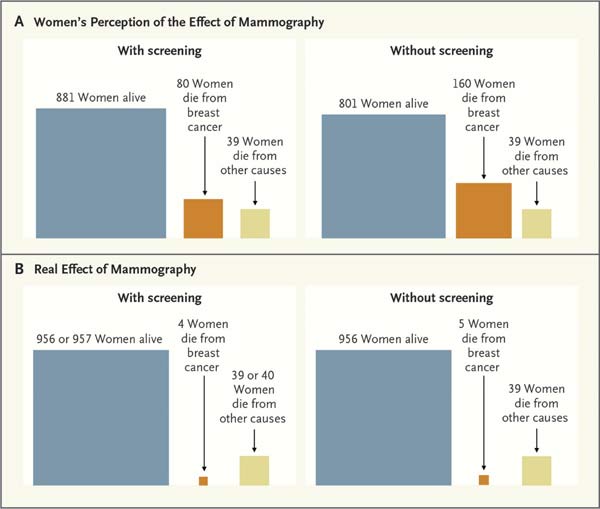
Incredible as it may sound, the 20 percent mortality risk reduction touted by conventional medicine actually amounts to just 1 woman per 1,000 who get regular mammograms. How can that be?
As explained in the video, for every 1,000 women who do not get mammograms, 5 of them will die of breast cancer. For every 1,000 women who do get mammograms, 4 will die anyway.
The difference between the two groups is 20 percent (the difference of that one person in the mammogram group whose life is saved). On the other side of the equation, out of every 1,000 women who get regular mammograms over a lifetime:
- HALF will receive a false positive. So while they do NOT have cancer, about 500 out of every 1,000 women getting mammograms will face the terror associated with a breast cancer diagnosis
- 64 will get biopsies, which can be painful and carry risks of adverse effects
- 10 will go on to receive cancer treatment for what is in actuality NOT cancer, including disfiguring surgery and toxic drugs or radiation. Surgery, chemo and radiation are all risky, and dying from the treatment for a cancer you do not have is doubly tragic
All things considered, the evidence seems quite clear; most women should probably avoid mammograms, as they cause far more harm than good.
Many studies have now come to that conclusion, and the most recent research,2 published just in time for Breast Cancer Awareness Month, again hammers home that point.
Harms of Mammography Eclipse Benefits
For this study, the researchers analyzed U.S. cancer statistics collected by the government in order to estimate the effectiveness of mammography.
By comparing records of breast cancers diagnosed in women over the age of 40 between 1975 and 1979 — a time before mammograms came into routine use — and between 2000 and 2002, three key findings emerged.3,4,5,6,7,8
- The incidence of large tumors (2 centimeters or larger) has declined, from 68 percent to 32 percent
- The number of women diagnosed with small tumors has increased, from 36 to 64 percent
- The incidence of metastatic cancer, which is the most lethal, has remained stable
This may initially sound like good news for mammograms, but in absolute numbers, the decrease in large tumors was actually rather small — a mere 30 tumors less per 100,000 women.
Meanwhile, the dramatic increase in small tumors was mostly attributed to overdiagnosis — an estimated 81 percent of these small tumors did not actually need treatment.
The fact that metastatic cancer rates remained even suggests we're not catching more of them, earlier. Instead, we're catching and treating mostly harmless tumors.
The researchers also found that two-thirds of the reduction in breast cancer mortality was attributable to improved treatment, such as the use of tamoxifen. Breast cancer screening only accounted for one-third of the reduction in mortality.
Lead researcher Dr. H.Gilbert Welch explains the findings of the study in the video above. As reported by WebMD:9
"The upshot, according to Welch, is that mammography is more likely to 'overdiagnose' breast cancer than to catch more-aggressive tumors early. What's more, the researchers said that while breast cancer deaths have fallen since the 1970s, that is mainly due to better treatment — not screening.
Welch noted the current study's findings have nothing to do with women who feel a lump in the breast. 'They need to get a mammogram,' he stressed. But, Welch suggested, when it comes to routine screening, women can decide based on their personal values."
Screening as Personal Choice
When speaking to NBC news, Welch went on to say that "screening is a choice. It's not a public health imperative."10 At present, most conventional cancer specialists do view mammograms as an imperative, although recommendations vary depending on who you listen to.
As of last year, the American Cancer Society (ACS) recommends women of average risk should have their first mammogram at age 45, followed by an annual mammogram up until age 55. Women 55 and older should have them every other year.11
Meanwhile, the U.S. Preventive Services Task Force (USPSTF) recommends waiting until the age of 50, and only getting a mammogram every other year thereafter.12 In response to heated debate over the varying guidelines, the U.S. Congress passed legislation requiring insurance companies to cover mammograms regardless of age.
Not surprisingly, the ACS has sharply criticized the latest study. In a statement, chief cancer control officer of ACS, Dr. Richard Wender, said: "These conclusions are bold, attention-grabbing and should be taken with a grain of salt — actually, an entire spoonful."
The problem with Wender's attitude is that this is by no means the first or only study suggesting that mammography has been vastly oversold. In fact, a number of studies have now refuted the validity of mammography as a primary tool against breast cancer.
The Evidence Overwhelmingly Refutes Routine Use of Mammography
Other studies that support the findings of the featured study include the following:
|
✓ Archives of Internal Medicine, 2007: A meta-analysis of 117 randomized, controlled mammogram trials. Among its findings: Rates of false-positive results are as high as 56 percent after 10 mammograms.13 |
|
✓ Cochrane Database Review, 2009: This review found that breast cancer screening led to a 30 percent rate of overdiagnosis and overtreatment, which actually INCREASED the absolute risk of developing cancer by 0.5 percent. The review concluded that for every 2,000 women invited for screening throughout a 10-year period, the life of just one woman was prolonged, while 10 healthy women were treated unnecessarily.14 |
|
✓ New England Journal of Medicine (NEJM), 2010: This study concluded that the reduction in mortality as a result of mammographic screening was so small as to be nonexistent — a mere 2.4 deaths per 100,000 person-years were spared as a result of the screening.15 |
|
✓ The Lancet Oncology, 2011: This study described the natural history of breast cancers detected in the Swedish mammography screening program between 1986 to 1990, involving 650,000 women. Since breast lesions and tumors are aggressively treated and/or removed before they can be determined with any certainty to be a clear and present threat to health, there has been little to no research on what happens when they are left alone. This study however, demonstrated for the first time that women who received the most breast screenings had a HIGHER cumulative incidence of invasive breast cancer over the following six years than the control group who received far less screenings.16 |
|
✓ The Lancet, 2012, showed that for every life saved by mammography screening, three women are overdiagnosed and treated with surgery, radiation or chemotherapy for a cancer that might never have given them trouble in their lifetimes.17 |
|
✓ Cochrane Database Review, 2013: A review of 10 trials involving more than 600,000 women found mammography screening had no effect on overall mortality.18 |
|
✓ NEJM, 2014: Drs. Nikola Biller-Andorno and Peter Jüni published a paper in which they describe the findings of an independent health technology assessment initiative to assess the effectiveness of mammography, of which they were a part:19
|
|
✓ British Medical Journal (BMJ), 2014: A Canadian study put the rate of overdiagnosis and overtreatment from mammography at nearly 22 percent.21 |
|
✓ JAMA Internal Medicine, July 2015: Here, researchers concluded mammography screenings lead to unnecessary treatments while having virtually no impact on the number of deaths from breast cancer. A positive correlation between breast cancer screening and breast cancer incidence was indeed found, but there was no positive correlation with mortality.22,23 |
|
✓ Journal of the Royal Society of Medicine, September 2015: The conclusion of this study is stated right in the title, which reads: "Mammography screening is harmful and should be abandoned."24,25 In short, the authors concluded that decades of routine breast cancer screening using mammograms has done nothing to decrease deaths from breast cancer, while causing more than half (52 percent) of all women undergoing the test to be overdiagnosed and overtreated. According to lead author Peter C. Gøtzsche, had mammograms been a drug, "it would have been withdrawn from the market long ago." |
It's Time to Revise the 'When in Doubt, Cut It Out' Mentality
Going back to where we started, even when using the cancer industry's own statistics mammography comes up short, provided you understand what the 20 percent actually means. To reiterate, the difference between getting routine mammograms and not getting them is that the life of 1 in 1,000 women is saved.
Four die even with mammograms, compared to five deaths among those who do not get screened. And again, 10 of those 1,000 screened women will be treated for cancer even though they do not actually have it. Clearly the choice is yours. If you find comfort in thinking you may be that one person who is saved, then by all means follow your heart or gut instinct.
Just be clear about the risks, because the chances are far greater you could be one of the 10 who ends up undergoing chemo or a mastectomy for a tumor that would not have caused you harm. As noted by Dr. Joann Elmore of the University of Washington School of Medicine:26
"We get credit for curing disease that never would have harmed the patient. We receive positive feedback from patients thanking us for 'saving my life,' alarming feedback from patients with 'missed diagnoses' and no feedback at all from patients whose cancer was overdiagnosed. The mantras, 'All cancers are life-threatening' and 'When in doubt, cut it out', require revision."
Solid Evidence for Vitamin D as a Cancer Prevention Tool
Mammograms are portrayed as the best form of "prevention" a woman can get. But early diagnosis is not the same as prevention. And when the cancer screening does more harm than good, how can it possibly qualify as your best hope? I believe the evidence really speaks for itself when it comes to mammography.
The same can be said for research into vitamin D, which repeatedly shows that optimizing your vitamin D level within a range of 40 to 60 nanograms per milliliter (ng/ml) provides impressive cancer protection. I believe testing your vitamin D level is one of the most important cancer prevention tests available. Ideally get tested twice a year.
There are exceptions, of course. If you feel a lump in your breast, a mammogram may be warranted, although even then there are other non-ionizing alternatives, such as ultrasound, which has been shown to be considerably superior to mammography, especially for dense-breasted women who are at much higher risk of a false negative when using mammography.
One of the most recent studies27 looking at vitamin D for breast cancer found that vitamin D deficiency is associated with cancer progression and metastasis. As noted by Stanford University researcher, Dr. Brian Feldman:28
"A number of large studies have looked for an association between vitamin D levels and cancer outcomes, and the findings have been mixed. Our study identifies how low levels of vitamin D circulating in the blood may play a mechanistic role in promoting breast cancer growth and metastasis."
Having higher levels of vitamin D has also been linked to increased likelihood of survival after being diagnosed with breast cancer.29 In one study, breast cancer patients who had an average of 30 ng/ml of vitamin D in their blood had a 50 percent lower mortality rate compared to those who had an average of 17 ng/ml of vitamin D.
I am really grateful that the medical community has embraced vitamin D and started using it. However, it's important to understand that the best way to get vitamin D is from sensible sun exposure, and if you're really interested in optimal health and healing you will do everything in your power to get it. This is one of the reasons I moved to Florida. I have not swallowed vitamin D in over 8 years and still have levels over 60 ng/ml.
There are many other benefits of sunlight exposure other than vitamin D. Over 40 percent of sunlight is near-infrared rays that your body requires to structure the water in your body and stimulate mitochondrial repair and regeneration. If you merely swallow vitamin D and avoid the sun, you are missing a primary benefit of sensible sun exposure.
If you are stuck in the winter and have low vitamin D, it is probably best to swallow oral vitamin D like a drug, but please recognize that this is a FAR inferior way to optimize vitamin D levels and you are missing many important biological benefits when you avoid sun exposure.
You can learn more about vitamin D's influence on cancer and other health problems in my previous article, "The Who, Why and When of Vitamin D Screening." The fact of the matter is there are many strategies that are far more beneficial in terms of breast cancer prevention than mammography. So if you're hitching your fate on mammograms, you're doing yourself a huge disservice.
For key dietary guidelines and lifestyle strategies that can help reduce your cancer risk, please see my previous article, "Top Tips to Decrease Your Breast Cancer Risk." Another excellent resource is Dr. Christine Horner's book, "Waking the Warrior Goddess: Dr. Christine Horner's Program to Protect Against and Fight Breast Cancer," which contains scientifically validated all-natural approaches that can protect against and treat breast cancer.
Related Articles:
More Younger Women Getting Breast Cancer Vitamin D Might Be Able to Slash Your Breast Cancer Risk by 90 Percent Dr. Christiane Northrup’s Top Tips for Women’s Breast Healthvia IFTTT
The Path To Total Dictatorship: America's Shadow Government And Its Silent Coup
ORIGINAL LINK


via IFTTT
Submitted by John Whitehead via The Rutherford Institute,
“Today the path to total dictatorship in the U.S. can be laid by strictly legal means, unseen and unheard by Congress, the President, or the people. Outwardly we have a Constitutional government. We have operating within our government and political system … a well-organized political-action group in this country, determined to destroy our Constitution and establish a one-party state.... The important point to remember about this group is not its ideology but its organization… It operates secretly, silently, continuously to transform our Government.... This group ... is answerable neither to the President, the Congress, nor the courts. It is practically irremovable.”— Senator William Jenner, 1954 speech
Unaffected by elections. Unaltered by populist movements. Beyond the reach of the law.
Say hello to America’s shadow government.
A corporatized, militarized, entrenched bureaucracy that is fully operational and staffed by unelected officials who are, in essence, running the country, this shadow government represents the hidden face of a government that has no respect for the freedom of its citizenry.
No matter which candidate wins the presidential election, this shadow government is here to stay. Indeed, as recent documents by the FBI reveal, this shadow government—also referred to as “The 7th Floor Group”—may well have played a part in who will win the White House this year.
To be precise, however, the future president will actually inherit not one but two shadow governments.
The first shadow government, referred to as COG or Continuity of Government, is made up of unelected individuals who have been appointed to run the government in the event of a “catastrophe.” COG is a phantom menace waiting for the right circumstances—a terrorist attack, a natural disaster, an economic meltdown—to bring it out of the shadows, where it operates even now. When and if COG takes over, the police state will transition to martial law.
Yet it is the second shadow government—also referred to as the Deep State—that poses the greater threat to freedom right now. Comprised of unelected government bureaucrats, corporations, contractors, paper-pushers, and button-pushers who are actually calling the shots behind the scenes, this government within a government is the real reason “we the people” have no real control over our government.
The Deep State, which “operates according to its own compass heading regardless of who is formally in power,” makes a mockery of elections and the entire concept of a representative government.
So who or what is the Deep State?
It’s the militarized police, which have joined forces with state and federal law enforcement agencies in order to establish themselves as a standing army. It’s the fusion centers and spy agencies that have created a surveillance state and turned all of us into suspects. It’s the courthouses and prisons that have allowed corporate profits to take precedence over due process and justice. It’s the military empire with its private contractors and defense industry that is bankrupting the nation. It’s the private sector with its 854,000 contract personnel with top-secret clearances, “a number greater than that of top-secret-cleared civilian employees of the government.” It’s what former congressional staffer Mike Lofgren refers to as “a hybrid of national security and law enforcement agencies”: the Department of Defense, the State Department, Homeland Security, the CIA, the Justice Department, the Treasury, the Executive Office of the President via the National Security Council, the Foreign Intelligence Surveillance Court, a handful of vital federal trial courts, and members of the defense and intelligence committees.
It’s every facet of a government that is no longer friendly to freedom and is working overtime to trample the Constitution underfoot and render the citizenry powerless in the face of the government’s power grabs, corruption and abusive tactics.
These are the key players that drive the shadow government.
This is the hidden face of the American police state that will continue long past Election Day.
Just consider some of the key programs and policies advanced by the shadow government that will continue no matter who occupies the Oval Office.
Domestic surveillance. No matter who wins the presidential popularity contest, the National Security Agency (NSA), with its $10.8 billion black ops annual budget, will continue to spy on every person in the United States who uses a computer or phone. Thus, on any given day, whether you’re walking through a store, driving your car, checking email, or talking to friends and family on the phone, you can be sure that some government agency, whether the NSA or some other entity, is listening in and tracking your behavior. Local police have been outfitted with a litany of surveillance gear, from license plate readers and cell phone tracking devices to biometric data recorders. Technology now makes it possible for the police to scan passersby in order to detect the contents of their pockets, purses, briefcases, etc. Full-body scanners, which perform virtual strip-searches of Americans traveling by plane, have gone mobile, with roving police vans that peer into vehicles and buildings alike—including homes. Coupled with the nation’s growing network of real-time surveillance cameras and facial recognition software, soon there really will be nowhere to run and nowhere to hide.
Global spying. The NSA’s massive surveillance network, what the Washington Post refers to as a $500 billion “espionage empire,” will continue to span the globe and target every single person on the planet who uses a phone or a computer. The NSA’s Echelon program intercepts and analyzes virtually every phone call, fax and email message sent anywhere in the world. In addition to carrying out domestic surveillance on peaceful political groups such as Amnesty International, Greenpeace and several religious groups, Echelon has also been a keystone in the government’s attempts at political and corporate espionage.
Roving TSA searches. The American taxpayer will continue to get ripped off by government agencies in the dubious name of national security. One of the greatest culprits when it comes to swindling taxpayers has been the Transportation Security Administration (TSA), with its questionable deployment of and complete mismanagement of millions of dollars’ worth of airport full-body X-ray scanners, punitive patdowns by TSA agents and thefts of travelers’ valuables. Considered essential to national security, TSA programs will continue in airports and at transportation hubs around the country.
USA Patriot Act, NDAA. America’s so-called war on terror, which it has relentlessly pursued since 9/11, will continue to chip away at our freedoms, unravel our Constitution and transform our nation into a battlefield, thanks in large part to such subversive legislation as the USA Patriot Act and National Defense Authorization Act. These laws completely circumvent the rule of law and the rights of American citizens. In so doing, they re-orient our legal landscape in such a way as to ensure that martial law, rather than the U.S. Constitution, is the map by which we navigate life in the United States. These laws will continue to be enforced no matter who gets elected.
Militarized police state. Thanks to federal grant programs allowing the Pentagon to transfer surplus military supplies and weapons to local law enforcement agencies without charge, police forces will continue to be transformed from peace officers into heavily armed extensions of the military, complete with jackboots, helmets, shields, batons, pepper-spray, stun guns, assault rifles, body armor, miniature tanks and weaponized drones. Having been given the green light to probe, poke, pinch, taser, search, seize, strip and generally manhandle anyone they see fit in almost any circumstance, all with the general blessing of the courts, America’s law enforcement officials, no longer mere servants of the people entrusted with keeping the peace, will continue to keep the masses corralled, controlled, and treated like suspects and enemies rather than citizens.
SWAT team raids. With more than 80,000 SWAT team raids carried out every year on unsuspecting Americans by local police for relatively routine police matters and federal agencies laying claim to their own law enforcement divisions, the incidence of botched raids and related casualties will continue to rise. Nationwide, SWAT teams will continue to be employed to address an astonishingly trivial array of criminal activity or mere community nuisances including angry dogs, domestic disputes, improper paperwork filed by an orchid farmer, and misdemeanor marijuana possession.
Domestic drones. The domestic use of drones will continue unabated. As mandated by Congress, there will be 30,000 drones crisscrossing the skies of America by 2020, all part of an industry that could be worth as much as $30 billion per year. These machines, which will be equipped with weapons, will be able to record all activities, using video feeds, heat sensors and radar. An Inspector General report revealed that the Dept. of Justice has already spent nearly $4 million on drones domestically, largely for use by the FBI, with grants for another $1.26 million so police departments and nonprofits can acquire their own drones.
School-to-prison pipeline. The paradigm of abject compliance to the state will continue to be taught by example in the schools, through school lockdowns where police and drug-sniffing dogs enter the classroom, and zero tolerance policies that punish all offenses equally and result in young people being expelled for childish behavior. School districts will continue to team up with law enforcement to create a “schoolhouse to jailhouse track” by imposing a “double dose” of punishment: suspension or expulsion from school, accompanied by an arrest by the police and a trip to juvenile court.
Overcriminalization. The government bureaucracy will continue to churn out laws, statutes, codes and regulations that reinforce its powers and value systems and those of the police state and its corporate allies, rendering the rest of us petty criminals. The average American now unknowingly commits three felonies a day, thanks to this overabundance of vague laws that render otherwise innocent activity illegal. Consequently, small farmers who dare to make unpasteurized goat cheese and share it with members of their community will continue to have their farms raided.
Privatized Prisons. States will continue to outsource prisons to private corporations, resulting in a cash cow whereby mega-corporations imprison Americans in private prisons in order to make a profit. In exchange for corporations buying and managing public prisons across the country at a supposed savings to the states, the states have to agree to maintain a 90% occupancy rate in the privately run prisons for at least 20 years.
Endless wars. America’s expanding military empire will continue to bleed the country dry at a rate of more than $15 billion a month (or $20 million an hour). The Pentagon spends more on war than all 50 states combined spend on health, education, welfare, and safety. Yet what most Americans fail to recognize is that these ongoing wars have little to do with keeping the country safe and everything to do with enriching the military industrial complex at taxpayer expense.
Are you getting the message yet?
The next president, much like the current president and his predecessors, will be little more than a figurehead, a puppet to entertain and distract the populace from what’s really going on.
As Lofgren reveals, this state within a state, “concealed behind the one that is visible at either end of Pennsylvania Avenue,” is a “hybrid entity of public and private institutions ruling the country according to consistent patterns in season and out, connected to, but only intermittently controlled by, the visible state whose leaders we choose.”
The Deep State not only holds the nation’s capital in thrall, but it also controls Wall Street (“which supplies the cash that keeps the political machine quiescent and operating as a diversionary marionette theater”) and Silicon Valley.
This is fascism in its most covert form, hiding behind public agencies and private companies to carry out its dirty deeds.
It is a marriage between government bureaucrats and corporate fat cats.
As Lofgren concludes:
[T]he Deep State is so heavily entrenched, so well protected by surveillance, firepower, money and its ability to co-opt resistance that it is almost impervious to change… If there is anything the Deep State requires it is silent, uninterrupted cash flow and the confidence that things will go on as they have in the past. It is even willing to tolerate a degree of gridlock: Partisan mud wrestling over cultural issues may be a useful distraction from its agenda.
In other words, as I point out in my book Battlefield America: The War on the American People, as long as government officials—elected and unelected alike—are allowed to operate beyond the reach of the Constitution, the courts and the citizenry, the threat to our freedoms remains undiminished.
So the next time you find yourselves despondent over the 2016 presidential candidates, remember that it’s just a puppet show intended to distract you from the silent coup being carried out by America's shadow government.
via IFTTT
CDC vaccine science covers up giant conflict of interest
ORIGINAL LINK
Filed under: CDC, Vaccine Fraud, Vaccinegate

via IFTTT
CDC vaccine science covers up giant conflict of interest
by Jon Rappoport
October 24, 2016
(To read about Jon’s mega-collection, Power Outside The Matrix, click here.)
If you wanted to buy a product, and the main source of research on the product was the company selling it, would you automatically assume the product was safe and effective?
But you see, that’s the just the beginning of the problem. Suppose the company’s research was cited thousands of times in the press, as the authoritative standard of proof—and anyone who disputed that research was labeled a conspiracy theorist and a quack and a danger to the community and an anti-science lunatic.
Would you begin to suspect the company had some awesome media connections? Would you suspect some very powerful people were backing the company?
This is exactly the situation with the US Centers for Disease Control (CDC). Read these two quotes:
The government’s Vaccine for Children Program (a CDC organization) purchases vaccines for about 50 percent of children in the U.S.” (The Atlantic, February 10, 2015)
“The CDC currently spends over $4 billion purchasing vaccines [annually] from drug makers…” (Health Impact News, October 24, 2016)
However, the CDC is also the gold standard for research on the safety and efficacy of vaccines. It turns out an unending stream of studies on these subjects. And the results of those studies are dutifully reported in the mainstream press.
Do you think, under any circumstances, the CDC would publish data showing vaccines are ineffective and dangerous? They’d be cutting their own throats.
“Well, we spend $4 billion a year buying vaccines from drug companies, but guess what? These vaccines are often dangerous…”
Every time you read about a CDC study on vaccines, keep this obvious conflict of interest in mind.
When, in 2014, William Thompson, a long-time CDC researcher, publicly admitted he and his colleagues had buried data that would have shown the MMR vaccine increases the risk of autism, he was throwing a stick of dynamite into the whole CDC operation. He was also saying, in recorded phone conversations, that the CDC was lying about vaccine safety in other studies.
This is why major media refused to cover or investigate Thompson’s claims. This is why they spread a blanket of silence over his revelations.
Thompson was threatening a $ 4-billion-a-year enterprise.
The CDC is both a PR agency for, and a buyer from, Big Pharma.

Speaking of PR, would you like to see an example of how the CDC promotes the yearly flu vaccine by lying egregiously about flu deaths in the United States?
In December of 2005, the British Medical Journal (online) published a shocking report by Peter Doshi, which created tremors through the halls of the Centers for Disease Control (CDC), where “the experts” used to tell the press that 36,000 people in the US die every year from the flu.
Here is a quote from Doshi’s report, “Are US flu death figures more PR than science?” (BMJ 2005; 331:1412):
“[According to CDC statistics], ‘influenza and pneumonia’ took 62,034 lives in 2001—61,777 of which were attributable to pneumonia and 257 to flu, and in only 18 cases was the flu virus positively identified.”
Boom.
You see, the CDC has created one overall category that combines both flu and pneumonia deaths. Why do they do this? Because they disingenuously assume that the pneumonia deaths are complications stemming from the flu.
This is an absurd assumption. Pneumonia has a number of causes.
But even worse, in all the flu and pneumonia deaths, only 18 revealed the presence of an influenza virus.
Therefore, the CDC could not say, with assurance, that more than 18 people died of influenza in 2001. Not 36,000 deaths. 18 deaths.
Doshi continued his assessment of published CDC flu-death statistics: “Between 1979 and 2001, [CDC] data show an average of 1348 [flu] deaths per year (range 257 to 3006).” These figures refer to flu separated out from pneumonia.
This death toll is obviously far lower than the parroted 36,000 figure.
However, when you add the sensible condition that lab tests have to actually find the flu virus in patients, the numbers of flu deaths plummet even further.
In other words, it’s all promotion and hype.
“Well, uh, we say that 36,000 people die from the flu every year in the US. But actually, it’s closer to 20. However, we can’t admit that, because if we did, we’d be exposing our gigantic psyop. The whole campaign to scare people into getting a flu shot would have about the same effect as warning people to carry iron umbrellas, in case toasters fall out of upper-story windows…and, by the way, we’d be put in prison for fraud.”
The CDC must turn out a steady stream of outrageous lies about the need for vaccines. If they didn’t, they’d have no way to justify the billions of dollars they spend every year buying the vaccines from drug companies.
Since the sold-out major media won’t connect these dots, I and others need to.
Jon Rappoport
The author of three explosive collections, THE MATRIX REVEALED, EXIT FROM THE MATRIX, and POWER OUTSIDE THE MATRIX, Jon was a candidate for a US Congressional seat in the 29th District of California. He maintains a consulting practice for private clients, the purpose of which is the expansion of personal creative power. Nominated for a Pulitzer Prize, he has worked as an investigative reporter for 30 years, writing articles on politics, medicine, and health for CBS Healthwatch, LA Weekly, Spin Magazine, Stern, and other newspapers and magazines in the US and Europe. Jon has delivered lectures and seminars on global politics, health, logic, and creative power to audiences around the world. You can sign up for his free NoMoreFakeNews emails here or his free OutsideTheRealityMachine emails here.
Filed under: CDC, Vaccine Fraud, Vaccinegate
via IFTTT
Columbia U. Radio Station Admits to Censoring Author, Wanted to Shield Religion from Criticism
ORIGINAL LINK
via IFTTT
 Never underestimate the capacity for secular institutions of higher education to protect religious belief from scrutiny. Columbia University's radio station invited author Laurie Stone to read her work over the air, but prohibited her from uttering the following line: "Women who live in secular countries and conform to religious dress codes make the lives of all women less free and less safe."
A student producer told Stone that the line—which comes from her book, My Life as an Animal, Stories—does not reflect "our station's values and more importantly our university's values," according to the National Coalition Against Censorship.
What's more, the producer described her own actions as a form of censorship. "We can continue this evening with the lines explicitly censored, but there is no wiggle room on the censorship," she told Stone.
Stone refused, and instead took to Facebook to complain. The radio station didn't like that:
WKCR's Arts Department Head, Danielle Fox, then emailed Ms. Stone demanding that she remove the Facebook post on the grounds it contained "personal information" and "harassing comments." In the Facebook post, Stone claimed Courville treated her like a "antichrist bitch."
One need not agree with Stone's opinions to be disturbed about a university refusing to give airtime to a particular view because it might offend a particular religion. Not questioning religious dictates, it seems, is one of Columbia's "values." (Keep in mind that this is the same university that once hosted Mahmoud Ahmadinejad.)
The station has since apologized and offered assurances that it remains committed to robust freedom of expression. Offering Stone another chance to read her work would probably be the best way to prove that.
via IFTTT
Did Russia Hack the DNC … Really?
ORIGINAL LINK

via IFTTT
Obama, Clinton and the mainstream media all say that Russia hacked the Democratic National Committee and released emails to throw the election to Trump.
But former CIA, State Department, and House Intelligence Committee security expert Fred Fleitz notes:
Only two intelligence entities – the Office of the Director of National Intelligence (DNI) and the Department of Homeland Security (DHS) – have weighed in on this issue, not 17 intelligence agencies [as Hillary Clinton had claimed]. And what they said was ambiguous about Russian involvement. An unclassified October 7, 2016 joint DNI-DHS statement on this issue said the hacks
“. . . are consistent with the methods and motivations of Russian-directed efforts. These thefts and disclosures are intended to interfere with the US election process. Such activity is not new to Moscow — the Russians have used similar tactics and techniques across Europa and Eurasia, for example, to influence public opinion there. We believe, based on the scope and sensitivity of these efforts, that only Russia’s senior-most officials could have authorized these activities.”
Saying we think the hacks “are consistent with the methods and motivations of Russian-directed efforts” is far short of saying we have evidence that Russia has been responsible for the hacks. Maybe high-level officials would have authorized them if Russian hackers were responsible, but the DNI and DHS statement did NOT say there was evidence Russia was responsible.
Indeed, the NSA executive who created the agency’s mass surveillance program for digital information, who served as the senior technical director within the agency, who managed six thousand NSA employees, the 36-year NSA veteran widely regarded as a “legend” within the agency and the NSA’s best-ever analyst and code-breaker, who mapped out the Soviet command-and-control structure before anyone else knew how, and so predicted Soviet invasions before they happened (“in the 1970s, he decrypted the Soviet Union’s command system, which provided the US and its allies with real-time surveillance of all Soviet troop movements and Russian atomic weapons”) – says that Russia probably would not have used a “known” hacking method to gather and then leak DNC emails to sway the election.
Instead – if it were Russia – they probably would have used a different, covert method, so people couldn’t see their fingerprints (like the U.S. did with the Stuxnet hack).
Moreover, Binney said that he thought the hack may have been conducted by an NSA employee who was upset at Clinton’s careless handling of America’s most sensitive intelligence.
On the other hand, the head of the organization which leaked the emails to the press – Julian Assange of Wikileaks – not only denied that it was the Russians, but has strongly and repeatedly hinted that the hacker was a DNC insider.
Washington’s Blog asked NSA technical director Bill Binney about these two – NSA leaker and DNC leaker – and he explained:
Both are clear possibilities.
Also, there could be other governments, groups or individuals that hacked into HRC [i.e. Hillary Rodham Clinton] or the DNC and had the emails. Now the question is who sent them to Wikileaks? It could be any one of them or as Julian [Assange] somewhat implied that it was an insider in the DNC.
If the idiots in the intelligence community expect us to believe them after all the crap they have told us (like WMD’s in Iraq and “no we don’t collect data on millions or hundreds of millions of Americans”) then they need to give clear proof of what they say. So far, they have failed to prove anything.
Which suggests they don’t have proof and just want to war monger the US public into a second cold war with the Russians.
After all, there’s lots and lots of money in that for the military-industrial-intelligence-governmental complex of incestuous relationships.
We asked Binney:
What if the intelligence community spokespeople say “we can’t reveal the evidence we have that the Russians did it, because that would reveal our sources and methods?”
He responded:
If you recall, a few years ago they pointed to a specific building in China that was where hacks on the US were originating. So, let’s see the same from the Russians. They don’t have it. That’s why they don’t show it. They want to swindle us again and again and again. You can not trust these intelligence agencies period. (And see this.)
The former intelligence analyst, British Ambassador to Uzbekistan, and chancellor of the University of Dundee, Craig Murray, wrote last week:
I left Julian [Assange] after midnight. He is fit, well, sharp and in good spirits. WikiLeaks never reveals or comments upon its sources, but as I published before a fortnight ago, I can tell you with 100% certainty that it is not any Russian state actor or proxy that gave the Democratic National Committee and Podesta material to WikiLeaks. The claim is nonsense. Journalists are also publishing that these were obtained by “hacking” with no evidence that this was the method used to obtain them.
[We’ll update this post with a quote from Murray as soon as we reach him.]
Remember also that the intelligence official – DNI Director Clapper – who pushed the claim that the Russian might be behind the hack guy who started is a documented liar and political hack.
In any event, if Russia did hack the DNC emails, what does it actually mean? Well, the former head of both the CIA and NSA said:
I have to admit my definition of what the Russians did [in alleging hacking the Democratic National Committee] is, unfortunately, honorable state espionage.
A foreign intelligence service getting the internal emails of a major political party in a major foreign adversary? Game on. That’s what we do.
By the way, I would not want to be in an American court of law and be forced to deny that I never did anything like that as director of the NSA.
In other words, even if Russia was the source of the DNC emails, the U.S. has done the same exact thing.
via IFTTT

Bundy Prosecutors Admit That Undercover Informants Outnumbered Defendants In Recent Trial
ORIGINAL LINK
via IFTTT
For the past six weeks Oregonians have been treated to a political trial of the “Malheur 7” (Ammon Bundy, Ryan Bundy, Shawna Cox, Jeff Banta, David Fry, Neal Wampler and Ken Medenbach,). I was privileged to have a ringside seat at the trial as a volunteer researcher and paralegal for Ryan Bundy (who represents himself) at the trial. As I write these words, the jury is out, considering whether the defendants conspired to prevent U.S. Fish & Wildlife Service or Bureau of Land Management officers from performing their duties at the Malheur National Wildlife Refuge in rural eastern Oregon. The Bundy brothers and other defendants are alleged to have participated in an “armed standoff” occupation of the Refuge during January 2016 (while protesting the unconstitutional occupation by the federal government itself over the Refuge and other public lands).
via IFTTT
Subscribe to:
Posts (Atom)