
Related Posts:
via IFTTT

Seeking Truth in a World of Propaganda. Links do not necessarily indicate agreement with stories or perspectives.
“Those who are able to see beyond the shadows and lies of their culture will never be understood, let alone believed, by the masses.” - Plato

Mark Zuckerberg (Credit: AP/Manu Fernadez)
Many educators cheered the news, announced earlier this week, that a consortium of tech firms had pledged a collective $300 million towards bettering STEM education in the United States. A New York Times article on their donation spoke of it in glowing terms — a trade group executive described its potential to advance “opportunity,” while Ivanka Trump called STEM skills “foundational.” The positive press about a charitable gift is probably not too surprising. Most of us have a gut reaction to the word “charity.” It implies goodwill, and a philanthropic spirit. Because of this cultural understanding of charitable giving as “pure,” giving is generally tax-deductible.
Yet, as with any monetary relationship, charity is a form of control. It also teaches an idea about the way the world works — about what kinds of things are important to fund and what aren’t, about how social change happens, and about who is responsible for “fixing” the world’s problems. Charity’s answer to that last question, usually, is “the rich.”
While philanthropy is near-universally thought of as a “good” thing, a society that ran its social welfare state solely through charity would be a nightmare. The problem is that because the rich are interested in advancing their agendas, they generally only donate to prospects that fund those agendas. Learning the arts or the humanities, or learning to be a critical thinker, are useless — perhaps even harmful — skills to creating supple, pliant, obedient employees for the world’s corporations. (That is a big reason why you rarely hear of any corporations donating vast sums to education in those money-poor disciplines.)
When we let donors dictate which educational programs are well-funded and which aren’t, we cede control of our values and our minds to the whims of the wealthy. We, in effect, become their subordinates. We lose the collective value of democratic control, of living in a world in which all of us— not merely corporate donors and the foundations they fund — have a say as to how education function and how society operates.
But perhaps you are a centrist or a conservative who does not take issue with the anti-democratic maxim that we must leave rich technocrats to oil the gears of progress. Even if you think that the rich deserve the power that comes with their wealth — and that the rest of us poors should have no say in how our lives go — this STEM education gift should still alarm you. That’s because these tech companies don’t really care about your children, or their education. They just want to pay lower wages to future engineers.
Because there is an ongoing shortage of STEM skills, those professions’ wages are comparably quite high. Glassdoor, a job and recruiting site that tracks wages for different professions, pegs the average salary for a Bay Area software engineer to be over $124,000. The comparatively high salaries of middle-management tech workers has fueled the income inequality of the Bay Area and driven gentrification, both here and in other cities with big tech sectors like New York. And while the tech companies often seem proud of their hand in fueling an unequally distributed economic boom in the Bay Area, they are also desperate to end that, by paying their workers less if possible — ideally, much, much less.
This is a general maxim for any capitalist enterprise: in order to maximize profits, one wants to pay one’s employees as little as possible, and get the most labor out of them. The latter half of that equation the tech sector has down pat: by making their workplaces “fun,” full of amenities like ping-pong, snacks, gourmet meals, showers, massage rooms and commuter shuttles, employees are encouraged to spend as much time as possible at work. The tech companies know that their investment in these oft-parodied amenities pays off in terms of increased productivity. It also inspires a certain reverence for one’s employer, which articulates itself in the social sphere, as many techies literally see themselves as forming a distinct culture and interest group (and sometimes, ironically, believe they are oppressed).
But the first part of that corporate maxim — to pay one’s employees less — ay, there’s the rub. For as long as programming and engineering skills are in high demand, wages will be high for those professions. What is to be done to drive them down?
Over the past decade, Silicon Valley companies did find one creative solution to this problem, albeit a blatantly illegal one: colluding to drive down wages, and not poach each other’s employees. In case you forgot about this quickly-buried scandal, here’s a primer: an antitrust investigation in 2010 revealed that Apple, Google, Intel, Pixar and other large tech firms colluded to pay 100,000 of their employees far less than they were worth. These companies stole a collective $9 billion in wages from programmers. Interestingly, the much-lauded $300 million gift for STEM education represents a sum of one-thirtieth the amount of money stolen from employees through this collusion.
Even though the gig is up, tech companies are certainly still interested in paying their employees less — but through legal means. One potential solution to this is to make STEM skills as commonplace as possible, as normal as learning addition and subtraction, so that software engineering is not a difficult skill to find — and hence, not as valuable.
Just as the corporate investment in employee amenities pays off in terms of productivity and loyalty, this $300 million donation to STEM education will eventually pay off in the form of lower wages for programmers and engineers. It’s a very long game, true. But to think of this $300 million charitable donation as somehow pure of heart, or a “gift” of some sort, is mistaken. Eventually, the tech industry will reap the rewards, and the profits.
Comparing testimony from Vietnamese women and American soldiers, Gina Marie Weaver, in her book Ideologies of Forgetting: Rape in The Vietnam War, finds that rape of Vietnamese women by American troops during the US invasion of Vietnam was a “widespread”, “everyday occurrence” that was essentially “condoned”, even encouraged, by the military, and had its foundation in military training and US culture. She explores why US rape in Vietnam was so common, and why this aspect of US behavior has been virtually “erased” from “narratives of the war”. She stresses the issue is also important as rape in the US military continues at a high level today, having been mostly transferred away from foreign populations and onto female American soldiers.
Rape of Vietnamese women by US troops “took place on such a large scale that many veterans considered it standard operating procedure.” It was “systematic and collective”; an “unofficial military policy”. One soldier termed it a “mass military policy.” Indeed, rape followed by murder of Vietnamese women was “so common that American soldiers had a special term for the soldiers who committed the acts in conjunction: a double veteran”. Examples of soldier testimony regarding rape include: “…they raped the girl, and then, the last man to make love to her, shot her in the head” (Weaver notes the phrase “make love” here speaks in part to the military and general culture’s conflation of love, sex, and violence); two US soldiers dragged a young, naked woman out of a “hootch”. The reporting soldier said rape was “pretty SOP [Standard Operating Procedure]”. The woman woman was then tossed onto a “pile” of “19 women and children”, and soldiers around the pile “opened up on full automatic on their M-16s, and that was the end of that”; soldiers pulled a girl out of a bomb shelter and raped her in front of her family. The reporting soldier said he knew of “10 or 15 of such incidents at least.” The platoon leader “condone[d] rape”; female prisoners were “raped, tortured, and then were completely destroyed – their bodies were destroyed”; one sergeant reportedly told his platoon, “if there’s a woman in a hootch … rape her.”
Weaver explores the military and civilian culture of the period that produced these behaviors. Soldiers generally cited racism and sexism, noting these were “pre-existent” and then “heightened” in military training. One soldier said “the military was just an exaggeration, a caricature, of all that had gone before”. Weaver notes there was a conflation of “enemy” and “race”; the “enemy” – i.e. the population being invaded by foreigners and slaughtered – does not have uniforms, but is an entire race of “gooks”, or evil, sub-human “objects”. US culture and military training also encouraged the idea that women were inferior and the feminine was something to be hated and violently rejected. Masculinity was defined through violent hostility to femininity. Women, like the Vietnamese people, were objects – in the case of women, detestable objects that existed to serve men sexually. Thus, Vietnamese women, Weaver notes, were doubly inferior, doubly hated. Training essentially demanded men become misogynist predators. Further hostility towards the feminine arose due to the prominence of women in the Vietnamese forces; the idea of being killed by a woman made the threat of the feminine that much more potent, and aggression against the feminine that much more common and extreme. There was also an idea in the culture that men simply “had” to have sex; that they could not abstain during their tours of duty. Weaver further notes some of the aggression acted out in Vietnam arose from the “powerlessness” of the working class American family, a “powerless kin unit” that could not “really determine [its] own future”, causing “powerless” father figures often to lash out violently through “intense male chauvinism”. US women’s movements of the sixties were “catalyzed by these very attitudes”. A further “sense of sexual entitlement” was “linked to soldiers’ belief in American exceptionalism” – the belief that the US was doing Vietnam a favor by destroying the country and killing millions of people, so Vietnamese women thus owed something to American men. Many soldiers also pointed to movies with violent caricatures of masculinity, particularly “cowboys and Indians” films, especially ones starring John Wayne, as inspiration for joining the military. When film crews came to Vietnam, soldiers would often strike poses as if they were soldiers in a Hollywood movie, thus “pretending to be” what they were. In 1968, to help propagandize Americans in favor of the war, John Wayne actually made a Western style film, The Green Berets, pitting US soldiers as “cowboys” against Vietnamese “Indians”. The film was a box office success but panned critically. Military recruiters claimed recruitment climbed whenever John Wayne films were shown on TV.
Weaver, also a scholar of nationalism, then delves into how and why the history of rape has been “forgotten”, repressed, or erased. She discusses the ways in which rape is generally used to “reinforce nationalism”: 1) men claim to defend the nation against enemies who would rape “their” women, and 2) rapes committed by one’s own nation are whitewashed, etc. Thus, to bolster or “restore comfortable myths of American exceptionalism”, “producers of cultural narrative … forget” these and other aspects of US behavior that cause shame; owning up to them would debunk “the militarized … exceptionalism from which such behavior sprang”. Even academics, “whose special job it is to remember such events”, “participate in this erasure.” One reason it has occurred, says Weaver, is the nation’s re-positioning and re-imagining of the Vietnam veteran as pure victim. This erases Vietnamese victims and allows the US nation, by extension, to become the war’s true victim. This is in part a failure of trauma theory to provide a nuanced analysis wherein a veteran can be both victim and victimizer/war criminal (though it seems this “failure” may be a function of the ingrained nationalism, including in academia, that Weaver describes). Weaver points out that many veterans are “victimized” by the memory of atrocities they have committed, but by committing them they are also victimizers. Allowing them to admit what they have done (as many have tried to do) and accepting what they have to say, rather than whitewashing it, is thus, Weaver says, an important part of the healing process.
The “primary vehicle of forgetting violence against women in Vietnam” is “[v]isual media – specifically Hollywood films.” Weaver looks in particular at some nominally “anti-war” films. Kubrick’s Full Metal Jacket, based on Vietnam veteran Hasford’s novel The Short-Timers, erases Hasford’s depictions of rapes by US soldiers, as well as his illustration of the military conflation of rape and murder. Hasford’s novel contains no Vietnamese prostitutes, but Kubrick’s film creates two. Kubrick thus replaces women victimized by Americans with women who corrupt Americans (even though, Weaver notes, the US military was “almost solely responsible” for the proliferation of prostitution in Vietnam through the intentional destruction of the economy and agriculture, which forced people to turn to any means necessary to survive).
Oliver Stone’s Platoon depicts a rape about to take place but keeps it out of frame and has the “normative”, everyman American soldier intervene against the “bad seed” outcasts to stop it. De Palma’s Casualties of War does largely the same thing, first bordering on justifying a rape by establishing that the soldiers expected to find prostitutes in the area but did not, then (contrary to its source material), while depicting the rape in frame (though without nudity), having the “normative”, middle-class everyman American (in reality all of the soldiers involved in this were “family men” of the same social class), played by Michael J. Fox, intervene against the lower class “bad seed” soldiers (an intervention that in reality did not occur), thus encouraging the interpretation that this was an atypical, essentially non-American occurrence. The rapist/murderers were then, in reality, reported and tried. De Palma includes their trial and sentencing, thus suggesting the problem was both limited and dealt with by the justice system, encouraging feelings of pride and closure. However, Weaver notes, he erases that the already very short sentences were commuted to virtually nothing.
Weaver mentions that a later Stone film, Heaven and Earth, depicts the rape of a Vietnamese woman, Hayslip, by a North Vietnamese soldier (another rape that actually occurred in real life). She does not delve into this scene at all, but I hypothesized that it would depict the rape more graphically and directly than any of the other films, would include no intervention to stop the rape, no justification, and no suggestion that the offender was either non-normative or was brought to justice. I watched the scene, and my hypothesis was correct. It is the most graphic of any of the rape scenes from the above films. Stone shows the North Vietnamese soldier pushing Hayslip to the muddy ground in the rain, ripping her top open, starkly revealing her breasts, and then opening his pants and raping her, with medium shots showing the act, including multiple thrusts, and close up shots of both faces during the act: her tortured expression and his evil grimace. There is no “normative”, everyman North Vietnamese savior to stop the act; the crime is not justified in any way; the rapist is depicted as a normative soldier, while another, similar soldier stands guard. A close comparison of Stone’s two rape scenes would have contributed to Weaver’s demonstration of how nationalism influences depiction of rape: as Weaver illustrates, rapes committed by members of one’s “own” country tend to be erased, hidden, disavowed, justified, or a “normative”, national everyman savior intervenes to stop the rapes, which are being committed by “non-normative” nationals. Rape committed by a member of an outside, or especially a targeted nation, on the other hand, can be depicted in graphic and gruesome detail with no redeeming elements whatsoever.
Robert J. Barsocchini is a graduate student in American Studies and a journalist. Years working as a cross-cultural intermediary for corporations in the film and Television industry sparked his interest in the often astounding discrepancy between Western self-image and reality. His work has been cited, published, or followed by numerous professors, economists, lawyers, military and intelligence veterans, and journalists.
American Rape of Vietnamese Women was “Considered Standard Operating Procedure” was originally published on Washington's Blog
As if the public needed any more evidence that violence is a central part of Antifa’s mission, conservative comedian Steve Crowder has published footage that he and his producer surreptitiously recorded after infiltrating a local Antifa cell and accompanying it to a protest at the University of Utah.
The shockingly candid footage offers a disturbing glimpse into the innerworkings of Antifa - a loosely organized band of far-left agitators - and the central tenant of violent resistance that encapsulates the group's philosophy. The footage primarily focuses on a transgender woman, the purported leader of a small cell of Antifa protesters, who can be heard telling Crowder's producer that she’s armed with a handgun, and that she expects reinforcements to arrive later with “two AKs”. The organizer can also be heard recommending that Crowder’s producer buy a small blade at a military surplus store and strap it to his ankle “just in case.”
What they show appears to confirm that the group protesters were planning to disrupt a speaking event hosted by conservative commentator and Daily Wire founder Ben Shapiro, whom Antifa has accused of being a nazi despite the fact that he is Jewish. Shapiro's recent appearances at UC Berkeley and other university campuses drew protests, with demonstrators labeling him a “fascist.”
But perhaps the most surprising thing about the footage was the fact that mainstream media reporters AND police essentially told Crowder & Co. to get lost when they shared it with them.
In another shocking excerpt, the Antifa leader – whom Crowder didn’t name because he said he didn’t want to “dox” anybody, though he added that police have confirmed that they have been monitoring her – described a plan to lure right-wing demonstrators to a secluded area where, presumably, they would be attacked by Antifa.
“Plain clothes, hard tactics, I don’t think they’ll know what hit them. Because they’re not prepared for what we’re planning,” the organizer says at one point.
In the video, another unnamed Antifa member who goes by the pseudonym Clark can be heard explaining that the difference between Antifa and other activist groups is a “willingness to respond with violence.”
As we’ve reported time and time again, Antifa protesters have been inciting violence across the country since Trump’s upset victory in November, beginning with protests during Trump’s inauguration that quickly turned violent in destructive.
According to Fox 13 News in Salt Lake City, Crowder published the undercover video Thursday that purports to show far left-wing protesters distributing weapons ahead of the speech. Crowder’s production team presented the video to police moments after it was recorded.
Yet after evaluating the video, the police determined that there was no credible threat.
“Police looked at the video, evaluated other information available to them, and determined the individuals did not pose a credible threat that warranted action,” Nelson told Fox 13 News.
Similarly violent clashes instigated by members of the far-left group erupted on the campus of UC Berkeley in early February, where members of the group hurled Molotov cocktails and attacked “facists” and “nazis” who were attending a speaking event by Milo Yiannopoulos, causing extensive property damage on campus.
While both the mainstream media and more mainstream leftists initially defended the group, public sentiment has soured on the group.
Several media organizations – including the LA Times, Washington Post, the Atlantic, Bloomberg and the Wall Street Journal – have criticized the group’s violent tactics. A month ago, it was reported that the FBI and the Department of Homeland Security classified Antifa as a "domestic terrorist" group in internal communications that described them as "primary instigators of violence at public rallies" going back to at least April 2016 when the reports were first published."



If you were Apple, what tricks would you utilize to increase the sales of your latest product?
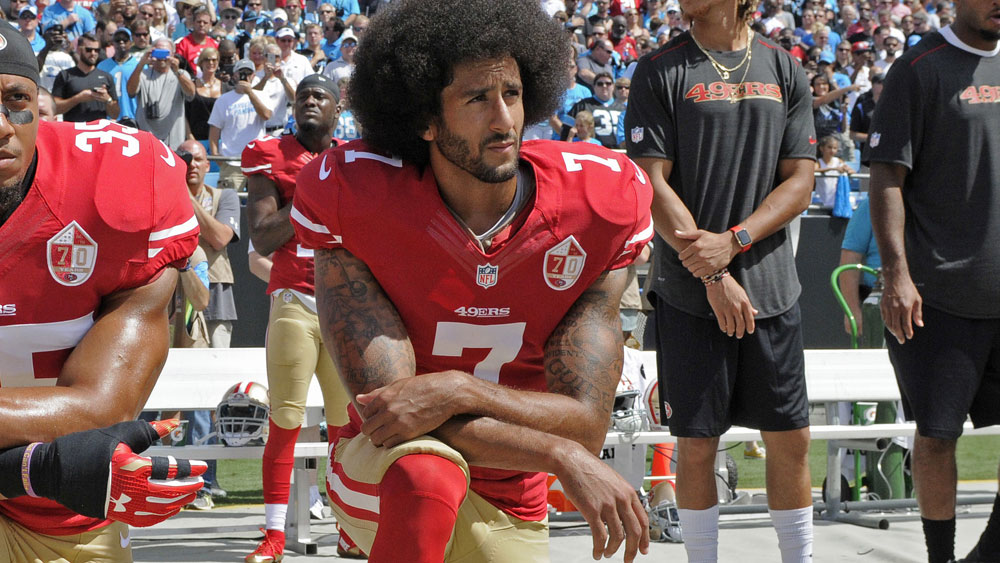
My new favorite cartoon show has no animated characters, no eye-popping double takes, no attempted murders via defective ACME products and no rabbits dressing up as women to deceive unrealistically credulous hunters with speech impediments. Nevertheless, it is just as wacky, zany and hilarious as any other cartoon show, and makes for just as entertaining an escape from the grinding everyday experience of the real world. My favorite cartoon show is called Russiagate, and you can tune in to watch it every day on cable news.
In their latest knee-slapping goofball escapade, the cast and crew of the Russiagate cartoon have been asserting, with straight faces, that the debate over the on-field protests against racism and police brutality by NFL players is the result of a Kremlin conspiracy. As usual they offer no evidence for this claim apart from the authoritative tone in which they say it, and as usual it is being swallowed and passed around as fact by the pussyhatted McWarriors of the McResistance anyway.
Without a shred of evidence, GOP Sen. James Lankford blames Russia for NFL #takeaknee protests https://t.co/MTOoQDv96a
New reports from establishment outlets like the New York Times, Washington Post, Reuters and ABC News have — in all seriousness and in real life — been advancing a completely unsubstantiated claim made by ambitious rookie Senator James Lankford that the Russian government worked to stir up the debate over the NFL protests using Twitter bots and viral hashtags.
“We watched, even this weekend, the Russians and their troll farms, their internet folks, start hashtagging out #TakeAKnee and also hashtagging out #BoycottNFL,” Lankford said during a Senate hearing on threats to US security.
“They were taking both sides of the argument this weekend … to try to raise the noise level of America and make a big issue seem like an even bigger issue as they are trying to push divisiveness in this country.”
Never mind the fact that this divisiveness happens to consist of the same exact textbook wedge issue politics that Democrats and Republicans have been using for decades to manipulate the public into supporting America’s two increasingly indistinguishable pro-establishment political parties. Never mind the fact that Russians would be doing both Democrats and Republicans a huge favor by fanning the flames of a debate involving both America’s blood-soaked racial problems and flag-waving patriotism to bolster the insipid us vs. them political environment which the US power establishment uses constantly to keep the public locked into a fake two-party system with the illusion of free choice. This is a cartoon show. Don’t think about it too hard.
@FlowersxSilence @chrizap @MaxBlumenthal Oh be fair. Everyone knows there was no racism in the US until Lenin and Putin started tweeting about it in 1917.
Even Clint Watts is not sure Twitter accounts weighing in on NFL debate were RU. But it has become accepted truth. https://t.co/jIsQnR9txw
The whole NYT article is based on secret decisions by new neocon/Dem group (https://t.co/s1dIqBqxmb), but it's Russia, so no evidence needed https://t.co/tz44erHxWd
Bill Kristol, Mike Morell & Chertoff start new group & w/in 2 months its secret analysis is authoritative in NYT https://t.co/iKjKyJc0Xy
In a feigned attempt to substantiate their cartoonish reporting, these Russiagate-promulgating establishment outlets have been citing a neoconservative policy group the The Intercept’s Glenn Greenwald ripped to shreds back in July of this year. Greenwald’s article shows how the Alliance for Securing Democracy policy group is full of discredited lying war hawks like Bill Kristol, and goes on to describe how those neocons have been re-aligning themselves with the Democratic party in order to advance their bloodthirsty agendas more effectually.
This makes it all the more laughable when these outlets cite Alliance for Securing Democracy as a “bipartisan” group. Democratic neocons and Republican neocons working together to escalate cold war tensions is all it takes for something to be labeled “bipartisan” these days.
From Reuters:
A website built by researchers working with the Alliance for Securing Democracy, a bipartisan, transatlantic project to counter Russian disinformation, showed tweets promoting both sides of the football debate from 600 accounts that analysts identified as users who spread Russian propaganda on Twitter.
From the New York Times:
Since last month, researchers at the Alliance for Securing Democracy, a bipartisan initiative of the German Marshall Fund, a public policy research group in Washington, have been publicly tracking 600 Twitter accounts — human users and suspected bots alike — they have linked to Russian influence operations.
These establishment propaganda rags go out of their way to emphasise that this neoconservative firm is “bipartisan” to dupe readers into the belief that its findings are unbiased, as most Americans are unaware that neoconservatism spans both sides of the political aisle with increasing focus on the donkey party of late. This is really the only tool they have for inspiring confidence in their claims, since the Alliance for Securing Democracy refuses to disclose how it came to its conclusions or how it identifies Russian propaganda accounts on Twitter.
How does this new Kristol/Morell/Chertoff group decide who is a Russian propaganda account? It won't say. OK for NYT https://t.co/ex7qZPXG5t
This latest episode of daffy cartoon antics is coming on the back of the thoroughly discredited claims that Russian advertisements on Facebook influenced the 2016 election and the thoroughly discredited claim that Russia attempted to hack the elections systems of 21 states in the leadup to the November vote. In an excellent new article about the latter issue titled “Yet Another Major Russia Story Falls Apart. Is Skepticism Permissible Yet?”, Greenwald wrote the following today:
Regardless of your views on Russia, Trump and the rest, nobody can possibly regard this climate as healthy. Just look at how many major, incredibly inflammatory stories, from major media outlets, have collapsed. Is it not clear that there is something very wrong with how we are discussing and reporting on relations between these two nuclear-armed powers?
Something very wrong indeed, Double-G. There’s something awfuwy scwewy going on awound here.

— — —
I’m a 100 percent reader-funded journalist so if you enjoyed this, please consider helping me out by sharing it around, liking me on Facebook, following me on Twitter, or throwing some money into my hat on Patreon.
Via Baker & Company Advisory Group,
Do you consider debt as income? Before you answer that, let’s perform a thought experiment. Imagine that you had taken a long cruise last fall and charged $10,000 to an American Express card. When you did your taxes this year, would have told the IRS that you had $10,000 income from American Express? Of course you wouldn’t. Suppose a major oil company issues $800 million worth of bonds to develop a new old field. Would the company report that as income to the stockholders or the IRS? Of course they wouldn’t. I am sure those sound like silly questions as the answer is a self evident “NO!” We do not consider borrowed money as income. It is a liability that must be paid back. Then why do we count Federal Government debt when measuring national income? I will leave speculation as to the “why” to the readers and focus on the fact that we do count new Treasury Debt as income.
The modern concept of GDP was first developed by the Department of Commerce in 1934. Commerce commissioned Nobel Laureate Simon Kuznets of the National Bureau of Economic Research to develop a set of national economic accounts. Professor Kuznets headed a small group within the Bureau of Foreign and Domestic Commerce’s Division of Economic Research. I picture them meeting to develop statistical measures that would help the government to determine if the economy was recovering from the Depression. They are debating on how to measure all of the various sources of income. One economist suggests that regardless of the source of his income, there are only two things he can do… Spend it or invest it and we know how to measure consumption and investment (& savings). This was the foundation of the expenditure approach to measure GDP. I can imagine another one of the economists suggesting that when we sell more to other countries, the excess should be added to national income and subtracted if we buy more than we sell (Balance of Trade). Then another economist suggests that there is a third alternative to the idea that he will either spend or invest his income and that is paying taxes. Since the government takes a portion of National Income and spends it, they decided to add Government spending into the GDP calculations. While each component of this basic formula for GDP breaks down into hundreds or thousands of sub-components, the final calculation is:
GDP= PI + BT + GS
Where PI is private income (measured as consumption or investment)
Where BT is balance of trade
Where GS is government spending
So the final formula for GDP includes Government Spending. Notice that the government spending component does not take into account whether or not the government spent money taken out of private income (taxes) or borrowed it. When measuring National Income, we are giving equal weight to spending taxes on actual Private Income and money the Treasury borrows.
I suggest that government debt is not part of “ National Income” because it is not income. It is borrowed (often from sovereigns that are not our friends) and must be paid back eventually. We do not consider borrowed money as income anywhere else and it shouldn’t be considered as National Income. Debt is artificial stimulus not National Income! Governments must pay back debt either through higher taxes, inflation/depreciated currency, reduced services or some combination thereof. If we want an accurate picture of whether or not the economy is self sustaining, then we need to consider a measure I would like to introduce as “Actual National Income”which does not count artificial stimulus. Therefore to accurately measure the health of the economy, government debt must be subtracted from the formula. Please consider the GDP formula with the following modification.
Actual GDP = PI + BT + (GS – GB)
Where GB is government borrowing
So, if you acknowledge for the sake of argument that government debt is not actual national income, the following graph is how the U.S. economy looks like excluding stimulus. This is Actual GDP excluding artificial stimulus.
The data and chart comes from the Federal Reserve Economic Data base (FRED.) It is Gross domestic Product minus Treasury Debt. If you download them to a spread sheet GDP is expressed in billions so 1,000,000,000 is expressed as 1, while Federal Debt is expressed in millions so 1,000,000,000 is expressed as 1,000. That is why the chart is (Gross Domestic Product * 1000.)
The government has always borrowed and spent money but actual GDP has grown as far back as the Fed has data. That is until 2008. Then something in our economy broke. Since then it appears the economy has been in what would be considered a depression but masked by huge Federal Government stimulus borrowing. Have we reached a level of economic activity that could sustain itself without this artificial stimulus? What would happen if the Government was forced to balance the budget? You decide for yourself, but remember that would remove 5-7% of our GDP. An economic depression is generally defined as a severe downturn that lasts several years. Does this look like a severe downturn that is still lasting several years? This is what our GDP minus artificial stimulus looks like.
Does that chart look like the data on a self sustaining recovery? If it were self sustaining the slope would be rising as it was prior to 2008. It continues to decline and is therefore anything but self-sustaining. In economics, deficit spending has long been called “Fiscal Stimulus.” Since 2008, this artificial stimulus has averaged 7.45% of GDP. The arithmetic (GDP-GB) is quite simple; without the artificial stimulus created by spending the proceeds of newly issued Treasury bonds, our GDP has declined an average of 7.45% each year since 2007! The following data/proof is downloaded from the source of the previous chart.
From 1929 to the end of the Great Depression and WWII, the Fed increased its balance sheet from 6% of GDP to 16% of GDP. From 2008 to 2014 the Fed grew its balance sheet from 6% of GDP to over 22% of GDP. The effective FED Funds target rate sank to 0-¼% band at the end of 2008 and stayed there until the end of 2015, when they went to 1/4-1/2% and stayed there a year. In fact, the Fed did not start serially raising rates until the end of 2016. Essentially, the Fed sat at the zero boundary for 8 years. Many wonder why they took so long to start the process of normalizing rates.
The FED has given us 8 years of “0” rates and almost twice as much of an increase in balance sheet expansion as they used in the Great Depression and WWII. Why? Did they see something that was more dangerous than the dual threats to the U.S.’s actual existence than the Great Depression and WWII combined? Or perhaps they were just engaged in a reckless and potentially dangerous monetary experiment? I have been asking those questions since the Fed’s balance sheet expansion exceeded that of the Great Depression & WWII. I believe what I have been describing as “ Actual GDP” may provide the answer. The Fed & the Government may have seen a depression that had the potential to be more threatening, deeper and longer than that of the 1930’s. If that assumption is correct, then the Fed & the Government have successfully masked a depression, avoiding a negative feedback loop and giving the economy time to heal. Has it healed? Please refer to the first graph “GDP minus Federal Debt” chart and tell me if you think the actual economy has healed. It is still heading down so I believe an informed and rational answer would be NO. If it has not healed one wonders what the Fed is doing.
In a report published on Wednesday August 30, 2017, titled “With A Shutdown, There Will Be Blood”, U.S. chief economist at S&P, Beth Ann Bovino, writes that “failure to raise the debt limit would likely be more catastrophic to the economy than the 2008 failure of Lehman Brothers and would erase any of the gains of the subsequent recovery.” I believe Bivino is on to something, even though we now have a temporary extension of the debt ceiling. With the Federal Government borrowing and spending over 6-7% of GDP, then it stands to reason that without the Government’s ability to borrow new money, GDP would collapse 6-7% before a negative feedback loop type mechanism is engaged making it worse. It is just arithmetic. Since 2010 the amount of net new Treasury Bonds issued has averaged 6.5% of GDP. If the Federal Government were unable to issue new bonds then that amount would no longer be in GDP. Again, It is just arithmetic.
The labor market is reported as having created millions of jobs, but what kind of jobs? We often hear that we have full employment and a very tight labor market, that we have created so many jobs the Fed must raise rates. Since no one wants to raise a family working multiple part time jobs, let’s examine U.S. employment in terms of full time jobs,
The Federal Reserve data base (drawing on U.S. Bureau of Labor Statics) tells us there were 121,875,000 people employed with full time jobs in November of 2007 (just before the 2008 crises). As of August 2017 there were 125,755,000 people with full time jobs. That means our economy has added a paltry 3,880,000 full time jobs in almost 10 years as the population grew by about 23 million.
According to the National Center for Educational statistics there were 3,897,000 people who received a college degree including associates, bachelors, masters and PHDs in the school year 2016-2017.
The good news is that most of the people who graduated from college in the 2016/2017 school year can have full time jobs. The bad news is that in the 2016/2017 school year, those who dropped out of college, graduated from high school or dropped out of high school do not have a full time job. The really bad news is that everyone who graduated from college, who dropped out of college, graduated from high school or dropped out of high school from 2007 through 2016 do not have a full time job. There have not been enough full time jobs created in our economy for anyone out of high school or college in the last 9 out of 10 years. If the creation of enough full time jobs to employ only 1 year of college graduates out of 10 years sounds like a tight labor market to you and not a depression, then perhaps some of the readers would like you to share some of whatever you are smoking .
In conclusion, I believe the U.S. economy is in a depression masked by debt. I further believe there is no indication we have had an actual recovery of the actual economy.
These observations could inform intermediate and long term strategies. I am not using these observations as a timing tool, but rather as a depth finder for assessing risk when the next crisis unfolds or when market participants realize the emperor, not only has no clothes, he maxed out his credit cards buying them.


“I think that when Americans talk about the Vietnam War … we tend to talk only about ourselves. But if we really want to understand it … or try to answer the fundamental question, ‘What happened?’ You’ve got to triangulate,” says filmmaker Ken Burns of his celebrated PBS documentary series “The Vietnam War.” “You’ve got to know what’s going on. And we have many battles in which you’ve got South Vietnamese soldiers and American advisors or … their counterparts and Vietcong or North Vietnamese. You have to get in there and understand what they’re thinking.”
Burns and his co-director Lynn Novick spent 10 years on “The Vietnam War,” assisted by their producer Sarah Botstein, writer Geoffrey Ward, 24 advisors, and others. They assembled 25,000 photographs, feature close to 80 interviews of Americans and Vietnamese, and spent $30 million on the project. The resulting 18-hour series is a marvel of storytelling, something in which Burns and Novick take obvious pride. “The Vietnam War” provides lots of great vintage film footage, stunning photos, a solid Age of Aquarius soundtrack, and plenty of striking soundbites. Maybe this is what Burns means by triangulation. The series seems expertly crafted to appeal to the widest possible American audience. But as far as telling us “what happened,” I don’t see much evidence of that.
Like Burns and Novick, I also spent a decade working on a Vietnam War epic, though carried out on a far more modest budget, a book titled “Kill Anything That Moves.” Like Burns and Novick, I spoke with military men and women, Americans and Vietnamese. Like Burns and Novick, I thought I could learn “what happened” from them. It took me years to realize that I was dead wrong. That might be why I find “The Vietnam War” and its seemingly endless parade of soldier and guerrilla talking heads so painful to watch.
War is not combat, though combat is a part of war. Combatants are not the main participants in modern war. Modern war affects civilians far more and far longer than combatants. Most American soldiers and Marines spent 12 or 13 months, respectively, serving in Vietnam. Vietnamese from what was once South Vietnam, in provinces like Quang Nam, Quang Ngai, Binh Dinh, as well as those of the Mekong Delta – rural population centers that were also hotbeds of the revolution — lived the war week after week, month after month, year after year, from one decade into the next. Burns and Novick seem to have mostly missed these people, missed their stories, and, consequently, missed the dark heart of the conflict.
To deprive their Vietnamese enemies of food, recruits, intelligence, and other support, American command policy turned large swathes of those provinces into “free fire zones,” subject to intense bombing and artillery shelling, that was expressly designed to “generate” refugees, driving people from their homes in the name of “pacification.” Houses were set ablaze, whole villages were bulldozed, and people were forced into squalid refugee camps and filthy urban slums short of water, food, and shelter.

A U.S. Marine carries a blindfolded woman suspected of Vietcong activities over his shoulder. She and other prisoners were rounded up during the joint Vietnamese-U.S. Operation Mallard, near Da Nang, Vietnam.
Photo: Bettmann Archive/Getty Images
I spoke with hundreds of Vietnamese from these rural areas. In hamlet after hamlet, they told me about being rousted from their homes and then being forced to drift back to the ruins, for deeply-held cultural and religious reasons, and often simply to survive. They explained what it was like to live, for years on end, under the threat of bombs and artillery shells and helicopter gunships. They talked about homes burned again and again and again, before they gave up rebuilding and began living a semi-subterranean existence in rough-hewn bomb shelters gouged into the earth. They told me about scrambling inside these bunkers when artillery fire began. And then they told me about the waiting game.
Just how long did you stay in your bunker? Long enough to avoid the shelling, of course, but not so long that you were still inside it when the Americans and their grenades arrived. If you left the shelter’s confines too soon, machine-gun fire from a helicopter might cut you in half. Or you might get caught in crossfire between withdrawing guerrillas and onrushing U.S. troops. But if you waited too long, the Americans might begin rolling grenades into your bomb shelter because, to them, it was a possible enemy fighting position.
They told me about waiting, crouched in the dark, trying to guess the possible reactions of the heavily-armed, often angry and scared, young Americans who had arrived on their doorsteps. Every second mattered immensely. It wasn’t just your life on the line; your whole family might be wiped out. And these calculations went on for years, shaping every decision to leave the confines of that shelter, day or night, to relieve oneself or fetch water or try to gather vegetables for a hungry family. Everyday existence became an endless series of life-or-death risk assessments.
I had to hear versions of this story over and over before I began to get a sense of the trauma and suffering. Then I started to appreciate the numbers of people affected. According to Pentagon figures, in January 1969 alone, air strikes were carried out on or near hamlets where 3.3 million Vietnamese lived. That’s one month of a war that lasted more than a decade. I began to think of all those civilians crouched in fear as the bombs fell. I began to tally the terror and its toll. I began to understand “what happened.”
I started to think about other numbers, too. More than 58,000 U.S. military personnel and 254,000 of their South Vietnamese allies lost their lives in the war. Their opponents, North Vietnamese soldiers and South Vietnamese guerrillas, suffered even more grievous losses.
But civilian casualties absolutely dwarf those numbers. Though no one will ever know the true figure, a 2008 study by researchers from Harvard Medical School and the Institute for Health Metrics and Evaluation at the University of Washington and a Vietnamese government estimate, suggest there were around two million civilian deaths, the vast majority in South Vietnam. A conservative killed-to-injured ratio yields a figure of 5.3 million civilians wounded. Add to these numbers 11 million civilians driven from their lands and made homeless at one time or another, and as many as 4.8 million sprayed with toxic defoliants like Agent Orange. “The Vietnam War” only weakly gestures at this civilian toll and what it means.

An elderly Vietnamese woman reaches into large jar to draw water in an attempt to fight flames consuming her home in a village 20 miles southwest of Da Nang, South Vietnam on Feb. 14, 1967.
Photo: AP
Episode five of “The Vietnam War,” titled “This Is What We Do,” begins with Marine Corps veteran Roger Harris musing about the nature of armed conflict. “You adapt to the atrocities of war. You adapt to killing, dying,” he says. “After a while, it doesn’t bother you. I should say, it doesn’t bother you as much.”
It’s a striking soundbite and is obviously offered to viewers as a window onto the true face of war. It made me think, however, about someone who experienced the war far longer and more intimately than Harris did. Her name was Ho Thi A and in a soft, measured voice she told me about a day in 1970 when U.S. Marines came to her hamlet of Le Bac 2. She recounted for me how, as a young girl, she’d taken cover in a bunker with her grandmother and an elderly neighbor, scrambling out just as a group of Marines arrived — and how one of the Americans had leveled his rifle and shot the two old women dead. (One of the Marines in the hamlet that day told me he saw an older woman “gut-shot” and dying and a couple of small clusters of dead civilians, including women and children, as he walked through.)
Ho Thi A told her story calmly and collectedly. It was only when I moved on to more general questions that she suddenly broke down, sobbing convulsively. She wept for ten minutes. Then it was fifteen. Then twenty. Then more. Despite all her efforts to restrain herself, the flood of tears kept pouring out.
Like Harris, she had adapted and moved on with her life, but the atrocities, the killing, the dying, did bother her

Ho Thi A in 2008.
Photo: Tam Turse
Add together all the suffering of all of South Vietnam’s Ho Thi A’s, all the women and children and elderly men who huddled in those bunkers, those whose hamlets were burned, those made homeless, those who died under the bombs and shelling, and those who buried the unfortunates that did perish, and it’s a staggering, almost unfathomable toll – and, by sheer numbers alone, the very essence of the war.
It’s there for anyone interested in finding it. Just look for the men with napalm-scarred or white phosphorus-melted faces. Look for the grandmothers missing arms and feet, the old women with shrapnel scars and absent eyes. There’s no shortage of them, even if there are fewer every day.
If you really want to get a sense of “what happened” in Vietnam, by all means watch “The Vietnam War.” But as you do, as you sit there admiring the “rarely seen and digitally re-mastered archival footage,” while grooving to “iconic musical recordings from [the] greatest artists of the era,” and also pondering the “haunting original music from Trent Reznor and Atticus Ross,” just imagine that you’re actually crouched in your basement, that your home above is ablaze, that lethal helicopters are hovering overhead, and that heavily-armed teenagers — foreigners who don’t speak your language — are out there in your yard, screaming commands you don’t understand, rolling grenades into your neighbor’s cellar, and if you run out through the flames, into the chaos, one of them might just shoot you.
Top photo: U.S. Marine stands with Vietnamese children as they watch their house burn after a patrol set it ablaze after finding AK-47 ammunition, Jan. 13, 1971, 25 miles south of Da Nang.
Nick Turse is the author of “Kill Anything That Moves: The Real American War in Vietnam,” one of the books suggested as “accompaniments to the film” on the PBS website for “The Vietnam War.” He is a frequent contributor to The Intercept.
The post The Ken Burns Vietnam War Documentary Glosses Over Devastating Civilian Toll appeared first on The Intercept.

VISIT MY NEW WEB SITE:
Contact at lendmanstephen@sbcglobal.net.
This and other incriminating evidence clearly reveal US support for ISIS – the scourge it pretends to combat, arming its fighters, providing other material …


