My third collection, Power Outside The Matrix, contains a lengthy Writer’s Tutorial. Aside from practical advice, I stress what freedom means to a writer, what it really means in terms of available energy.
ORIGINAL LINK

Seeking Truth in a World of Propaganda. Links do not necessarily indicate agreement with stories or perspectives.
“Those who are able to see beyond the shadows and lies of their culture will never be understood, let alone believed, by the masses.” - Plato



I. All We Like Sheep
In the 1980s, when the Reagan administration chose the name “Peacekeeper” for an intercontinental ballistic missile sporting 300-kiloton nuclear warheads, critics of the program were over a barrel. “Peacekeepers kill!” “Down with Peacekeepers!” “Support for Peacekeepers is support for war!” You see the problem.
Higher education gets similar rhetorical insulation with phrases like “Equity, Diversity, and Inclusion,” which is why on American college campuses pledges of fidelity to some version of this trinity have been slipped into annual reviews, teaching evaluations, and applications for employment with hardly a whisper of opposition. Dissent always sounds diabolical.
This was demonstrated last spring when two Villanova professors objected in a Wall Street Journal Op-Ed to their institution’s new teaching evaluation form which asks students to comment on the professor’s “cultural awareness” and sensitivity to “individual differences” and “social identities.” The calumny wrote itself. A “Response” signed by one hundred Villanova professors implied that Doctors Sheehan and Wilson, unlike the faculty signatories, do not take seriously “charges of insensitivity, injustice, and bigotry.” Villanova’s President and Provost attributed to Sheehan and Wilson the belief that “a commitment to diversity, equity, and inclusion is antithetical to a liberal arts education.” Only warmongers could oppose Peacekeepers, after all.
The trouble is, words and phrases that have ordinary meanings outside the academy have been given extraordinary meanings inside. Consider, for example, what “sensitivity” to race and ethnicity means according to the magna carta of campus cultural awareness, “Racial Microaggressions in Everyday Life,” by Teachers College professor Derald Wing Sue. Suppose a white professor wants to hear more from a reserved student in her class, and in office hours encourages the student to speak up: “We want to know what you think. Speak up more.” According to Professor Sue, if this reserved student is black or white, the professor is on safe ground. But if the student is Asian—and I’m not making this up—the professor has potentially committed a micro-aggression. Why? Because being quiet is evidently an Asian “cultural value.” In suggesting that the Asian student “be more verbal,” the professor is requiring him to “assimilate to the dominant [White, and evidently louder] culture.”
If the professor urges an Asian student to “calm down” and to stop being “so loud,” she is apparently back on safe ground. But if the professor asks the same of a black student, she may have committed yet another microaggression, for the remarkable reason that being “loud” and “animated” is evidently a “cultural value” for black people. In other words, demonstrating “cultural awareness” often means trafficking in facile ethno-racial stereotypes, which the illiberal Left has repackaged as “social identities.”
Then there’s the question of how one is to determine the racial, cultural, sexual, and religious “identities” of one’s students in the first place. Common sense and classroom experience suggest that it’s best to focus squarely on the course’s subject matter and to engage students according to what they say and write, without attempting to ascribe to them anything so essentializing as an “identity.” Nothing I’ve read about “inclusive classrooms” dissuades me from this view. On the contrary. Take a passage from the University of Michigan’s guide to “Creating Inclusive College Classrooms” which says that “among students who are different in a highly visible way” are women who wear “Islamic clothing.” Apart from the fact that both Christian and Jewish women in various parts of the Middle East wear what the Michigan guide calls “Islamic” clothing, the more significant point is that the guide’s authors have decided for 750 million women around the world that to be a Muslim is to wear the Abaya, Burkha, Chador, Hijab, Jilbab, or the Niqab. Surely this decision is offensive to, and exclusive of, millions of Muslim women like Yasmin Alibhai-Brown, who described such clothing in her book Refusing the Veil as “degrading to women,” “a cover for sexism and violence,” and inimical to the true spirit of Islam.
Even if a professor were to establish the various “identities” of her students, it’s unclear what being sensitive to those identities entails. The philosopher Erich Voegelin asserted that mass extermination in the name of religious belief is the product of monotheism—more specifically, “an innovation of Deuteronomy.” Would quoting Voegelin’s claim be considered insensitive to conservative Christian or orthodox Jewish students in the class? Or would it be offensive to assume that any of them would be offended, implying as it does that they’re uncritical pietists?
The punishments which the Koran’s Allah promises to exact on non-believers provide more evidence for Voegelin’s claim. Would remarking the Koran’s florid fantasies of violence be considered evidence of the professor’s cultural insensitivity? It wouldn’t be if students were taught to distinguish between criticizing a religion’s ideas on the one hand, and discriminating against its followers on the other. Are they so taught? The faculty “Response” to Professors Sheehan and Wilson insists that Villanova should be free of, among other things, “Islamophobia”—a term which obscures precisely this distinction between anti-Muslim bigotry and criticism of Islam. “A new word had been created to help the blind remain blind: Islamophobia,” writes Salman Rushdie in Joseph Anton, reiterating a point he made along with eleven other writers more than a decade ago in the pages of Charlie Hebdo, where “Islamophobia” was described as a “wretched concept” used to intimidate the religion’s critics and reformers into silence. Support for that claim would seem to have been offered inadvertently by the Islamic Human Rights Commission, which named Charlie Hebdo “Islamophobe of the Year” in March of 2015, just two months after 12 members of the satirical weekly were massacred in their Paris offices by Islamic terrorists. Yet the Villanova faculty “Response” uses the term “Islamophobia” as if it were an unequivocal tool of the morally upright.
The 100 faculty signatories also want their university to be free of “anti-LGBTQ sentiments”—a consummation devoutly to be wished. But when a conservative Muslim student devoutly wishes to condemn homosexuality and transsexuality on religious grounds, should the professor risk being labeled Islamophobic for condemning the student’s transphobia and homophobia, or risk being labeled homophobic and transphobic for refusing to?
Suppose the professor’s refusal stems from the recognition that the very ideas of “transphobia” and “homophobia” are themselves historico-cultural pejoratives posing as transhistorical, transcultural psychiatric disorders, and thus Eurocentric in principle and potentially xenophobic in practice. A far-fetched hypothetical? Last spring hundreds of predominantly Muslim parents at Britain’s Parkfield Community School withdrew their 600 children from classes because of a “No Outsiders” program which taught that “it’s okay to be gay.” “We respect the British values,” said one parent, who felt that the program was not, however, “respecting our ethos as a community.”
There is immediate evidence too for the parochialism of the term “Islamophobia”: in 2017 the Chinese government medicalized Islamophilia, declaring “extremist” Uighur-Muslim ideas to be an “ideological illness” which requires hospitalization for those who have been “infected.” A 12-minute Uighur-language recording issued by the Chinese Communist Party explains that while some people infected with the ideas “have not committed any crimes … [t]here is always the risk that the illness will manifest itself at any moment, which would cause serious harm to the public.” China’s response to this illness, the internment and “re-education” of between one and two million Uighurs, likely constitutes the largest incarceration of an ethnic minority since World War II.
Would remarking on this fact signal a professor’s laudable condemnation of Islamophobia, or her latent and objectionable Sinophobia? According to the “Michigan Guide on Inclusive Classrooms,” professors should not present the policies of foreign governments “as either wholly good or wholly bad,” and should avoid regularly making invidious distinctions between American policies and, for example, “social policies in China.”
Perhaps the invidiousness of the distinction between Chinese and U.S. policies could be softened if the professor noted that Beijing insisting that Xinjiang be free of pro-Muslim sentiments is not in principle different from 100 faculty in an American University insisting that their campus be free of “anti-LGBTQ sentiments.” Or, since Villanova is a private school, maybe a closer comparison is the one between the Chinese government requiring “treatments” for an “ideological illness” in 2017, and the University of Delaware—an American state school—administering what it called “treatments” for potentially retrograde political attitudes of its entering students a decade earlier in 2007. It’s a small world after all.
II. Cult Awareness as Cultural Awareness
Highlighting the authoritarian tendencies of activist faculty and administrators is obviously not an intended outcome of “cultural awareness” and “anti-bias” campaigns. Nor for that matter is exposing the Eurocentric potential of the pejorative “homophobic,” the Sinophobic potential of the pejorative “Islamophobic,” the Islamophobic potential of the pejoratives “Sinophobic” and “homophobic,” or the xenophobic potential of compulsory multiculturalism, whose premises are by no means transcultural. But given the ease with which these intersectional prohibitions become a web of unavoidable tripwires, what’s to keep those who promote the prohibitions from being ensnared themselves? Theoretically nothing, but practically everything. With rare exception, if you’ve signaled your allegiance to the question-begging version of “social justice” now current in colleges and universities, you’ve got something close to the benefit of clergy.
Then too, the political monoculture that especially prevails in the humanities and social sciences has meant that most undergraduates are kept in the dark about the contradictory claims of intersectionality, in precisely the same way that novitiates are kept in the dark about the contradictory claims of Holy Writ. Once the institutions become ideologically homogenous within, the only credible threats are the ones from without: hence the importance of deplatforming outside speakers. Although deplatforming pretends to be about protecting fragile students from hateful ideas, it’s really about protecting fragile ideology from meaningful critique. Seton Hall’s decision to disinvite Stanley Fish from speaking on campus, for example, is as disingenuously self-serving as the Church of Scientology’s decision to disinvite Sara Kelly from attending L. Ron Hubbard’s posthumous 91st birthday bash. Kelly’s sin was trashing the film adaptation of Battlefield Earth. Fish’s sin was critiquing higher ed’s “regime of virtue.”
Charges of indoctrination are vehemently denied by academics themselves, of course, and a common defensive strategy is to wax indignant on behalf of students. Back in 2007, an administrator at the University of Delaware blamed the critics of its infamously politicized orientation program for implying that Delaware undergraduates were “so empty-headed and ignorant that they could be ‘indoctrinated’ with ease.” The Villanova faculty “Response” reprises that argument—minus the accidental self-indictment—by suggesting that Professors Sheehan and Wilson’s concerns about indoctrination were “insulting to students who are adults … capable of critical thinking and making their own decisions.”
But compare this public defense of student autonomy to what one of the two co-authors of Villanova’s faculty “Response” says when writing for a coterie audience of fellow academics. In a 2014 essay, Villanova Professor Billie Murray urges her colleagues to “establish parameters for students’ explorations of communication activism,” and explicitly rejects a non-partisan pedagogy that would let students “participate in public discussions on issues that they choose.’” Professor Murray says that her own course doesn’t simply offer a “set of tactics and strategies, but a clear understanding of what it means to work toward a world free of domination and oppression.” In practice, this means that, for example, working for Planned Parenthood is one of her course’s five service options, whereas working for a pro-life group is not. Although I support a woman’s right to choose, it is worth asking: Is this what Villanova’s President and Provost mean when they laud their institution’s commitment to a “pedagogy that recognizes that knowledge creation is part of the dynamic exchange among and between perspectives”?
The President and Provost also trumpet Villanova’s dedication “to the highest academic standards” in their dismissal of Wilson and Sheehan’s concerns about political indoctrination. Since we recently passed the fifth anniversary of the tragic events in Ferguson and the shooting of Michael Brown, I thought I’d test that by plugging the terms “Villanova, Ferguson, Bias” into a Google search. On the first page of results was a Villanova Tedx talk entitled “Being White and Seeing Black: Ferguson, Neuroscience and Imagination” by Villanova Professor Tim Horner, one of the signatories of the faculty “Response.” In his talk, Professor Horner confesses to his own racial bias, citing as evidence both the dispiriting results of his implicit bias test (“a moderate preference for white faces”), and the sweat-inducing fear he experienced as a young college student on Chicago’s L-train when, late one night, two black men entered the car that he occupied alone. After a brief foray into the “neuroscience of racial bias,” Professor Horner concludes that the fear Darren Wilson experienced in the moments before he shot and killed Michael Brown, was as baseless and as racially biased as the fear he himself had experienced on Chicago’s L-train all those years ago.
Excluded tout court from this analysis are the Obama Justice Department findings, readily available for six months at the time of the talk, which expose the bad faith of this conclusion. To mention the most relevant of the findings: 1) Darren Wilson rightly suspected that Michael Brown had just strong-armed a convenient store clerk during the theft of cigars; 2) as confirmed by eyewitness testimony and forensic evidence, Darren Wilson was assaulted through the driver-side window of his SUV by Brown who, in a struggle to get control of Wilson’s pistol, was shot in the hand; 3) after fleeing, Brown turned back toward Wilson, ignored repeated commands to stop, and was “moving forward,” “running toward,” or “charging” Wilson when he was finally killed—this according to both Wilson and credible eyewitnesses, most of whom were African Americans.
By contrast, Professor Horner 1) had no reason to suspect his fellow L-train passengers of anything, 2) had no contact with them during the trip, and 3) arrived at his destination without incident. Nevertheless, the only difference Dr. Horner discerns between his fear of the two black men in his train car and Wilson’s fear of Michael Brown is one which redounds to the credit of his own metacognitive acumen: “that’s the difference between him and me,” he says to his approving audience: “I no longer trust that fear—I have become mindful of how my brain constructed that bias.”
This illustrates the speciousness of the claim made by Villanova’s President and Provost that “there is no conflict between academic standards and the values of unity and love.” The problem isn’t simply that a lecture on “the science of racial bias” places a transparently un-scientific embargo on all facts uncongenial to its thesis, or even that its baseless attribution of homicidal racism to Darren Wilson is published under the imprimatur of an institution of higher learning. The larger problem is that the lecture’s misrepresentations are both enabled by and advanced with a warranted confidence that no one in the audience, certainly no academic, would risk calling out these misrepresentations because of the crucial role they play in buttressing a narrative, sacrosanct on the academic Left, about black victimization and what Professor Horner calls, with crowd-pleasing racist indictment, “toxic, white ignorance.” That’s the narrative that gets you love on a college campus, and it’s the one that gets you unity. But as the most cursory reading of the DOJ Report on the death of Michael Brown will show, it gets you nowhere near an academic standard.
III. Undergraduates Unleashed
Fortunately, the vast majority of college students are less susceptible to this kind of coercive group-think than most faculty and administrators, since less depends on their acquiescence. Most undergraduates cannot in fact be “indoctrinated with ease.” A significant minority can not only be indoctrinated, however, but roused and mobilized, which is why Oberlin College’s Dean of Students, Meredith Raimondo, could write credibly in 2017 of “unleashing students” on Emeritus professor Roger Copeland, who had publicly—and presciently—condemned Oberlin’s “rush to judgement” in declaring Gibson’s Bakery “racist.” “Fuck him,” Raimondo texted Oberlin’s Vice President for Communications Ben Jones, and mentioned using students—those “adults,” capable of “making their own decisions”—to do it. There’s no evidence that Oberlin’s communications VP was in the least puzzled by Raimondo’s assertion of control.
That’s because there was nothing to be puzzled about. It’s common knowledge on many campuses that those students who, with little more than rumor to go on, are willing to declare others “bigots” or “racists” and in the process derail both their lives and livelihoods on a whim, are easily influenced by those faculty and administrators with agendas to prosecute. Although it was students, for example, who disrupted Bret Weinstein’s class at Evergreen State College and then hunted for him on campus, it was a small group of faculty and administrators who’d provided the ideological marinade for them to soak up, and President George Bridges who ordered the campus police to stand down as students searched cars and roamed the campus with baseball bats.
A more recent example comes from Professor Steven Gerrard, whose support of a free speech initiative at Williams College earned him the title “Enemy of the People.” Although he received that designation in a letter signed by a group of students, at a faculty meeting in which he attempted to respond from the podium to the students’ letter it was “a group of younger faculty,” according to Professor Gerrard, “who demanded that I be quiet and let the students speak.” It was faculty too, according to Professor Gerrard, who “not only supported . . . but instigated” the “protests, marches, threats and demands—everything but rational argument.”
It’s in the context of this kind of support-cum-instigation on the part of activist faculty that soliciting student opinion about a professor’s “cultural awareness,” or sensitivity to “individual differences” and “social identities” should be understood. Having developed and then delivered to students a terminology infused with self-contradictory intersectionalist dogma, the academic Left now suggests that these terms are non-ideological registers of pedagogical inclusiveness and rapport. They’re not. If acts of genuine bigotry and bias are committed in a classroom, students don’t need special prompting to report it. But once terms like “racist” and “white supremacist” are selectively elasticized to include everything from the electoral college and defenses of free speech, to the Democratic Party, mathematics, and the anti-abortion movement, then leading questions couched in “progressive” patois are required in order to uncover the newly-minted heresies.
If that doesn’t work, there’s a further step—one which I wouldn’t have thought possible had I not experienced it first-hand a few years ago when, in a review letter, an academic dean simply invented student complaints about a lack of diversity in my choice of authors for a course on the novel—a course whose connection with diversity, ironically enough, I’ve written about in the American Scholar. In any case, although not a single student, minority or otherwise, had ever made such a complaint, not even a letter from my department chair pointing out that fact could induce the dean to remove the fabrication, which remains in my file to this day. For the equity professional, the mind is its own place.
Obviously, the problem goes well beyond Villanova. But the controversy there brings to the fore what might otherwise remain hidden in colleges lacking Villanova’s Catholic affiliation—namely, the kinship between the pastoral-aggressive rhetoric of religion and that of the activist academic Left. Villanova’s President and Provost declare in the opening line of their response to Sheehan and Wilson, that “[t]here is nothing more central to Villanova’s Catholic, Augustinian identity, than our community.” It’s worth noting that this word “community,” connected here with a religious tradition, has become the preferred term in secular institutions as well to designate what we used to call a “college” or “university.” The substitution is hardly accidental. The primary values of a college are unfettered intellectual inquiry and open, civil debate; the college “community” is whatever emerges when those two principles are rigorously upheld.
But when “community” comes first, the metabolism of intellectual inquiry—a metabolism fed by debate and dissent—is suppressed in favor of reigning orthodoxies. The “Catholic, Augustinian identity” which Villanova’s President invokes, evidently without irony, offers a long history of such suppression. Central to that history is none other than Augustine himself who, as Bishop of Hippo, wrote two letters in the early fifth century, in which he developed an influential justification for using force and “salutary fear” to bring heretics in line with the institutionalized orthodoxy of the day. In no case were the suppressions Augustine’s work helped authorize for the next fifteen hundred years ever advanced under the banner of falsehood, disunion, and hatred. On the contrary, it was always truth, unity, and love that justified the persecution of those whose opinions were considered religiously incorrect.
Is it a coincidence that such an august tradition of coercion and censorship in the name of truth and justice now finds itself embracing, and embraced by, a putatively secular tradition which, with similar arrogance, presumes to dictate “what it means to work for a world free of domination and oppression”? On this point especially, the Church might have benefitted from the mirror provided by Michel de Montaigne when he wrote, “Ambition, avarice, cruelty, vengeance, do not have enough natural impetuosity of their own; let us spark them and fan their flames by the glorious title of justice and piety.” But Montaigne’s Essays, from which that remark comes, was itself deplatformed in 1676 and placed on the Roman Catholic Index of Forbidden Books. There it remained, along with thousands of other texts, for the next three centuries until the Index was itself belatedly abolished by Pope Paul VI. Old traditions die hard, and the oldest are always ripe for resurrection.
Lyell Asher is an associate professor of English at Lewis & Clark College.
Featured Image by Edwin Andrade on Unsplash
The post Villanova and the Compulsory Pieties of Higher Education appeared first on Quillette.

Authored by Mike Adams via NaturalNews.com,
Just as we warned would happen, the tech giants are now moving aggressively to ban all speech that contradicts whatever “official” position is decided to be “the truth” by the corrupt establishment. This week, Facebook announced it would block all content on Facebook that questions the official dogma on vaccines, which falsely insists that vaccines have never harmed anyone (a hilarious lie), that vaccines contain only safe ingredients (a blatant deception) and that vaccines always work on everyone (another laughable lie).
Facebook is achieving this by labeling vaccine awareness information “misinformation” or “hoaxes.” At the top of the list is the assertion that vaccines are linked to autism — something that even the CDC’s own top whistleblower scientist reveals to be true, yet the vaccine industry claims it’s all a hoax (in order to cover of the crimes of medical violence against children that are being committed by the vaccine pushers).
Notably, tech giants are now banning vaccine truth information by labeling it “misinformation” in exactly the same way they ban conservative content by labeling it “hate speech.” They simply invent a false category to justify the ban, all while crushing the free speech of users (and ultimately leading to the vaccine maiming of millions of innocent children). Under this twisted system of speech policing, they can ban any content they don’t like by simply labeling it “false” or “hateful,” even if it’s true and important.
Don’t like infanticide and the killing of human infants after they are born? That’s “hate speech against women,” Facebook will soon declare. And you’ll be banned from talking about abortion.
Concerned about fluoride and how it harms developing brains and lowers the IQs of children? That will be labeled a “hoax” by Facebook, even though it is scientifically verified through multiple studies to be true.
“Monika Bickert, Facebook’s vice president for global policy management, said the social media network would reduce the distribution of false data and provide users with authoritative information about vaccinations,” reports AFP, via Breitbart.
Of course, “authoritative information” means whatever propaganda the vaccine deep state is pushing at the moment. The vaccine industry is steeped in conflicts of interest and a long history of suppressing scientists and whistleblowers who attempt to warn the public about the toxic effects of vaccine ingredients such as Thimerosal (containing mercury), aluminum adjuvants, MSG, formaldehyde and other neurotoxins that are openly admitted by the CDC to be ingredients used in vaccines administered to children.
Just recently, the Association of American Physicians and Surgeons denounced mandatory vaccines, citing “no rigorous safety studies” and warning about vaccine industry corruption of science. Their statement includes the following:
Manufacturers are virtually immune from product liability, so the incentive to develop safer products is much diminished. Manufacturers may even refuse to make available a product believed to be safer, such as monovalent measles vaccine in preference to MMR (measles-mumps-rubella). Consumer refusal is the only incentive to do better.
There are enormous conflicts of interest involving lucrative relationships with vaccine purveyors.
Research into possible vaccine adverse effects is being quashed, as is dissent by professionals.
Vaccines are neither 100% safe nor 100% effective. Nor are they the only available means to control the spread of disease.
Yet Facebook, under pressure from radical, deranged Democrat Adam Schiff, has now been bullied into banning conversations about vaccines in order to appease the vaccine industry and cover up its crimes.
The bigger picture in all this goes way beyond the issue of vaccines, of course. With this decision, Facebook is now signaling that it will ban all conversations or content that contradicts “official positions” on any topic. Those topics will very rapidly be expanded to include GMOs, cancer treatments, water fluoridation, politics, elections, abortions, pesticides and nutrition.
It’s no longer difficult to imagine Facebook banning all conversations about nutrition, citing the absurd FDA position that there is no such thing as a nutrient which can prevent, cure or treat any disease or health condition. That’s the actual “authoritative” FDA position, so by the same logic that Facebook has applied to the vaccine debate, they could simply ban all posts about vitamin D, vitamin D, resveratrol, astaxanthin or any other supplement.
Imagine being banned from Facebook for saying that vitamin C boosts your immune function. That’s exactly what’s coming.
Even worse, Facebook could declare that “authoritative sources” have concluded President Trump colluded with the Russians. Any human opinion that contradicted that “authoritative source” would be banned on Facebook.
The problem with Facebook relying on so-called “authoritative sources” for censorship is that such sources almost always represent the corrupt globalist, pro-pharma, pro-establishment point of view that’s steeped in fraud, deception and falsehoods. Vaccines, for example, are so dangerous that the U.S. government has now paid out nearly $4 billion in awards to families of vaccine-damaged children, yet any mention of those government statistics which are openly published by HHS (VAERS.HHS.gov) will be falsely labeled a “hoax” by Facebook, since the vaccine industry falsely insists that vaccines have never harmed anyone.
Thus, truth become a “hoax,” but lies become the “official truth.” Facebook becomes the Ministry of Truth (or more accurately, the Ministry of Lies), and all voices of truth and reason are silenced in the name of protecting corrupt, harmful industries that sacrifice children for profit.
This is what it has all come to now, which is why people are leaving Facebook in huge numbers.
Before long, Facebook won’t even allow any human opinions at all, and the “social media” site will be nothing but AI robots spewing official propaganda that meets the definition of “authoritative” information from the globalist establishment.
* * *
Stay informed about Facebook at FacebookCollapse.com or MarkZuckerberg.news. Support our mission and enhance your own self-reliance: The laboratory-verified Organic Emergency Survival Bucket provides certified organic, high-nutrition storable food for emergency preparedness. Completely free of corn syrup, MSG, GMOs and other food toxins. Ultra-clean solution for years of food security. Learn more at the Health Ranger Store.


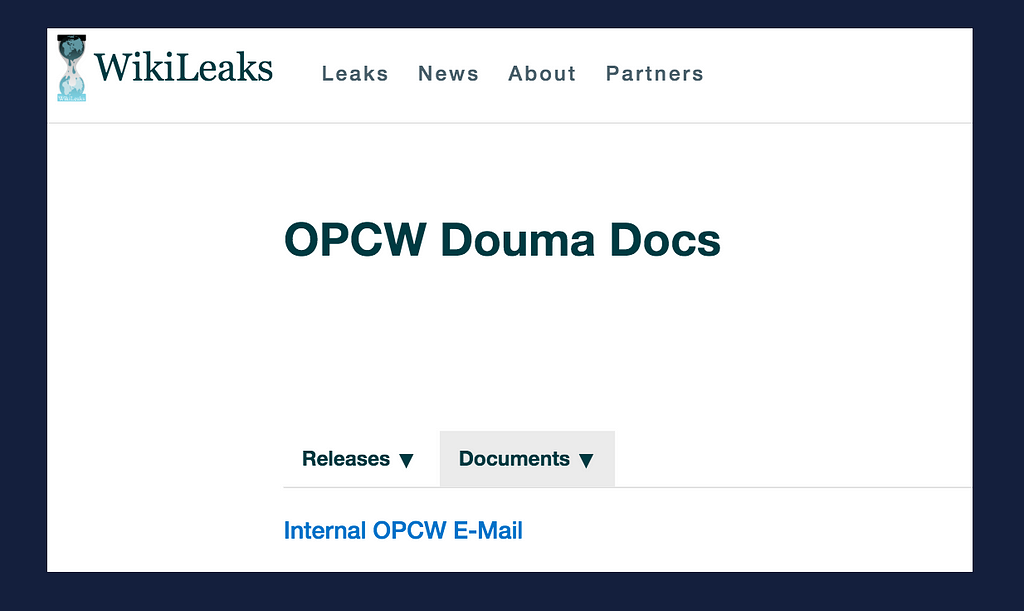
On the sixth of July last year, the Organisation for the Prohibition of Chemical Weapons (OPCW) released its interim report on its findings regarding an alleged poison gas attack in Douma, Syria in April 2018. The incident, which resulted in dozens of civilian casualties, was blamed on the Syrian government by the US, UK and France, who launched retaliatory airstrikes on multiple targets in that nation.
The interim report claimed that “various chlorinated organic chemicals were found” in different locations on the scene, but strangely said nothing about the levels at which those chemicals were found. The Moon of Alabama blog highlighted this suspicious exclusion on the day the report came out, noting that levels are absolutely essential in determining chemical weapons use when you’re talking about compounds which are found virtually everywhere at some level in any industrialized region.
“The preliminary OPCW report says nothing about the concentrations in which these substances were found,” MoA observed. “Without knowing the concentrations, which may be extremely low, one can not come to further conclusion.”
“The ‘various chlorinated organic chemicals’ are unsurprising,” MoA wrote. “Chlorine is widely used for water purification and cleaning and ‘chlorinated organic chemicals’ will be found in any household.”
A new addition to the body of leaks which have been hemorrhaging from the OPCW shows that such skepticism was indeed entirely warranted. A leaked email sent shortly before the interim report was published reveals that the chlorinated organic chemicals which OPCW investigators found on the scene were as low as one or two parts-per-billion, meaning, just as Moon of Alabama speculated last year, that they were found at trace quantities you’d expect to find in any industrialized area.
RELEASE: Secret internal e-mail from OPCW whistleblower, a member of the fact-finding mission sent to Douma, Syria, after the alleged chemical attack in April last year, accusing OPCW management of doctoring report on the incident and distorting facts. https://t.co/ndK4sRikNk
The leaked email, which has been published by WikiLeaks and several other outlets, was sent by an unnamed OPCW investigator to the OPCW’s then-cabinet chief Bob Fairweather, outright accusing OPCW leadership of misleading the public with the information it was omitting from the report it was drafting. Those who’ve been following this scandal closely may remember Fairweather as the man who journalist Jonathan Steele recently reported was responsible for calling investigators into his office to be intimidated by unknown officials from the United States government.
The email was sent to Fairweather on June 22nd, laden with pointed words and phrases like “misrepresents the facts”, “selectively omitting”, “highly misleading”, “disingenuous”, “inaccurate”, and “a major deviation from the original report.” Less than two weeks later, on July the fourth, the investigators were reportedly called into Fairweather’s office for a disturbing meeting with US officials which deeply rattled them.
“On July 4 there was another intervention,” Steele’s report reads. “Fairweather, the chef de cabinet, invited several members of the drafting team to his office. There they found three US officials who were cursorily introduced without making clear which US agencies they represented. The Americans told them emphatically that the Syrian regime had conducted a gas attack, and that the two cylinders found on the roof and upper floor of the building contained 170 kilograms of chlorine. The inspectors left Fairweather’s office, feeling that the invitation to the Americans to address them was unacceptable pressure and a violation of the OPCW’s declared principles of independence and impartiality.”
It’s worth noting at this time that the US government already has a known and established history of leveraging the ostensibly neutral and international OPCW to conform to its preexisting military agendas.
Good background on todays leak: https://t.co/VkQSZGT6ec
Fairweather’s intimidation ploy appears to have been a response to comments made in the email, and probably other similar internal objections made by other investigators at that time. The email reads as follows (transcript and parenthetical annotations made by Daily Mail):
Dear Bob,
I wish to express, as a member of the FFM (Fact Finding Mission) team that conducted the investigation into the alleged chemical attack in Douma on 7 April, my gravest concern at the redacted version of the FFM report, which I understand was at the behest of the ODG. (Office of the Director General). After reading this modified report, which incidentally no other team member who deployed into Douma has had the opportunity to do, I was struck by how much it misrepresents the facts. Many of the facts and observations outlined in the full version are inextricably interconnected and, by selectively omitting certain ones, an unintended bias has been introduced into the report, undermining its credibility. In other cases, some crucial facts that have remained in the redacted version have morphed into something quite different to what was initially drafted. If I may, I will outline some specific aspects to the redacted report that are particularly worrisome.
The statement in paragraph 8.3 of the final conclusions ‘The team has sufficient evidence at this time to determine that chlorine, or another reactive chlorine-containing chemical, was likely released from cylinders’, is highly misleading and not supported by the facts. The only evidence available at this moment is that some samples collected at Locations 2 and 4 were in contact with one or more chemicals that contain a reactive chlorine atom. Such chemicals could include molecular chlorine, phosgene, cyanogen chloride, hydrochloric acid, hydrogen chloride or sodium hypochlorite (the major ingredient of household chlorine-based bleach). Purposely singling out chlorine gas as one of the possibilities is disingenuous. It is also worth noting that the term ‘reactive chlorine-containing chemical’ used in the redacted report is, in fact, inaccurate. It actually describes a reactive chemical that contains chlorine which itself (the chlorine) is not necessarily reactive e.g. chlorophenol. The original report uses the more accurate term ‘a chemical containing reactive chlorine’.
The redacted report states that the gas was likely released from the cylinders (in Locations 2 and 4). The original report purposely emphasised the fact that, although the cylinders might have been the source of the suspected chemical release, there was insufficient evidence to affirm this. It is possible the error was simply a typo. This is a major deviation from the original report.
Paragraph 8.2 states that ‘based on the high levels of various chlorinated organic derivatives, […] detected in environmental samples’. Describing the levels as ‘high’ likely overstates the extent of levels of chlorinated organic derivatives detected. They were, in most cases, present only in parts per billion range, as low as 1–2 ppb, which is essentially trace quantities.
The original report discusses in detail the inconsistency between the victims’ symptoms, as reported by witnesses and seen in video recordings. Omitting this section of the report (including the Epidemiology which has been removed in its entirety) has a serious negative impact on the report as this section is inextricably linked to the chemical agent identified. It either supports or detracts from the confidence in the identity of any possible chemical. In this case the confidence in the identity of chlorine or any choking agent is drawn into question precisely because of the inconsistency with the reported and observed symptoms. The inconsistency was not only noted by the FFM team but strongly noted by three toxicologists with expertise in exposure to CW (Chemical Weapons) agents.
The original report has extensive sections regarding the placement of the cylinders at both locations as well as the relative damage caused to the impact points, compared to that caused to the cylinders suspected of being the sources of the toxic chemical. These sections are essentially absent from the redacted report. This information was important in assessing the likelihood of the ‘presence’ of toxic chemicals versus the ‘use’ of toxic chemicals.
A feature of this investigation and report was the robust and extensive scientific basis for sampling plans and analysing the data collected. A comprehensive bibliography of peer-reviewed scientific literature was attached to support and enhance the credibility of the work of the mission. This has unfortunately been omitted from the redacted report.
By singling out chlorine above other equally plausible substances containing reactive chlorine and presenting it as a fact in isolation creates, I believe, a level of partiality that would negatively impact on the perceived credibility of the report, and by extension that of the Organisation. I am requesting that the fact-finding report be released in its entirety as I fear that this redacted version no longer reflects the work of the team. The original report contains facts and observations that are all equally valid. The fact that inconsistencies are highlighted or observations not fully understood does not justify their omission. The inconsistencies and observations are based on the evidence and data collected. Further information in the future may help resolve them but the facts as they stand at present will not alter and need to be reported.
If the redacted version is to be released, I respectfully request to attach my differing observations, in accordance with the spirit of paragraph 62 of part II of the Verification Annex of the CWC.
Yours sincerely
Today's @OPCW final report on 7 April 2018 attack in Douma confirms chemical weapons used, demonstrating the vital importance of @OPCW's work. This confirmed chlorine attack was only the latest example of Asad regime's CW attacks on its own population. https://t.co/cXXJTCiZI7
— @UK_OPCW
The OPCW’s final report published March of this year continued the pattern of crucial omissions even more egregiously than the interim report.
“Regarding the alleged use of toxic chemicals as a weapon in Douma, the evaluation and analysis of all the above-referenced information gathered by the FFM provide reasonable grounds that the use of a toxic chemical as a weapon has taken place on 7 April 2018,” the final report claims. “This toxic chemical contained reactive chlorine. The toxic chemical was likely molecular chlorine.”
Again, no mention of the omissions complained about in the leaked email.
This is really important. Why aren't we talking about it? "We may have just discovered a major piece of the puzzle explaining how seemingly independent international organizations help deceive us into consenting to wars and regime change interventionism around the world." https://t.co/yH8mfU9eBC
Back when I published an article about the first OPCW whistleblower this past May it was shared by actress Susan Sarandon on Twitter, who captioned it with the question, “This is really important. Why aren’t we talking about it?” Click on the tweet and read through the comments if you want to see the platoon of blue-checkmarked narrative managers who converged on her post telling her I’m a crazed conspiracy theorist who mustn’t be listened to. I got this story right, and everyone who’s been ignoring it or dismissing it has made an ass of themselves.
So congratulations to me. Congratulations to Moon of Alabama for getting this story right from day one. Congratulations to Piers Robinson, Tim Hayward, and the Working Group on Syria, Propaganda and Media who published the first OPCW leak back in May of this year in the face of numerous obnoxious smear pieces from the mainstream media. Congratulations to Jimmy Dore, Aaron Maté and the handful of other alternative media figures who’ve been keeping this story alive while all the “reputable” mainstream news outlets tried to let it die.
We were right, they were wrong. Maybe going forward people should listen to us a bit more and listen to them a bit less.
__________________________
Thanks for reading! The best way to get around the internet censors and make sure you see the stuff I publish is to subscribe to the mailing list for my website, which will get you an email notification for everything I publish. My work is entirely reader-supported, so if you enjoyed this piece please consider sharing it around, liking me on Facebook, following my antics on Twitter, checking out my podcast on either Youtube, soundcloud, Apple podcasts or Spotify, following me on Steemit, throwing some money into my hat on Patreon or Paypal, purchasing some of my sweet merchandise, buying my new book Rogue Nation: Psychonautical Adventures With Caitlin Johnstone, or my previous book Woke: A Field Guide for Utopia Preppers. For more info on who I am, where I stand, and what I’m trying to do with this platform, click here. Everyone, racist platforms excluded, has my permission to republish or use any part of this work (or anything else I’ve written) in any way they like free of charge.
Bitcoin donations:1Ac7PCQXoQoLA9Sh8fhAgiU3PHA2EX5Zm2
Authored by Jefferson Morley via Counterpunch.org,
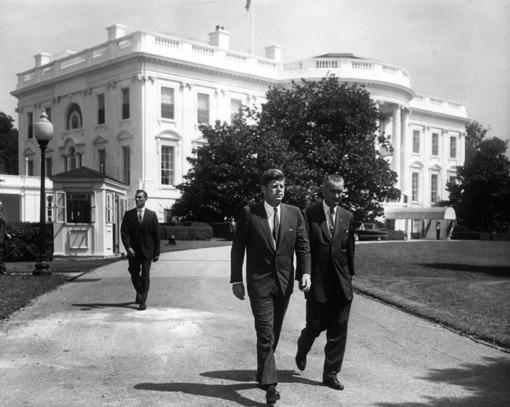
When I launched JFK Facts, a blog about the assassination of President John F. Kennedy, in 2012, I was often asked by strangers, “So who killed JFK?” “I don’t know,” I shrugged. “It’s too early to tell.” Given that the handsome liberal president had been shot dead a half-century before, my answer was a lame joke based on an apocryphal story. Henry Kissinger once said that when he asked Zhou Enlai, “What was the effect of the French Revolution on world history?” the Chinese statesmen replied, “It’s too early to tell.”
True to Kissingerian form, the story turns out to be not exactly true. Zhou was actually responding to a question about France’s political convulsions in 1968, not 1789.
But Kissinger’s spin on the anecdote struck me as perceptive.
The meaning of a great historical event might take a long time–a very long time–to become apparent. I didn’t want to jump to conclusions about the causes of JFK’s murder in downtown Dallas on November 22, 1963.
It’s still too early to tell. Fifty six years after the fact, historians and JFK researchers do not have access to all of the CIA’s files on the subject The 1964 Warren Commission report exonerated the agency with its conclusion that Kennedy was killed by one man alone. But the agency was subsequently the subject of five official JFK investigations, which cast doubt on its findings.
The Senate’s Church Committee investigation showed that the Warren Commission knew nothing of CIA assassination operations in 1963. JFK records released in the last 20 years show the Commission’s attorneys had no real understanding the extensive counterintelligence monitoring of Lee Harvey Oswald before JFK was killed. We now know that senior operations officers, including counterintelligence chief James Angleton, paid far closer attention to the obscure Oswald as he made his way to Dallas than the investigators were ever told.
To be sure, there is no proof of CIA complicity in JFK’s death. And conspiracy theories spouted by the likes of the Alex Jones and James Fetzer deserve no attention. The fact remains some of the most astute power players of 1963–including Lyndon Johnson, Charles DeGaulle, Fidel Castro, and Jackie and Robert Kennedy–concluded that JFK was killed by his enemies, and not by one man alone. Did these statesmen get it wrong, and the under-informed Warren Commission get it right?
The new documentary, Truth is the Only Client, says yes. The film, shown last month in the auditorium of the U.S. Capitol, features interviews with numerous former Warren Commission staffers. Supreme Court Justice Stephen Breyer, who served as a fact checker for the Commission in 1964, defends the lone gunman conclusion, saying, “You have to look at the new evidence and when you do, I come to the same conclusion.”
Justice Breyer, oddly, passes judgment on evidence he has not seen. The record of the CIA’s role in the events leading JFK’s assassination is far from complete. In 2013 I reported on JFK Facts that Delores Nelson CIA’s information coordinator had stated in a sworn affidavit filed in federal court, that the agency retained 1,100 assassination-related records that had never been made public.
A small portion of this material was released in 2017, including new details about the opening of the CIA’s first Oswald file in October 1959.
Yet thousands of JFK files remain secret. According to the latest figures from the National Archives, a total of 15,834 JFK files remain fully or partially classified, most of them held by the CIA and FBI. Thanks to an October 2017 order from President Trump, these documents will not be made public until October 2021, at the earliest.
The assumption of Justice Breyer and many others is that any and all unseen CIA material must exonerate the agency. It’s an odd conclusion. If the CIA has nothing to hide, why is it hiding so much? While 95 percent of the still-secret files probably are trivial, the remaining 5 percent—thousands of pages of material–are historically pregnant. If made public, they could clarify key questions in the long-running controversy about JFK’s death.
These questions have been raised most concisely by Rolf Mowatt-Larssen, a career CIA officer who served in senior positions. Now a senior fellow at Harvard’s Belfer Center, Mowatt-Larssen has implicated his former employer in the Dallas ambush. In a presentation at Harvard last December, Mowatt-Larssen hypothesized that a plot to kill JFK emanated from the CIA’s station in Miami where disgruntled Cuban exiles and undercover officers loathed JFK for his failure to overthrow Castro’s government in Cuba.
Mowatt-Larssen has yet to publish his presentation and documentation, so I can’t say if he’s right or wrong. But he asks the right question: “How can intelligence operational and analytical modus operandi help unlock a conspiracy that has remained unsolved for 55 years?” And he focuses on the right place to dig deeper: the CIA’s Miami office, known as WAVE station.
My own JFK questions involve George Joannides, a decorated undercover officer who served as branch chief in the Miami station in 1963. He ran psychological warfare operations against Cuba. In 2003, I sued the CIA for Joannides’ files. The lawsuit ended 15 years later in July 2018, when Judge Brett Kavanaugh, in his last opinion before ascending to the Supreme Court, tossed my case. Kavanaugh declared the agency deserved “deference upon deference” in its handling of Freedom of Information Act requests about JFK files.
Nonetheless, my lawsuit illuminated the extraordinary sensitivity of the psy-ops Joannides ran out of WAVE station. As reported in the New York Times, Fox News, Associated Press, and Politico, Morley v. CIA forced disclosure of the fact Joannides had received the CIA’s Career Intelligence Medal in 1981. The honor came two years after he stonewalled the House Select Committee on Assassination about what he knew of Oswald’s contacts with pro-and anti-Castro Cubans in the summer and fall of 1963.
I believe Joannides was honored because he concealed the existence of an authorized covert operation involving Oswald that has never been publicly acknowledged. In CIA lingo, Joannides protected the agency’s “sources and methods” concerning Oswald. And he might have done more. His actions may have also shielded other officers who knew of a scheme to kill the liberal president and lay the blame on Cuba.
Never been seen by JFK investigators, they contain details about his Joannides’ undercover work in Miami in 1963, when he funded Oswald’s antagonists among the anti-Castro Cuban exiles. They also detail his work in 1978, when he duped chief investigator Robert Blakey and the House Select Committee on Assassination. These records, the agency says, cannot be released in 2019 without risk of “irreversible harm” to national security.
It’s a bizarre claim, at odds with the law. These ancient documents, all of them more than 40 years old, meet the statutory definition of “assassination-related,” according to federal judge John Tunheim. He chaired the Assassination Records Review Board which oversaw the declassification of 4 million pages of JFK files between 1994 and 2017. In an interview, Tunheim told me that, under the terms of the 1992 JFK Records Act, the Joannides files are subject to mandatory review and release. “It’s a no-brainer,” he said.
Yet the files remain off-limits to the public. Thanks to the legal consensus, articulated by Justices Kavanaugh and Breyer, the CIA enjoys “deference upon deference” when it comes to the JFK assassination story. As a result, the JFK Records Act has been flouted. The public’s interest in full disclosure has been thwarted.
Yet legitimate questions persist: Did a plot to kill JFK originate in the agency’s Miami station as Mowatt-Larssen suggests? The fact that the CIA won’t share the evidence that could answer the CIA man’s question is telling.
So these days, when people ask me who killed JFK, I say the Kennedy was probably victimized by enemies in his own government, possibly including CIA officers involved in anti-Castro and counterintelligence operations. I have no smoking gun, no theory. Just look at the suspicious fact pattern, still shrouded in official secrecy, and it’s easy to believe that JFK was, as Mowatt-Larssen puts it, “marked for assassination.”
* * *
Jefferson Morley is editor of the Deep State blog and author of The Ghost: The Secret Life of CIA Spymaster James Jesus Angleton.