Monday, December 10, 2018

Your Apps Know What You Did Last Night (And They're Not Keeping It Secret)

ORIGINAL LINK

Your wife may not know about those little trips to that Thai massage place in the strip-mall, but your smartphone does - and it may be telling any one of at least 75 companies exactly what time you went, how you got there and where you stopped on the way - with staggering precision to within a few yards, according to the New York Times

The millions of dots on the map trace highways, side streets and bike trails — each one following the path of an anonymous cellphone user.

One path tracks someone from a home outside Newark to a nearby Planned Parenthood, remaining there for more than an hour. Another represents a person who travels with the mayor of New York during the day and returns to Long Island at night.

Yet another leaves a house in upstate New York at 7 a.m. and travels to a middle school 14 miles away, staying until late afternoon each school day. Only one person makes that trip: Lisa Magrin, a 46-year-old math teacher. Her smartphone goes with her.

An app on the device gathered her location information, which was then sold without her knowledge. It recorded her whereabouts as often as every two seconds, according to a database of more than a million phones in the New York area that was reviewed by The New York Times. While Ms. Magrin’s identity was not disclosed in those records, The Times was able to easily connect her to that dot.

The app tracked her as she went to a Weight Watchers meeting and to her dermatologist’s office for a minor procedure. It followed her hiking with her dog and staying at her ex-boyfriend’s home, information she found disturbing. -NYT

"It’s the thought of people finding out those intimate details that you don’t want people to know," said Magrin, whose location data was reviewed by The Times

Several of the 75 companies which collect location data receive anonymous - yet extremely precise location data from users who enable location services for such benign purposes as weather, news and mapping software, according to the Times. Several appmakers have claimed to track up to 200 million mobile devices in the United States alone - around half of the devices in use during 2017.

These companies sell, use or analyze the data to cater to advertisers, retail outlets and even hedge funds seeking insights into consumer behavior. It’s a hot market, with sales of location-targeted advertising reaching an estimated $21 billion this year. IBM has gotten into the industry, with its purchase of the Weather Channel’s apps. The social network Foursquare remade itself as a location marketing company. Prominent investors in location start-ups include Goldman Sachs and Peter Thiel, the PayPal co-founder.

...

More than 1,000 popular apps contain location-sharing code from such companies, according to 2018 data from MightySignal, a mobile analysis firm. Google’s Android system was found to have about 1,200 apps with such code, compared with about 200 on Apple’s iOS.

...

To evaluate location-sharing practices, The Times tested 20 apps, most of which had been flagged by researchers and industry insiders as potentially sharing the data. Together, 17 of the apps sent exact latitude and longitude to about 70 businesses. Precise location data from one app, WeatherBug on iOS, was received by 40 companies. When contacted by The Times, some of the companies that received that data described it as “unsolicited” or “inappropriate.” -NYT

"Location information can reveal some of the most intimate details of a person’s life — whether you’ve visited a psychiatrist, whether you went to an A.A. meeting, who you might date," said Oregon Democratic Senator Ron Wyden, who has proposed bills which would limit the ability of big tech to collect and sell such data. "It’s not right to have consumers kept in the dark about how their data is sold and shared and then leave them unable to do anything about it."

Always watching

Manhattan nurse Elise Lee told the Times she was thoroughly creeped out after she saw that her device had been tracked to the main operating room at the hospital where she works. 

“It’s very scary,” said Ms. Lee, who allowed The Times to examine her location history in the data set it reviewed. “It feels like someone is following me, personally.”

Initially designed to help local businesses market to mobile phone customers, location-based data collection has morphed into a "data collection and analysis machine," reports the Times

Now, retailers are contracting with tracking companies to provide intelligence on their customers and competitors - while financial firms are using the data to make investment decisions. 

For a web seminar last year, Elina Greenstein, an executive at the location company GroundTruth, mapped out the path of a hypothetical consumer from home to work to show potential clients how tracking could reveal a person’s preferences. For example, someone may search online for healthy recipes, but GroundTruth can see that the person often eats at fast-food restaurants.

We look to understand who a person is, based on where they’ve been and where they’re going, in order to influence what they’re going to do next,” Ms. Greenstein said.

Financial firms can use the information to make investment decisions before a company reports earnings — seeing, for example, if more people are working on a factory floor, or going to a retailer’s stores. -NYT

Attorneys are getting in on the tracking game too, as ambulance chasing lawyers can simply purchase emergency room location information according to Long Island advertising firm Tell All Digital, which contracts with a location company to run ad campaigns for personal injury lawyers targeting those who have had unfortunate visits to the hospital. 

"The book ‘1984,’ we’re kind of living it in a lot of ways," said Tell All managing partner Bill Kakis. 

The Weather Channel app - owned by a subsidiary of IBM, told users that sharing their locations would give them "personalized local weather data, alerts and forecasts." In fact, the app also analyzes tracking data for hedge funds in a pilot program which was promoted on the company's website, and which IBM says has ended. They are hiding behind the argument that "other uses" of tracking data is discussed in a separate "privacy settings" area of the app. 

The Times found information on advertising in that section, however found no such notification upon a search of the app. 

"Most people don’t know what’s going on," said data broker Emmett Kilduff, whose company Eagle Alpha sells information to financial firms and hedge funds. He said responsibility for complying with regulations governing data collection fall on the companies which collect it. 

Several people in the location business said that it would be relatively simple to figure out individual identities in this kind of data, but that they didn’t do it. Others suggested it would require so much effort that hackers wouldn’t bother.

It “would take an enormous amount of resources,” said Bill Daddi, a spokesman for Cuebiq, which analyzes anonymous location data to help retailers and others, and raised more than $27 million this year from investors including Goldman Sachs and Nasdaq Ventures. Nevertheless, Cuebiq encrypts its information, logs employee queries and sells aggregated analysis, he said. -NYT

In January, we detailed how interactive online fitness tracking app Strava's online "heatmap" of user routes had unwittingly revealed the location, staffing, patrol routes and layout of U.S. and foreign military bases around the world, as discovered international security researcher Nathan Ruser

In most urban areas such as major cities such as New York, Strava's map appeared as solid neon lights following just about every road on which one might exercise. 

Remote locations, however, such as deserts in places like Syria and Iraq are almost entirely dark aside from clandestine locations where military personnel using fitness trackers are stationed.  Personnel in some of the US government's most sensitive facilities have been unwittingly been broadcasting sensitive information up to and including underground tunnels. 

FBI Academy:

NSA Headquarters:

Cross-referencing @mjranum's recent post about using Google Maps to identify CIA "Black" sites in Djibouti, with the #Strava heat-map, appears to offer corroboration https://t.co/PfXDqRIvSS pic.twitter.com/GlxWOoKWcj

— Alec Muffett (@AlecMuffett) January 28, 2018
The bottom line

Collecting location data is of course all about following the money. App developers can profit from directly selling harvested data, or by sharing it for location-based ads which command a premium. At half a cent to two cents per user per month, an app with 10 million users can generate as much as $2.4 million per year. 

Smaller companies compete for the rest of the market, including by selling data and analysis to financial institutions. This segment of the industry is small but growing, expected to reach about $250 million a year by 2020, according to the market research firm Opimas. -NYT

Google and Facebook are big players in location-based advertising, according to the Times. The companies say they use the data internally to track whether ads lead to sales at brick-and-mortar stores, while Google says it modifies the data to be "less exact." 

Apple and Google, meanwhile, have taken steps to put a leash on the amount of location data collected. In the most recent version of the Android operating system, for example, apps which are not in use are now limited to collecting locations "a few times an hour" as opposed to continuously. Apple has been requiring apps to justify collecting location details in pop-up messages to notify users. That said, the company's instructions for writing the pop-ups do not require disclosing that the data may be used for advertising purposes. 

After learning that her phone was constantly spying on her, the nurse interviewed by the Times, Elise Lee, immediately limited the data which apps could collect on her - and she warned other operating-room nurses to do the same. 

"I went through all their phones and just told them: ‘You have to turn this off. You have to delete this," Lee said. "Nobody knew."


via IFTTT

Sunday, December 9, 2018

The Deathly Insect Dilemma. “It is not Normal for 50%-to-90% of a Species to Drop Dead”

ORIGINAL LINK
Global Research, December 08, 2018
CounterPunch 7 December 2018
insect2)

Insect abundance is plummeting with wild abandon, worldwide! Species evolve and go extinct as part of nature’s normal course over thousands and millions of years, but the current rate of devastation is off the charts and downright scary.

Moreover, there is no quick and easy explanation for this sudden emergence of massive loss around the globe. Yet, something is dreadfully horribly wrong. Beyond doubt, it is not normal for 50%-to-90% of a species to drop dead, but that is happening right now from Germany to Australia to Puerto Rico’s tropical rainforest.

Scientists are rattled. The world is largely unaware of the implications because it is all so new. It goes without saying that the risk of loss of insects spells loss of ecosystems necessary for very important stuff, like food production.

Farmland birds that depend upon a diet of insects in Europe have disappeared by >50% in just three decades. French farmland partridge flocks have crashed by 80%. Nightingale abundance is down by almost 80%. Turtledoves are down nearly 80%.

In Denmark (1) owls, (2) Eurasian hobbies, and (3) Bee-eaters, which subsist on large insects like beetles and dragonflies, have abruptly disappeared. Poof, gone!

Krefeld Entomological Society (est. 1905) in Germany trapped insect samples in 63 nature preserves in Europe representing nearly 17,000 sampling days (equivalent to 46.5 years). Krefeld consistently found massive declines in every kind of habitat they sampled. Up to 80% wipeouts.

As for one example, Krefeld data for hoverflies, a pollinator often mistaken for a bee, registered 17,291 hoverflies from 143 species trapped in a reserve in 1989. Twenty-five years later at the same location, 2,737 individuals from 104 species or down 84%. (Source: Gretchen Vogel, Where Have All The Insects Gone? Science Magazine, May 10, 2017)

A shortage of insect pollinators in the Maoxian Valley in China has forced farmers to hire human workers at $19 per worker/per day to replace bees. Each worker pollinates 5-to-10 apple trees by hand per day.

Jack Hasenpusch of Australian Insect Farms, which collects swarms of insects, says:

 “I’ve been wondering for the last few years why some of the insects have been dropping off … This year has really taken the cake with the lack of insects, it’s left me dumbfounded, I can’t figure out what’s going on.” (Source: Mark Rigby, Insect Population Decline Leaves Australian Scientists Scratching For Solutions, ABC Far North, Feb. 23, 2018)

According to entomologist Dr. Cameron Webb / University of Sydney, researchers around the world widely acknowledge the problem of insect decline but are at a loss to explain the causes.

Functional Extinctions

Today’s Sixth Extinction is so prevalent that scientists prefer to designate species loss as “functional extinctions,” which means functionally extinct animals and plants are still present but no longer prevalent enough to affect an ecosystem. Not only, seed dispersal and predation and pollination and other ecological functions are also lost.

“More than three-quarters of the world’s food crops rely at least in part on pollination by insects and other animals,” (Source: Pollinators Vital to Our Food Supply Under Threat, FAO/UN).

But, already some insect populations have dropped by as much as 90%, e.g., (1) the Monarch butterfly in North America and (2) the great yellow bumblebee in Europe.

One of the biggest drivers of decline is loss of wild flowers. Here’s the problem: Low-intensity farming of small fields lined with weeds and flowers (think: “American Gothic” by Grant Wood circa 1930) have been overrun by vast industrial crop monocultures with fields stretching to the distant horizon with not a weed or a flower in sight, which paradoxically serves as evidence that the overused maxim “the good ole days” shows true grit.

Additionally, herbicides like glyphosate (Roundup) allow industrial farming to grow perfect monocultures of crops, as everything else is wiped out. But, where does the glyphosate ultimately go? Breakfast anyone?

The world is rapidly filling up to its brim with insecticides that are toxic to pollinators. For example, neonicotinoids (agricultural insecticides) are meant to kill specific insect pests but invariably get into plant tissue and nectar and pollen and kills insects carte blanche, across the board. Thus, ironically, farmland ecosystems are poisoned by industrial farming practices.

Neonicotinoids are a divisive issue worldwide:

“The European Union today expanded a controversial ban of neonicotinoid pesticides, based on the threat they pose to pollinators. The decision pleased environmental groups and was greeted with trepidation by farming associations, which fear economic harm.” (Source: European Union Expands Ban of Three Neonicotinoid Pesticides, Science Magazine, April 27, 2018)

As of August 2018, the EPA has scheduled “planned completion” of a “Review of Neonicotinoid Pesticides” for sometime in 2019. A coalition of food safety and environmental groups delivered 219,210 public comments to EPA earlier in the year, urging the agency ban neonicotinoid pesticides, which they view as a leading cause of pollinator decline. Additionally, more than 4.4 million Avaaz members have called for a ban on neonics (Avaaz, est. 2007, is one of the world’s largest most powerful online activist networks).

“People from around the country have made it clear: The EPA must act now to save our pollinators. No matter what Scott Pruitt’s industry friends say, this is a problem we can’t ignore. The health of our food system depends on it,” said U.S. Representative Earl Blumenauer (D-OR). (Source: Environment America, News Release, 219,210 Americans Call on EPA to Ban Bee-Killing Pesticides, April 21, 2018).

“Neonics are 5,000 to 10,000 times more toxic than DDT,” according to Jean-Marc Bonmatinof of The National Centre for Scientific Research in France,” Ibid.

Rachel Carson (Silent Spring, 1962) would be horrified. As far back as the 60s she warned about indiscriminate use of pesticides and accused the chemical industry of disinformation, and she scolded public officials for accepting the chemical industry’s claims; ultimately, her efforts led to a nationwide ban on DDT and inspiration for creation of the EPA. (The ban on DDT saved America’s national bird since 1782, the bald eagle.)

Similar to concerns about use of synthetic pesticides, sensitivity of insects to global warming has only recently been exposed in new studies published in the Proceedings of the National Academy of Sciences, showing alarming losses of insects in pristine tropical rainforests over a multi-decade study that has rocked the science world.

Over that same 40-year time period, the average high temperature in the rainforest increased by 4 degrees Fahrenheit. Which negatively impacts insects because after a certain thermal threshold insects will no longer lay eggs, and their internal chemistry breaks down.

“Without insects and other land-based arthropods, EO Wilson, the renowned Harvard entomologist, and inventor of sociobiology, estimates that humanity would last all of a few months,” Ibid.

Well then, the number of insects still out there qualifies as one of the most puzzling questions of the 21st century.

Postscript: “Our planet is now in the midst of its sixth mass extinction of plants and animals — the sixth wave of extinctions in the past half-billion years. We’re currently experiencing the worst spate of species die-offs since the loss of the dinosaurs 65 million years ago. Although extinction is a natural phenomenon, it occurs at a natural “background” rate of about one to five species per year. Scientists estimate we’re now losing species at 1,000 to 10,000 times the background rate, with literally dozens going extinct every day.” (Source: The Extinction Crisis, Center for Biological Diversity, biologicaldiversity.org) Whew!

*

Note to readers: please click the share buttons above. Forward this article to your email lists. Crosspost on your blog site, internet forums. etc.

Robert Hunziker lives in Los Angeles and can be reached at rlhunziker@gmail.com.

Featured image is from Ryan McGuire | CC BY 2.0

The original source of this article is CounterPunch
Copyright © Robert HunzikerCounterPunch, 2018


https://www.globalresearch.ca/the-deathly-insect-dilemma-it-is-not-normal-for-50-to-90-of-a-species-to-drop-dead/5662215


via IFTTT

Thursday, December 6, 2018

FBI Knew Steele Dossier Was Bogus Before Using In FISA Application: Solomon

ORIGINAL LINK

A string of emails quietly requested by House Republicans for declassification by President Trump may be the smoking gun that the FBI and DOJ committed egregious abuses of the Foreign Intelligence Surveillance Act (FISA), according to The Hill's John Solomon. 

The email exchanges - kept from Congressional investigators for over two years, "included then-FBI Director James Comey, key FBI investigators in the Russia probe and lawyers in the DOJ’s national security division," according to the report - and took place in early to mid-October of 2016, prior to the FBI successfully securing a FISA warrant to spy on Trump campaign adviser Carter Page. 

The email exchanges show the FBI was aware — before it secured the now-infamous warrant — that there were intelligence community concerns about the reliability of the main evidence used to support it: the Christopher Steele dossier.

The exchanges also indicate FBI officials were aware that Steele, the former MI6 British intelligence operative then working as a confidential human source for the bureau, had contacts with news media reporters before the FISA warrant was secured. -The Hill

Two weeks after the FBI secured the FISA warrant using the Steele Dossier, Steele was fired by the FBI on November 1, 2016 for inappropriate communications with the news media. 

Also withheld from both Congress and the general public until months later is the fact that Steele had been paid by Fusion GPS - an opposition research firm hired by Hillary Clinton and the DNC to dig up dirt on Donald Trump. Moreover, Steele absolutely hated Donald Trump. 

And as Solomon notes; "If the FBI knew of his media contacts and the concerns about the reliability of his dossier before seeking the warrant, it would constitute a serious breach of FISA regulations and the trust that the FISA court places in the FBI."

That’s because the FBI has an obligation to certify to the court before it approves FISA warrants that its evidence is verified, and to alert the judges to any flaws in its evidence or information that suggest the target might be innocent. -The Hill

The FBI, however, went to extreme lengths to convince the FISA judge that Steele ("Source #1"), was reliable when they could not verify the unsubstantiated claims in his dossier - while also having to explain why they still trusted his information after having terminated Steele's contract over inappropriate disclosures he made to the media.

"Not withstanding Source1's reason for conducting the research into Candidate1's ties to Russia, based on Source1's previous reporting history with the FBI, whereby Source1 provided reliable information to the FBI, the FBI believes Source 1s reporting herein to be credible

On top of that, Bill Priestap told Congress that corroboration of the dossier was in its "infancy" when FISAs were being granted. An FBI unit found dossier was only "minimally" corroborated.

— Chuck Ross (@ChuckRossDC) July 22, 2018

Of course, none of this mattered to the FBI - which painted Carter Page in the most criminal light possible, as intended, in order to convince the FISA judge to grant the warrant. In order to reinforce their argument, the FBI presented various claims from the dossier as facts, such as "The FBI learned that Page met with at least two Russian officials" - when in fact that was simply another unverified claim from the dossier.

It flat out accuses Page of being a Russian spy who was recruited by the Kremlin, which sought to "undermine and influence the outcome of the 2016 U.S. presidential election in violation of U.S. criminal law," the application reads.

ALERT: The declassified FBI warrant application attests to secret FISA court that "THE FBI LEARNED that Page met with at least two Russian officials during the trip,"as if FBI learned this independently,when in fact it's clear it relied on Clinton-paid dossier for the information

— Paul Sperry (@paulsperry_) July 22, 2018

FBI represented to a federal judge that investigators knew for certain that Carter Page met w/ Igor Sechin and Diveykin. Except, the FISA app acknowledges this intel came from Steele dossier. And FBI has acknowledged dossier was not verifieid. https://t.co/7ZstgwlVOh pic.twitter.com/NDYvBIhXB0

— Chuck Ross (@ChuckRossDC) July 21, 2018

Another approach used to beef up the FISA application's curb appeal was circular evidence, via the inclusion of a letter from Democratic Senate Minority Leader Harry Reid (NV) to former FBI Director James Comey, citing information Reid got from John Brennan, which was in turn from the Clinton-funded dossier

BREAKING: FBI's FISA warrant actually cites as "evidence" to spy on Carter Page/Trump campaign "Senate Minority Leader" Harry Reid's 2016 letter to Comey citing information he got from John Brennan who got it from the Clinton dossier -- talk about circular evidence!

— Paul Sperry (@paulsperry_) July 22, 2018

Meanwhile - current and former members of the US intelligence community continue to hinge their theories of Trump-Russia collusion on the Steele Dossier, despite Comey admitting that it was "salacious" and "unverified" during sworn testimony. 

Most intelligence officials, such as former CIA Director John Brennan and former Director of National Intelligence James Clapper, have embraced the concerns laid out in the Steele dossier of possible — but still unproven — collusion between the Trump campaign and Russia.

Yet, 10 months after the probe started and a month after Robert Mueller was named special counsel in the Russia probe, Comey cast doubt on the the Steele dossier, calling it “unverified” and “salacious” in sworn testimony before Congress.

Former FBI lawyer Lisa Page further corroborated Comey’s concerns in recent testimony before House lawmakers, revealing that the FBI had not corroborated the collusion charges by May 2017, despite nine months of exhaustive counterintelligence investigation. -The Hill

Congressional investigators now want to question Comey about the October email string and whether it contributed to his assessment. According to Solomon, the newly requested email chain "provides the most direct evidence that the bureau, and possibly the DOJ, had reasons to doubt the Steele dossier before the FISA warrant was secured." 

"If these documents are released, the American public will have clear and convincing evidence to see the FISA warrant that escalated the Russia probe just before Election Day was flawed and the judges [were] misled," one source told Solomon. 

What's more, House GOP investigators now have a growing pile of evidence that some of the information inserted into a fourth and final application for the FISA - signed by Deputy Attorney General Rod Rosenstein, was suspect - as evidence by hints by House Intelligence Committee member Devin Nunes (R-CA) on Fox News's Sean Hannity TV show November 20. Nunes said that the declassification of the requested documents will "give finality to everyone who wants to know what their government did to a political campaign."

As Solomon bluntly puts it: 

The bureau, under a Democratic-controlled Justice Department, sought a warrant to spy on the duly nominated GOP candidate for president in the final weeks of the 2016 election, based on evidence that was generated under a contract paid by his political opponent.

That evidence, the Steele dossier, was not fully vetted by the bureau and was deemed unverified months after the warrant was issued.

At least one news article was used in the FISA warrant to bolster the dossier as independent corroboration when, it fact, it was traced to a news organization that had been in contact with Steele, creating a high likelihood it was circular intelligence reporting.

And the entire warrant, the FBI’s own document shows, was being rushed to approval by two agents who hated Trump and stated in their own texts that they wanted to “stop” the Republican from becoming president.

 No wonder Comey wanted a public testimony - where he wouldn't have to discuss any of this. 


via IFTTT

Why Can The CIA Assassinate People?

ORIGINAL LINK

Authored by Jacob Hornberger via The Future Of Freedom Foundation,

Given that we have all been born and raised under a regime that has the CIA, hardly anyone questions the power of the CIA to assassinate people.

The CIA’s power of assassination has become a deeply established part of American life.

Yet, the Constitution, which called the federal government into existence and established its powers, does not authorize the federal government to assassinate people.

If the proponents of the Constitution had told the American people that the Constitution was bringing into existence a government that wielded the power to assassinate people, there is no way that Americans would have approved the deal, in which case they would have continued operating under the Articles of Confederation.

Under the Articles, the powers of the federal government were so weak, it didn’t even have the power to tax, much less the power to assassinate people. That’s because our American ancestors wanted it that way. The last thing they wanted was a federal government with vast powers.

In fact, the purpose of the Constitutional Convention was simply to amend the Articles of Confederation. During the 13 years of operating under the Articles, problems had arisen, such as trade wars between the states. The convention was intended to fix those problems with amendments to the Articles.

Instead, the delegates came out with an entirely different proposal, one that would call into existence a federal government that had more powers, including the power to tax.

Americans were leery. The last thing they wanted was a powerful central government. They had had enough of that type of government as British citizens under the British Empire. They believed that the biggest threat to people’s freedom and well-being lay with their own government. They believed that if they approved a federal government, it would become tyrannical and oppressive, like other governments had done throughout history.

They were especially concerned with the power of the government to murder people, including citizens. They knew that state-sponsored murder was the ultimate power in any tyrannical regime. When a government can kill anyone it wants with impunity, all other rights are effectively nullified. And our ancestors were sufficiently well-versed in history to know that tyrannical regimes were notorious for killing their own citizens, especially those people who challenge, criticize, or object to the tyranny.

The proponents of the Constitution told Americans that they had nothing to be concerned about. The Constitution wasn’t calling into existence a government with general powers to do anything it wanted. Instead, by the terms of the document that would be calling the federal government into existence, its powers would be limited to the few powers that were enumerated within the document. Thus, if a power wasn’t enumerated, it didn’t exist and, therefore, couldn’t be exercised. Since the Constitution wasn’t giving the federal government the power to murder people, it couldn’t exercise that power.

On that basis, our American ancestors approved the deal, but only on the condition that the Constitution would be immediately amended after approval with a Bill of Rights. To make sure that federal officials understood that they didn’t have the power to murder people, the Fifth Amendment was enacted. It prohibited the federal government from killing people without first according them due process of law. It’s worth noting that the protections of the Fifth Amendment are not limited to American citizens. The Amendment prohibits the federal government from murdering anyone, including people who are not U.S. citizens.

What is due process of law? It’s a phrase that stretches all the way back to Magna Carta in 1215, when the barons of England forced their king to acknowledge that his powers over them were limited. Magna Carta prohibited the king from killing British citizens in violation of the “law of the land,” a phase that evolved over the centuries into “due process of law.”

Essentially, due process means notice and hearing. It says to the government: “You cannot kill anyone unless you first give him formal notice of the particular criminal offense that you are claiming warrants killing him.” Then, after notice, there has to be fair trial in which the accused has the right to be heard. The Sixth Amendment ensured that people would have the right of trial by jury because our ancestors didn’t trust judges or tribunals.

And so it was that the American people lived in a society for more than 150 years in which the federal government lacked the power to assassinate people, which is really just a fancy word for murder. A governmental assassination is the state-sponsored killing of a person without notice and trial — that is, without due process of law.

The situation changed after World War II, when the federal government, in a watershed event, was converted from a limited-government republic into what is known as a “national-security state,” a type of governmental system that is inherent to totalitarian regimes. U.S. officials maintained that the conversion was necessary in order to confront the Soviet Union, a communist state, which itself was a national-security state. The idea was that in order to defeat the Soviet Union in the Cold War, it would be necessary for the United States to adopt, temporarily, its same type of national-security state system.

In 1947, the CIA was called into existence as part of this new national-security state. President Truman, the president who was responsible for the federal government’s conversion to a national-security state, intended for the CIA to be strictly an intelligence-gathering agency. But someone slipped a bit of nebulous language into the law that called the CIA into existence, which the CIA seized upon to justify the adoption of omnipotent powers, including the power to assassinate people with impunity, so long as the assassination was to protect “national security.” Needless to say, the CIA had the omnipotent power to make that determination.

As monumental as the conversion to a national-security state was, it was not done through a constitutional amendment. The Constitution continued to be the supreme law that governed the operations of the federal government, including the CIA. Thus, since the Constitution did not give the federal government the power to assassinate people and since the Fifth Amendment expressly prohibited the federal government from assassinating people, the U.S. Supreme Court and the rest of the federal judiciary had the responsibility to declare the CIA’s power to assassinate people unconstitutional.

Unfortunately, however, in a national-security state power is everything and especially omnipotent power. Recognizing that as a practical matter, there would be no way that the federal judiciary could keep the CIA from assassinating people in the name of protecting “national security,” the federal courts went silent or even supportive.

In 1989 the Cold War ended. Yet, we still have a national-security state and we still have a CIA with the power to assassinate people, including Americans. Why is that?


via IFTTT

Wednesday, December 5, 2018

MSM Is Getting Weirder, More Frantic, And More Desperate By The Day

ORIGINAL LINK

When even the Washington Post is saying your Russiagate article is bad journalism, your Russiagate article is really, really bad journalism.

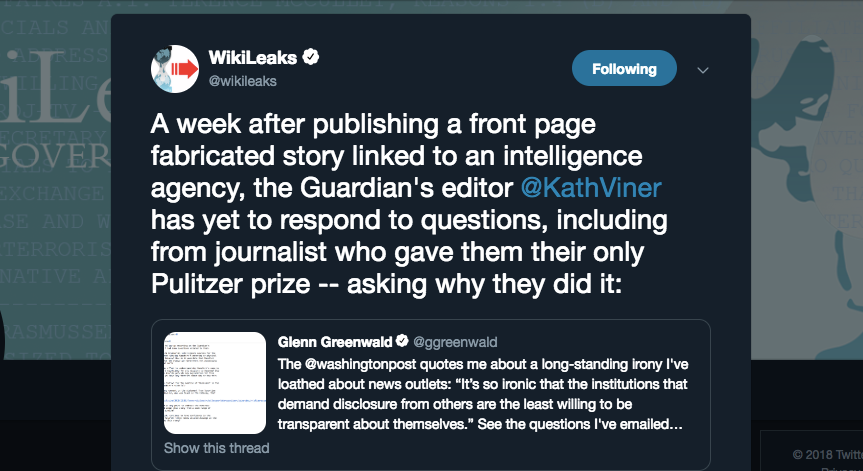
In an article titled “The Guardian offered a bombshell story about Paul Manafort. It still hasn’t detonated.”, WaPo writer Pul Farhi draws attention to the fact that it has been a week since the Guardian published a claim that former Trump campaign manager Paul Manafort met repeatedly with WikiLeaks founder Julian Assange, without any evidence backing up the claim, using solely anonymous sources, and despite the claims contradicting known records of Assange’s guests at the Ecuadorian embassy. Criticism and demands for answers have been growing louder and louder from both friends and enemies of WikiLeaks, with new plot holes opening up in the Guardian’s narrative daily, and the scandal is now moving into mainstream awareness.

And the Guardian remains silent, with its editor-in-chief Katharine Viner refusing to utter so much as a peep of defense this entire time. The only comment the publication has issued has been repeated day after day verbatim to every news outlet which writes about this bizarre occurrence: “This story relied on a number of sources. We put these allegations to both Paul Manafort and Julian Assange’s representatives prior to publication. Neither responded to deny the visits taking place. We have since updated the story to reflect their denials.” Which is basically just implying that they can print any libelous nonsense they want about anyone if their denials aren’t sent to the proper email address on time.

This, clearly, is bananas.

Do these establishment smear merchants not realize how creepy, desperate and frantic they make themselves look when they crank out these hit pieces on anti-imperialist voices? This one HuffPo editor writes this empire smut all the time and doesn't even notice how freaky it looks. https://t.co/RQZFKxgsm2

 — @caitoz

The Huffington Post has just published yet another brazen hit piece on University of Sheffield professor Piers Robinson. And when I say brazen, I mean really goddamn brazen. The entire article consists of nothing but senior HuffPo editor Chris York meticulously documenting the fact that a university professor is “heavily critical of western governments and media” who expresses skepticism of establishment narratives around 9/11, Syria, and Russia, and suggesting that it is bad and wrong for a university to employ anyone with dissenting views.

Even for a hit piece the article feels incredibly forced, ham-fisted and desperate. Reading it gives you the feeling as if York is leaning way into your personal space, pressing his face against your ear, and saying “You are not to believe the things that horrible man says about what is happening in your world. I will tell you what you are to believe about those controversial events. Big Brother is your friend. You love Big Brother.”

Which would be weird enough even without the fact that York has been personally targeting Robinson and other anti-imperialist voices with identical hit pieces over and over and over again this year. A senior HuffPo editor has published hit piece after hit piece after hit piece against a small group of academics and reporters who have very little influence compared to a mass media outlet, but still far too much for a virulent empire sentry like York.

And this is just what’s happening today. For the last two years the mass media machine has been behaving very, very strangely, and it isn’t getting better, it’s getting worse. Not since the lead-up to the invasion of Iraq have we seen mainstream media outlets trying to shove narratives down our throats so desperately and aggressively, and even then they were doing it for one very specific purpose.

This time around things are less clear-cut. I do not subscribe to the belief that the shift in behavior of the media is due to an establishment hatred of Trump; despite the rhetoric and the narratives, Trump has been protecting establishment interests just as reliably as his predecessors, and everyone who knows anything about Russiagate knows that it will never lead to the removal of Trump from office. A much more logical explanation is the need to manufacture support for the geopolitical agenda of isolating Russia and shoving it off the world stage to stop it from protecting China’s rise to superpower status, and in cold war the use of propaganda becomes even more important than in hot war. But I also think there’s more to it than that. I think a large part of the frantic urgency that we are seeing from the establishment propaganda machine is nothing other than an attempt to regain control of the narrative.

In 2016, for the first time ever, some things didn’t go as scripted for the propagandists and manipulators who pace the public into going along with plans laid that they never voted for by people they did not elect. Widespread internet access, alternative media, WikiLeaks, and discontent with the status quo converged and danced in such a way with one another in 2016 that a large number of people realized that the talking heads on their TV screens are lying to them all the time. An unacceptably large number of people.

Whoever controls the narrative controls the world. The unelected power establishment which rules over us depends on narrative control in order to rule, and if people do not trust the plutocrat-owned talking heads who are telling them what narratives to believe, there can be no control. In France we’ve been seeing uncontrollable protesters from across the political spectrum writing “We’ve chopped off heads for less than this” in graffiti on the Arc de Triomphe, which you may be certain has widened plutocratic eyes all around the world.

And that, I believe, is why the mass media has been behaving so strangely. For two years they have been reaching and leaning all over the place trying to regain control of the narrative like a novice ice skater trying to regain balance, and they are only getting closer to falling. Which probably makes the present moment the perfect time to give them a good shove. Spread truth about the mass media’s deceptions like the Guardian’s psyop against WikiLeaks, wake people up to what they’re trying to accomplish by herding people into partisan echo chambers, arresting Assange, censoring the internet, and marginalizing alternative media which provides dissident narratives.

The only thing keeping the many from rising like lions against the few to create a new world which benefits everyone is the establishment propaganda machine, and right now it is wildly off balance. Shove hard, and don’t stop shoving until it falls.

Arc de Triomphe still covered in graffiti this morning: 'We've chopped off heads for less than this' , 'Topple the Bougeoisie' , 'May 1968 December 2018'

 — @achrisafis

________________________

Thanks for reading! The best way to get around the internet censors and make sure you see the stuff I publish is to subscribe to the mailing list for my website, which will get you an email notification for everything I publish. My articles are entirely reader-supported, so if you enjoyed this piece please consider sharing it around, liking me on Facebook, following my antics on Twitter, throwing some money into my hat on Patreon or Paypal, buying my new book Rogue Nation: Psychonautical Adventures With Caitlin Johnstone, or my previous book Woke: A Field Guide for Utopia Preppers.

Bitcoin donations:1Ac7PCQXoQoLA9Sh8fhAgiU3PHA2EX5Zm2

stat?event=post.clientViewed&referrerSou

via IFTTT

Controversial Event Featuring Pro-Assad Speakers Cancelled By Leeds Council

https://www.huffingtonpost.co.uk/entry/media-on-trial-leeds-cancel-syria_uk_5aeafb68e4b00f70f0efda75

The View from the Trenches of the Alternative Media

ORIGINAL LINK
What's scarce in a world awash in free content and nearly infinite entertainment content?
After 3,701 posts (from May 2005 to the present), here are my observations of the Alternative Media from the muddy trenches.
It's increasingly difficult to make a living creating content outside the corporate matrix. The share of advert revenues paid to content creators / publishers has declined precipitously, shadow banning has narrowed search and social media exposure and the expansion of free content and competing subscription-based publishing has made subscription services an increasingly tough sell.
The most effective ways to silence critics and skeptics is to 1) de-monetize their sites / platforms and 2) restrict their access to the public via shadow banning and search algorithm "adjustments." The two are related, of course; as audiences dwindle, so do revenues and opportunities to sell subscriptions or promote patronage.
The corporate media's lumping of all alternative media in with "fake news" and troll-farms has intentionally tarnished all alternative media, as undermining independent journalism and commentary is an essential part of unifying public opinion behind "approved" ideologically uniform narratives.
Significant swaths of the public get their "news" and commentary solely from social media (Facebook and Twitter, and to a lesser degree, Instagram) or a handful of corporate media (which included PBS/NPR). As these channels limit / delegitimize alternative media voices, the public's access to alternative analysis and commentary diminishes even further.
A few quasi-monopolistic corporations have effectively become gatekeepers: what's approved is allowed to be viewed / heard / read, what raises eyebrows effectively disappears.
It's become increasingly difficult to make a living writing books. Advances for established authors have fallen from $10,000 or $20,000 to $2,500 or $1,000, and in the academic publishing world, $1,000 may be the entire sum paid to the author for writing a book.
Are people reading fewer books as video and entertainment content expand exponentially? Perhaps. Or are people reading whatever is free rather than buying ebooks/print books? There are likely multiple factors at work, but the bottom line is the Pareto Distribution is visible in the "long tail" of thousands of content creators who receive very little in the way of earnings and a handful at the top of the distribution who capture the lion's share of all royalties and other income.
What's scarce in a world awash in free content and nearly infinite entertainment content? Fresh, independent insight is eternally scarce, and in a world in which almost everyone is selling a cover story to secure their spot at the corporate-state trough (or win the approval of their social-media "tribe"), authenticity is also scarce.
The economic-financial value of insight and authenticity are unknown; the market doesn't price these as it does commodities such as "news". It's left to individuals to assess and establish the economic-financial value independent journalism and commentary.
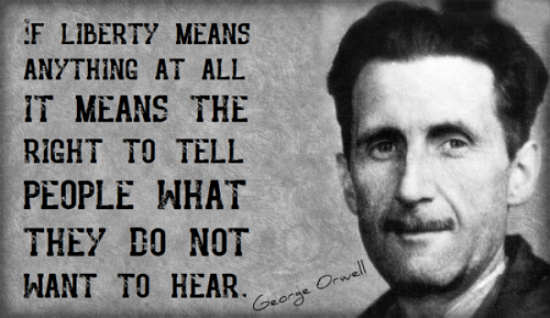
orwell-liberty.png
My new book Pathfinding our Destiny is available at a discount for the ebook and the print edition through December 15 ($5.95 ebook, $10.95 print). Read the first section for free in PDF format.


My new mystery The Adventures of the Consulting Philosopher: The Disappearance of Drake is a ridiculously affordable $1.29 (Kindle) or $8.95 (print); read the first chapters for free (PDF)
My book Money and Work Unchained is now $6.95 for the Kindle ebook and $15 for the print edition. Read the first section for free in PDF format.
My new book Pathfinding our Destiny: Preventing the Final Fall of Our Democratic Republic is discounted ($5.95 ebook, $10.95 print): Read the first section for free in PDF format.


If you found value in this content, please join me in seeking solutions by becoming a $1/month patron of my work via patreon.com.

NOTE: Contributions/subscriptions are acknowledged in the order received. Your name and email remain confidential and will not be given to any other individual, company or agency.
Thank you, J.P. B. ($5/month), for your wondrously generous pledge to this site -- I am greatly honored by your support and readership.
 
Thank you, Erle H. ($52), for your outstandingly generous contribution to this site -- I am greatly honored by your steadfast support and readership.
Go to my main site at www.oftwominds.com/blog.html for the full posts and archives.


via IFTTT

Monday, December 3, 2018

Top Ecuadorian Diplomat Destroys Guardian's Claim That Manafort Visited Assange

ORIGINAL LINK

A former consul and first secretary at the Ecuadorian embassy in London has put the final nail in the coffin of credibility for The Guardian, refuting the paper's fantastical and wholly unsupported claim that former Trump campaign manager Paul Manafort visited WikiLeaks founder Julian Assange in 2013, 2015 and the spring of 2016 - a charge vehemently denied by all parties involved. 

Fidel Narváez - who worked at Ecuador's London embassy from 2010 - 2018 has told The Canary that The Guardian's claim is entirely falseThe Canary has also reviewed a copy of correspondence between the Guardian and Narváez in which he makes a formal complaint accusing the paper of fabricating an earlier story about a Kremlin plot to smuggle Assange to Russia. 

Both WikiLeaks and Manafort have said they plan to sue The Guardian over the publication, with Manafort slamming the report as "totally false and deliberately libellous." 

Narváez - initially consul and then first secretary at the embassy, told the Canary that to his knowledge, Manafort never visited the embassy while he was employed there. What's more, his account supports points made by The Intercept's Glenn Greenwald about visitation rights at the embassy. 

It is impossible for any visitor to enter the embassy without going through very strict protocols and leaving a clear record: obtaining written approval from the ambassador, registering with security personnel, and leaving a copy of ID. The embassy is the most surveilled on Earth; not only are there cameras positioned on neighbouring buildings recording every visitor, but inside the building every movement is recorded with CCTV cameras, 24/7. In fact, security personnel have always spied on Julian and his visitors. It is simply not possible that Manafort visited the embassy.

The Guardian responded to Narváez's comments, stating: 

"This story relied on a number of sources. We put these allegations to both Paul Manafort and Julian Assange’s representatives prior to publication. Neither responded to deny the visits taking place. We have since updated the story to reflect their denials."

This answer is counter to a statement made by Manafort following the story's publication, in which he said "We are considering all legal options against the Guardian who proceeded with this story even after being notified by my representatives that it was false." 

Furthermore, Manafort's passport stamps also refute the Guardian's reporting, after the Washington Times reported that Manafort's three passports reveal just two visits to England in 2010 and 2012, which support his categorical denial of the "totally false and deliberately libelous" report in The Guardian, which said that Manafort visited Assange in the Ecuadorian Embassy - ostensibly to coordinate on the WikiLeaks release of Hillary Clinton's emails. 

WikiLeaks, meanwhile, bet The Guardian "a million dollars and its editor's head that Manafort never met Assange." 

This is going to be one of the most infamous news disasters since Stern published the "Hitler Diaries".

— WikiLeaks (@wikileaks) November 27, 2018

No word on whether they've taken the organization up on its offer. 


via IFTTT

National Self-Perception - International Man

https://internationalman.com/articles/national-self-perception/