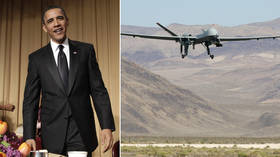
Former US President Barack Obama has sparked an anti-war backlash after saying in his new memoir he “took no joy” in ordering deadly drone strikes, reasoning that his administration “couldn't afford to look soft on terrorism.
ORIGINAL LINK

Seeking Truth in a World of Propaganda. Links do not necessarily indicate agreement with stories or perspectives.
“Those who are able to see beyond the shadows and lies of their culture will never be understood, let alone believed, by the masses.” - Plato

Authored by Debra Heine via American Greatness (emphasis ours),
Dominion Voting Systems Thursday night abruptly backed out of attending a fact-finding hearing that was set for Friday morning with the Pennsylvania House State Government Committee.
At a press conference Friday morning, State Govt Committee Chair Seth Grove said the 1.3. million Pennsylvanians who used Dominion’s voting machines have been “hung out to dry and slapped in their faces.”
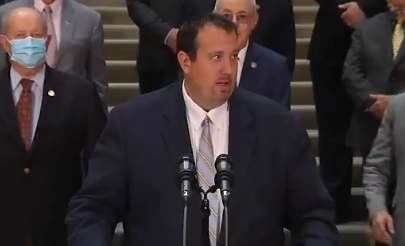
Pennsylvania lawmakers had scheduled the hearing with the voting machine manufacturer “to help identify and correct any irregularities in the election process,” according to the House Republican Caucus.
“It is vitally important voters have faith in the machines they use to cast their ballots. On the heels of Gov. Tom Wolf unilaterally decertifying every voting machine in the Commonwealth, we need to know whether these new machines met expectations, whether they are reliable and whether they are not subject to interference,” said Rep. Grove (R-York).
Dominion had initially agreed to attend the hearing, before it “abruptly canceled,” Grove said.
“I was impressed at what appeared to be the willingness that Dominion Voting Systems to address accusations and it would have put 1.3. million Pennsylvanians who used their machines at ease—including myself, thinking that Dominion was willing to publicly back up their product which PA taxpayers invested millions to purchase” he noted during the presser.
“Unfortunately, last evening, Dominion Voting Systems lawyered up, and backed out of their commitment to the people of Pennsylvania to provide their input in a public format.”
Grove blasted the company for “retreating into the darkness,” rather than appearing at the hearing with “honesty and integrity.”
The committee chair said he wanted to know why a company with nothing to hide would back out.
“Why would a vender of public goods fear discussing their product sold to the public for the public good? If Dominion’s products were successful and operated as they were supposed to, why wouldn’t Dominion take the opportunity to publicly review its success?” Grove demanded. “How hard is it to say, ‘our ballot machines worked exactly as promised and they’re 100 percent accurate’?”
“After weeks of accusations, why has Dominion Voting Systems not released any analysis of the success of its voting machines to the public in order to stop their accusers in their tracks? If they have nothing to hide, why are they hiding from us?” he asked.
“Today I am saddened to report to the taxpayers of Pennsylvania and the 1.3 million voters who trusted Dominion Voting Systems with their ballots, that Dominion Voting Systems has hung you out to dry and slapped you in your faces.” the committee chair declared.
Grove stated that Dominion’s behavior lent credibility to their accusers’ accusations.
#PAHouse State Govt Cmte Chair Seth Grove details how Dominion Voting Systems were used by 1.3 million PA'ns in 2020 General Election. 19% of the total votes cast in PA's 2020 General Election were cast on Dominion's systems. Dominion abruptly canceled today's hearing. pic.twitter.com/Qt4DAyYDzE
— PA House Republicans (@PAHouseGOP) November 20, 2020
Rep. Dawn Keefer noted that fourteen counties used the Dominion Voting Systems software, so they owe it to Pennsylvania voters to show up and answer some questions.
“We trust the workers in our polling places and in our counties,” Keefer said. “But what we don’t know is the role of 3rd party companies. And when they rescind their participation in our hearing, we’re left wondering why.”
Keefer added: “Transparency is key for our election security. Dominion Voting Software is asking us to give them only blind trust. We’re very disappointed in Dominion’s last minute cancellation in today’s hearing.
Transparency is key for our election security. Dominion Voting Software is asking us to give them only blind trust. We’re very disappointed in Dominion’s last minute cancelation in today’s hearing.”
Rep. Dawn Keefer details questions #PAHouse is left with after Dominion Voting Systems abruptly canceled their participation in this morning's hearing. pic.twitter.com/dWRPpDnPxq
— PA House Republicans (@PAHouseGOP) November 20, 2020

President Donald J. Trump, joined by Vice President Mike Pence and members of the White House Coronavirus Task Force, delivers remarks at a coronavirus (COVID-19) press briefing Friday, March 20, 2020, in the James S. Brady Press Briefing Room of the White House. (Official White House photo by Shealah Craighead)
With governors imposing a second wave of lockdowns in response to the coronavirus pandemic, physicians who decry the politicization of a drug they have found to be an effective treatment for COVID-19 testified to the Senate's Homeland Security Committee on Thursday.
The panel's chairman, Sen. Ron Johnson, R-Wis., noted the drug hydroxychloroquine was used as a "weapon" in the presidential election after it was promoted by President Trump.
"The doctors who have had the courage to follow the Hippocratic oath and use their off-label prescription rights to treat patients using hydroxychloroquine have been scorned and state medical boards have threatened to withdraw their licenses," the senator said.
Johnson said he has publicly advocated for "allowing doctors to be doctors, to practice medicine, explore different therapies and share their knowledge within the medical community and with the public."
He said international, federal and state "closed-minded bureaucrats" have let down the public, driven by conflicting interests.
"Tragically, media and social media have failed to ask the right questions and censored what they do not understand," he said.
Noting a vaccine won't be available for months, Johnson said he hoped the hearing would help correct "a glaring blunder that has cost far too many lives."
The ranking member, Sen. Gary Peters, D-Mich., accused the Trump administration of promoting "unproven treatments, further putting Americans at risk."
However, Dr. Peter McCullough, the vice chairman of internal medicine at Baylor University Medical Center, contended the widespread use of hydroxychloroquine in March, April and May was what kept "the curve" down.
Get the free "Guide to Home-Based COVID Treatment"
Dr. Harvey Risch, a professor of epidemiology at Yale University, emphasized the drug is "exceedingly safe," having been prescribed for more than 65 years to "hundreds of millions of people" in "10s of billions of doses."
Risch said that in May, when he saw studies on hydroxychloroquine being misrepresented, he thought it simply was "sloppy reporting."
He said he was "astounded" that studies on hospitalized patients were being represented as applying to outpatients, in violation of what he was taught in medical school.
Over the past six months, he said government research institutions have invested billions of dollars in expensive inpatient treatments but almost nothing for early outpatient treatments, "the first line of response to this pandemic."
He said there are seven studies on use of hydroxychloroquine in high-risk patients, and every one has shown reductions of 50% or more in the risk of hospitalization and mortality, he said.
Risch said the FDA's withdrawal of emergency use authorization for treating COVID-19 with hydroxychloroquine should be immediately withdrawn, arguing the risk associated with the drug is much less than others the agency has approved, such as remdesivir.
He said that even if a vaccine is effective, people will still get sick and die, and effective early treatment is essential.
Risch was challenged by Dr. Ashish Jha, dean of Brown University’s School of Public Health, who insisted that every quality study of the drug's efficacy for COVID-19 has found no benefit, declaring there is a "clear consensus" on the scientific and medical community.
He pointed to a large randomized control trial published in the New England Journal of Medicine that found higher rates of death among hospitalized patients on hydroxychloroquine.
And he argued that the Food and Drug Administration withdrew its emergency use authorization for hydroxychloroquine.
"For hydroxychloroquine there was no sufficient evidence and the evidence that was there certainly did not suggest the benefits would outweigh the risks," Jha said.
But Risch reiterated his argument that many studies focused on hospitalized patients who were very sick and pointed to the studies showing its efficacy within first few days of infection.
A fourth physician who testified was Dr. George Fareed, medical director at Pioneers Health Center in the Imperial Valley in California, which was the epicenter for the virus in the state in June and July.
He said he treated successfully more than 1,000 high-risk patients with a cocktail of hydroxychloroquine, azithromycin and zinc, which was developed by Dr. Zev Zelenko, who told WND in April of his 100% success treating 350 coronavirus patients.
Fareed emphasized that healthy people, with no underlying conditions such as diabetes and heart disease, don't need treatment.
He said his experience is in line with all of the studies that Dr. Risch mentioned, with very few hospitalizations and not a single cardiac event.
'Wreckless and dangerous' testimony
Jha charged that hydroxychloroquine is actually dangerous, stating that in April there was "a 93% increase in related calls to the U.S poison control centers."
"These things can hurt," he said.
"Given the dismal failure of hydroxychloroquine to date, there is little scientific basis to think it will be effective for anybody," he said.
Johnson, noting the "huge disconnect between experts, Harvard and Yale educated," asked McCullough to respond to the poison-report issue and his own experience with being treated himself for COVID-19 with hydroxychloroquine.
"Senator, I want my testimony to be clear on the record that I think Dr. Jha's testimony is wreckless and dangerous for the nation," he said.
McCullough said the poison report is exactly what Sen. Peters is interested in.
"You're interested in misinformation regarding COVID," he said.
The widespread use of hydroxychloroquine in the spring, he said, kept the first wave of the coronavirus "from skyrocketing."
The physician said the poison control center received 77 additional calls in April. When the reviewer looked at them, two-thirds had taken an extra dose.
"So, it boiled down to 17 cases out of over 500,000 administrations, and yet Dr. Jha holds that up to the American public as a scare point, to scare the American public away from an effective therapy for COVID-19," McCullough said.
Fareed, toward the end of the hearing, said he wondered "whether Dr. Jha actually treats patients, the way he talks."
Johnson asked Jha if he wanted to respond.
Jha said he's treated patients for the Veterans Administration for 20 years.
"As a practicing physician, I think a lot about the evidence," he said. "My patients want me to give them science-based treatments."
Johnson asked: "Have you treated any COVID patient?"
"I have not, sir," Jha replied.
See the hearing:
'A political drug'
An outspoken proponent of hydroxychloroquine, Dr. Steven Smith of East Orange, New Jersey, expressed in an interview with WND in May his frustration with the politicization of hydroxychloroquine.
He noted the FDA on its website "cautions against use of hydroxychloroquine" for COVID-19 outside of the hospital setting or a clinical trial due to risk of heart rhythm problems."
But he pointed out that in the 400 clinical trials on hydroxychloroquine the FDA has approved, not one requires EKG monitoring.
"People have doubled down on the toxicity of a drug that is not toxic," he said. "They've gone around and told everybody it's killing people. It's not."
Risch, in an interview with Fox News' Laura Ingraham in July, said hydroxychloroquine is "a political drug now, not a medical drug."
He said establishment media and politicians are "basically fighting a propaganda war against the medical facts" that is shaping not only how the population views the drug, but doctors as well."
Risch said he's received "hostile remarks" from doctors who say that "all the evidence is bad for it."
"And in fact, that's not true at all. And it's easy to show that the evidence – all the evidence is actually good for it when it's used in outpatient uses," he said. "Nevertheless, the only people who actually see that are a whole pile of doctors who are actually on the frontlines treating those patients across the country. And they are the ones who are at risk of being forced not to do it."
In a guest column for Newsweek, Risch, who has authored more than 300 peer-reviewed publications and currently hold senior positions on the editorial boards of several leading journals, argued hydroxychloroquine is the key to containing the virus.
In May, he published an article in the the world's leading epidemiology journal, the American Journal of Epidemiology, that analyzed five studies "demonstrating clear-cut and significant benefits" to treating patients with hydroxychloroquine along with other very large studies that demonstrated its safety.
"Physicians who have been using these medications in the face of widespread skepticism have been truly heroic," he wrote in the Newsweek column. "They have done what the science shows is best for their patients, often at great personal risk. I myself know of two doctors who have saved the lives of hundreds of patients with these medications, but are now fighting state medical boards to save their licenses and reputations. The cases against them are completely without scientific merit."
Smith, who briefed President Trump in April on the safety and effectiveness of hydroxychloroquine, pointed out the World Health Organization temporarily halted studying hydroxychloroquine in response to a widely reported observational study published in the medical journal The Lancet that concluded seriously ill COVID-19 patients who were treated with hydroxychloroquine were more likely to die.
But in an embarrassing turn, the premiere journal was forced to withdraw the study after three of the four authors issued an apology, citing concerns about the quality and veracity of the data.
The Lancet study's fatal flaws were immediately apparent to Smith when the study was released in May. Dr. Marc Siegel, associate professor of medicine at the New York University Langone Medical Center, called The Lancet study a "political hit job."

The post Senate hears experts decry demonization of livesaving 'Trump drug' appeared first on WND.
Shortly before the Associated Press announced late on Thursday that Joe Biden had won the state of Georgia after its secretary of state said that Biden had remained ahead after a hand recount of the state’s 5 million presidential votes making him the first Democratic presidential candidate in 28 years to win the state pending any potential litigation by Trump, the president's attorney Sidney Powell warned that a "flurry of lawsuits" await election officials who certify the results of the election which she believes are fraudulent.
The former federal prosecutor, who is also Michael Flynn's lead attorney in a case about lying to the FBI, told Fox Business host Lou Dobbs on Thursday that the Trump camp will press forward with legal action, targeting election officials as they certify the 2020 results in several key battleground states that have been called for President-elect Joe Biden. One of them would be Georgia's Republican Secretary of State, Brad Raffensperger, who must certify the results by Friday.
Sidney Powell: "The entire election, frankly, in all the swing states should be overturned and the legislatures should make sure that the electors are selected for Trump" pic.twitter.com/gA6aFVhvdt
— Jason Campbell (@JasonSCampbell) November 19, 2020
Dobbs also asked if Trump's llegal team will pursue legal action against Dominion Voting Systems and Smartmatic: "Are you pressing forward with legal action against them for those violations?" Dobbs asked.
"Not against the company and the software," Powell responded. "But the suits will be against the election officials to invalidate the results of the election and force it to the legislatures and the Electoral College and then the Congress if necessary."
As we reported earlier, Powell asserted that Dominion and Smartmatic are "inexplicably intertwined." She appeared with former New York City Mayor Rudy Giuliani and other members of Trump's election legal team at a press conference in Washington, D.C., to accuse Democrats of an elaborate plot by his opponents to "rig" voting machines in the presidential.
During that conference, Giulianni said that he "can prove that [Trump] won Pennsylvania by 150,000 votes" and that "the people who did this have committed one of the worst crimes that I've ever seen or heard." The former NYC mayor also said there is a pattern in the voting data that suggests "a plan from a centralized place” to commit voter fraud in Democrat-run cities.
At the same time, Powell said President Trump “won by a landslide," and that their legal team will prove it.
"American patriots are fed up with the corruption from the local level to the highest level of our government," she said. "We are not going to be intimidated. We are not going to back down. We are going to clean this mess up now. President Trump won by a landslide. We are going to prove it. And we are going to reclaim the United States of America for the people who vote for freedom."
Powell alleged a transnational conspiracy involving the “influence of communist money” from countries including Cuba, Venezuela, and “likely China” to overturn the presidential race via election software.
Powell also said that the legal team has testimony from an insider who unearthed provable fraud regarding voting machines and software used in multiple states. The person said they worked with the Venezuelan military, outlining a conspiracy between Smartmatic executives, former socialist Venezuelan dictator Hugo Chavez, and election officials in the country years ago.
The whistleblower said the “software and fundamental design of the electronic electoral system and software of Dominion and other election tabulating companies relies upon software that is a descendant of the Smartmatic Electoral Management System.”
"In short, the Smartmatic software is in the DNA of every vote-tabulating company’s software and system,” the whistleblower said.
Powell alleged that Smartmatic, Dominion, and others used technology on Election Day that was developed under Chavez’s regime years ago to “make sure he never lost an election.”
On Monday, Powell posted some of her evidence on Twitter, which consisted of three screenshots of an affidavit that she said was signed by a former military official from Venezuela about elections there. According to her and excerpts from the affidavit, elections software company Smartmatic helped the Venezuelan government rig its elections by switching votes and leaving no trail. The military official said in the excerpts that the U.S. election was “eerily reminiscent” of what happened in Venezuela’s 2013 presidential election.
“This person saw, by his own experience, exactly what was happening there was happening here,” Ms. Powell explained to Fox News on Monday.
The accusations triggered the New York Times, which dragged by its anti-Trump bias was forced to suggest that Venezuela's 2017 election was actually quite fair and open...
Previous claims that Smartmatic’s voting machines were rigged in Venezuela have been disputed and are “unsubstantiated,” according to The Associated Press.
... even though it was none other than the New York Times reporting in 2017 that "Venezuela Reported False Election Turnout" citing Smartmatic, whose machines were used in that particular Venezuela election and several previous ones.
Smartmatic has denied any ties to Dominion, while Dominion said that it has “no company ownership relationships with the Pelosi family, Feinstein family, Clinton Global Initiative, Smartmatic, Scytl, or any ties to Venezuela." Dominion bought assets from a subsidiary of Smartmatic three years after it was sold. Smartmatic wrote on its website that it "does not have any ties to any governments or political parties in any country. It has never been owned, funded or backed by any government."
Which is odd, considering that Wikileaks has leaked several formerly confidential cables disclosing the murky background of Smartmatic. In fact, we urge everyone to read the July 10, 2006 classified cable titled "Caracas' View of Smartmatic and its voting machines" written by Robert Downes, the U.S. Embassy’s political counselor in Caracas at the time. Here is an excerpt:
The Venezuelan-owned Smartmatic Corporation is a riddle both in ownership and operation, complicated by the fact that its machines have overseen several landslide (and contested) victories by President Hugo Chavez and his supporters. The electronic voting company went from a small technology startup to a market player in just a few years, catapulted by its participation in the August 2004 recall referendum. Smartmatic has claimed to be of U.S. origin, but its true owners -- probably elite Venezuelans of several political strains -- remain hidden behind a web of holding companies in the Netherlands and Barbados. The Smartmatic machines used in Venezuela are widely suspected of, though never proven conclusively to be, susceptible to fraud. The company is thought to be backing out of Venezuelan electoral events, focusing now on other parts of world, including the United States via its subsidiary, Sequoia. End Summary.
--------------------
Who Owns Smartmatic?
-------------------2. (C) Smartmatic was founded in the late 90s by three Venezuelans, Antonio Mugica, Alberto Anzola, and Roger Pinate. According to Mugica's conversations with poloffs in recent years, the three had developed a network capable of handling thousands of simultaneous inputs. An early application was ATMs in Mexico, but the U.S. presidential election in 2000 led the group to consider electronic voting platforms. The company formed the SBC consortium with Venezuelan telecom provider CANTV (at the time 28-percent owned by Verizon) and a software company called Bizta. Mugica said Smartmatic held 51-percent of the consortium, CANTV had 47 percent, and Bizta, 2 percent (ref a). The latter, also owned by the Smartmatic owners, was denounced in June 2004 by the press for having received a US$200,000 equity investment from a Bolivarian Republic of Venezuela (BRV) joint venture fund called FONCREI; a Chavez campaign adviser was placed on the board as well. Bizta reimbursed what it called the "loan" when it was made public and shed the Chavista board member.
3. (C) Mugica has told Poloffs on several occasions that Anzola, Pinate, and he are the owners of Smartmatic, though they have a list of about 30 investors who remain anonymous. Jose Antonio Herrera, Anzola's father-in-law (and first cousin to Venezuelan Ambassador to the United States Bernardo Alvarez), told poloff in 2004 the silent partners were mainly upper class Venezuelans, some of whom were staunch Chavez opponents. There were rumors, however, that Smartmatic's early profits came from Venezuelan defense contracts supplied by then-Defense Minister Jose Vicente Rangel, whom Chavez later promoted to Vice President. Perhaps coincidentally, the Vice President's daughter, Gisela Rangel Avalos, was the head of the local corporate registry when Smartmatic was registered, which contributed to allegations of the Vice President's involvement. These unconfirmed rumors also suggested that one-time Chavez political mentor Luis Miquilena was also a shareholder in the company.
4. (C) Mugica first approached the Embassy in 2004 when the company was bidding at the National Electoral Council (CNE) to provide a completely new electronic voting system. Mugica pitched Smartmatic as a U.S. company registered in Delaware with offices in Boca Raton, Florida. In fact, poloffs had several discussions with Mugica in the course of facilitating his L-1 inter-company transfer visa to work in the United States. Mugica said the company's corporate offices were in Boca Raton, but most of the research staff of some 70 employees remained in Caracas. Smartmatic essentially purchased its electoral expertise by hiring veteran election observer AMCIT Jorge Tirado and his team of consultants. Tirado served as the interface between Smartmatic and the CNE for several elections.
It only gets better...
In May 2006, Mugica told Poloff Smartmatic's corporate structure had changed (which had come out in press reports during 2005). Mugica said that Smartmatic was now two different companies under a Dutch holding company. U.S. setup was essentially the same, with Delaware registry and the Boca Raton accounting office overseeing U.S. operations. Smartmatic acquired the U.S voting machine company Sequoia Voting Systems on March 8, 2005, Mugica reported. All U.S. election machinery is assembled in New York, he said. Mugica noted that while their U.S. operations were important, more than half their sales were outside of Venezuela and the United States. The other Smartmatic company was based in Bridgetown, Barbados, where Mugica said the international sales operation was located. Most of the manufacturing for their electoral and other electronic machinery was done in China, Mugica said, with some component work also done in Taiwan. Smartmatic also manufactures some items in Italy through the company Olivetti (which built the original Smartmatic machines for Venezuela). The research and development shop was still located in Caracas, Mugica noted.
And better...
-----------------
A Shadow of Fraud
-----------------
6. (C) Of course, the Venezuelan opposition is convinced that the Smartmatic machines robbed them of victory in the August 2004 referendum. Since then, there have been at least eight statistical analyses performed on the referendum results. Most of the studies cross-check the results with those of exit polls, the signature drives and previous election results. One study obtained the data log from the CANTV network and supposedly proved that the Smartmatic machines were bi-directional and in fact showed irregularities in how they reported their results to the CNE central server during the referendum. (Note: The most suspicious data point in the Smartmatic system was that the machines contacted the server before printing their results, providing the opportunity, at least, to change the results and defeat the rudimentary checks set up by international observation missions. Since August 2004, the CNE has not repeated this practice.) These somewhat conspiratorial reports perhaps serve to breathe life into a defeated opposition, but have never proved conclusively the fraud (refs b and c).
And better...
The Smartmatic machines suffered a major blow, however, when in a test prior to the December 2005 National Assembly elections an opposition technician was able to defeat the machine's allegedly random storage protocols and, therefore, the secrecy of the vote. The technician took advantage of the fact that the computerized machines used a Windows operating system. A simple program downloaded from the Internet accessed underlying Windows files created "in order" as the machine processed Smartmatic's "randomizing" software. Although Smartmatic officials argued convincingly that such controlled results could not be feasibly replicated during a real election (ref d), the opposition parties boycotted. Abstention rates soared to at least 75 percent and confidence in the CNE among opposition voters plummeted. The disastrous results left Chavez with 100-percent control of the National Assembly, an albatross around the neck of a leader trying to appear democratic.
And even better...
-------------------
At Least Corruption
-------------------
8. (C) If Smartmatic can escape the fraud allegation, there is still a corruption question. Well before Smartmatic, Venezuelan law had dictated that voting ought to be automated to limit fraud -- the U.S. company ES&S and Spanish firm Indra had already sold systems to the electoral body. When the new pro-Chavez CNE was named in September 2003, however, it immediately set out to replace all existing systems. Declaring the bid process to be an emergency (though there was as yet no referendum scheduled), the CNE bypassed normal procedures and initiated a closed bid process. Smartmatic won the contract, which totaled at least US$128 million, including the delivery of 20,000 touch-screen voting machines (re-engineered lottery machines) yet to be built. There were immediate questions about how a virtually unknown company with no electoral experience could have landed such a large contract. Mugica asserted to poloff that everything was above board, though he conceded the company may have opened itself up to criticism by hiring a former interior vice minister named Morris Loyo to lobby the government. There were additional allegations of impropriety in October 2005 when the press reported that Smartmatic had paid the bill of CNE President Jorge Rodriguez at an exclusive Boca Raton resort. The company claimed Rodriguez had reimbursed them for the stay, during which Rodriguez reportedly examined an unspecified electoral system Smartmatic was developing. There were subsequent, unconfirmed rumors that Rodriguez was lobbying for Smartmatic in other countries.
Until we get to the startling conclusion:
Smartmatic is a riddle. The company came out of nowhere to snatch a multli-million dollar contract in an electoral process that ultimately reaffirmed Chavez' mandate and all-but destroyed his political opposition. The perspective we have here, after several discussions with Smartmatic, is that the company is de facto Venezuelan and operated by Venezuelans. The identity of Smartmatic's true owners remains a mystery. Our best guess is that there are probably several well-known Venezuelan businessmen backing the company who prefer anonymity either because of their political affiliation or, perhaps, because they manage the interests of senior Venezuelan government officials.
This is all from a confidential State Dept cable written in 2006.
Since then one can only imagine what fascinating changes have taken place to the org chart of the mysterious "riddle" that is the "de facto Venezuelan" Smartmatic, which emerged out of obscurity to win a top government contract in 2003, prompting the US State Department to ask "how a virtually unknown company with no electoral experience could have landed such a large contract." What is more fascinating is how for so many years, this mysterious company was directly involved in one allegation of election fraud in Venezuela after another (whereby communist dictators Chavez and Maduro won in consecutive "landslides") before it somehow made its way into the US.
“Health officials wanted to avoid what happened in hospitals in New York City, where refrigerated trailers were used as temporary morgues,” warns the CBC (Coronavirus Broadcasting Corporation) in a recent Morning Brief.
Well, I doubt the cadavers minded whether they were in a truck or a basement; it’s more sad that their families were not allowed to hold funeral services because of the unnecessary lockdown.
Either way, a rising curve probably had little to do with the New York oddity. More suspect were the the $39,000 payments dangled in front of hospital CEOs if they would rush patients on to ventilators (as many nurses have testified).
But any such backload of patients was not enough to max-out New York hospitals.
Yes, the U.S. Army Corps of Engineers did indeed hand over $660 million to private construction companies to build field hospitals, according to an NPR analysis. “But nearly four months into the pandemic, most of these facilities haven’t treated a single patient,” reported NPR journalist, Joel Rose.
That included three in New York State.
I respond to this point (with a screenshot of the records), and many more, in a new article I wrote, Is the CBC Drowning Itself in a Second Wave of Corona Disinformation? (published this week on The Centre for Research on Globalization).
