Saturday, October 3, 2015

The Shocking Reality: This Chart Shows Just How Bad Unemployment Is Today Compared to The Great Depression


Link

While the Obama administration and their mainstream surrogates maintain that the economy is growing at a booming pace, the reality of the situation is starkly different. According to a report from the Bureau of Labor Statistics some 94.6 million Americans (age 16 … Continue reading

The post The Shocking Reality: This Chart Shows Just How Bad Unemployment Is Today Compared to The Great Depression appeared first on .


via IFTTT

Friday, October 2, 2015

Leading Cause of Climate Change is Animal Agriculture, not Fossil Fuels

Washington's Blog
Link

There is some kind of “cowspiracy” going on…  Animal agriculture is the leading cause of climate change, but no one seems to want to address it. The documentary Cowspiracy, available on Netflix and through the film’s website, etc., does, and … Continue reading

Leading Cause of Climate Change is Animal Agriculture, not Fossil Fuels was originally published on Washington's Blog


via IFTTT

Tuesday, September 29, 2015

Robert Reich: How the Pro-Corporate Elite Has Rigged the System Against the Rest of Us

AlterNet.org Main RSS Feed
Link
Ever wonder why Americans pay more for Internet, airplane tickets and medicines?

 You often hear inequality has widened because globalization and technological change have made most people less competitive, while making the best educated more competitive.

There’s some truth to this. The tasks most people used to do can now be done more cheaply by lower-paid workers abroad or by computer-driven machines.

But this common explanation overlooks a critically important phenomenon: the increasing concentration of political power in a corporate and financial elite that has been able to influence the rules by which the economy runs.

As I argue in my new book, “Saving Capitalism: For the Many, Not the Few” (out this week), this transformation has amounted to a pre-distribution upward.

Intellectual property rights—patents, trademarks, and copyrights—have been enlarged and extended, for example, creating windfalls for pharmaceutical companies.

Americans now pay the highest pharmaceutical costs of any advanced nation.

At the same time, antitrust laws have been relaxed for corporations with significant market power, such as big food companies, cable companies facing little or no broadband competition, big airlines, and the largest Wall Street banks.

As a result, Americans pay more for broadband Internet, food, airline tickets, and banking services than the citizens of any other advanced nation.

Bankruptcy laws have been loosened for large corporations—airlines, automobile manufacturers, even casino magnates like Donald Trump—allowing them to leave workers and communities stranded.

But bankruptcy has not been extended to homeowners burdened by mortgage debt or to graduates laden with student debt. Their debts won’t be forgiven.

The largest banks and auto manufacturers were bailed out in 2008, shifting the risks of economic failure onto the backs of average working people and taxpayers.

Contract laws have been altered to require mandatory arbitration before private judges selected by big corporations. Securities laws have been relaxed to allow insider trading of confidential information.

CEOs now use stock buybacks to boost share prices when they cash in their own stock options.

Tax laws have special loopholes for the partners of hedge funds and private-equity funds, special favors for the oil and gas industry, lower marginal income-tax rates on the highest incomes, and reduced estate taxes on great wealth.

Meanwhile, so-called “free trade” agreements, such as the pending Trans Pacific Partnership, give stronger protection to intellectual property and financial assets but less protection to the labor of average working Americans.

Today, nearly one out of every three working Americans is in a part-time job. Many are consultants, freelancers, and independent contractors. Two-thirds are living paycheck to paycheck.

And employment benefits have shriveled. The portion of workers with any pension connected to their job has fallen from just over half in 1979 to under 35 percent today.

Labor unions have been eviscerated. Fifty years ago, when General Motors was the largest employer in America, the typical GM worker, backed by a strong union, earned $35 an hour in today’s dollars.

Now America’s largest employer is Walmart, and the typical entry-level Walmart worker, without a union, earns about $9 an hour. 

More states have adopted so-called “right-to-work” laws, designed to bust unions. The National Labor Relations Board, understaffed and overburdened, has barely enforced collective bargaining.

All of these changes have resulted in higher corporate profits, higher returns for shareholders, and higher pay for top corporate executives and Wall Street bankers – and lower pay and higher prices for most other Americans.

They amount to a giant pre-distribution upward to the rich. But we’re not aware of them because they’re hidden inside the market.

The underlying problem, then, is not just globalization and technological changes that have made most American workers less competitive. Nor is it that they lack enough education to be sufficiently productive.

The more basic problem is that the market itself has become tilted ever more in the direction of moneyed interests that have exerted disproportionate influence over it, while average workers have steadily lost bargaining power—both economic and political—to receive as large a portion of the economy’s gains as they commanded in the first three decades after World War II.

Reversing the scourge of widening inequality requires reversing the upward pre-distributions within the rules of the market, and giving average people the bargaining power they need to get a larger share of the gains from growth.

The answer to this problem is not found in economics. It is found in politics. Ultimately, the trend toward widening inequality in America, as elsewhere, can be reversed only if the vast majority join together to demand fundamental change.

The most important political competition over the next decades will not be between the right and left, or between Republicans and Democrats. It will be between a majority of Americans who have been losing ground, and an economic elite that refuses to recognize or respond to its growing distress. 


Related Stories


via IFTTT

Obama’s Self-Deceit | Consortiumnews

Obama’s Self-Deceit | Consortiumnews:


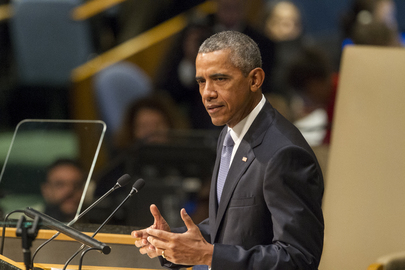
There was stunned silence in the General Assembly Hall on Monday as U.S. President Barack Obama warned leaders against falling back to pre-United Nations days, in which strong nations imposed their will by force against the weak. There was apparent disbelief as he said it was Russia and China that wanted a “return to the rules that applied for most of human history and that pre-date this institution.”
These ancient rules included the “belief that power is a zero-sum game; that might makes right; that strong states must impose their will on weaker ones; that the rights of individuals don’t matter; and that in a time of rapid change, order must be imposed by force.”
U.S. President Barack Obama addresses the United Nations General Assembly on Sept. 28, 2015. (Photo credit: United Nations.)
The silence in the chamber came because everything Obama ascribed to others perfectly describes U.S. behavior from the end of the Second World War until today.
'via Blog this'

Why The Banking Elite Want Riots in America

Why The Banking Elite Want Riots in America:


'via Blog this'

Sunday, September 27, 2015

"Putin: we know for sure US helped overthrow of Yanukovych"

Signs of the Times
Link
The sovereignty of all states, including Ukraine, should be respected, Russian President Vladimir Putin told CBS's 60 Minutes, stressing that he knows "for sure" that the US was involved in the ouster of President Yanukovich in 2014 Speaking to veteran journalist Charlie Rose, Putin said that Russia respects the sovereignty of Ukraine, adding that "at no time in the past, now or in the future has or will Russia take any part in actions aimed at overthrowing the legitimate government." He added that Moscow "would like other countries to respect the sovereignty of other states, including Ukraine. Respecting the sovereignty means preventing coups, unconstitutional actions and illegitimate overthrowing of the legitimate government." It is "absolutely unacceptable" to address issues through unconstitutional means, he said referring to the coup in Ukraine in February 2014. "Our partners in the United States are not trying to hide the fact that they supported those opposed to President Yanukovich," he said. Putin added that he "knows for sure" that the US had in some way helped oust Viktor Yanukovich. Moscow knows "who had meetings and worked with people who overthrew" the ex-president, as well as "when and where they did it," he said. "We know the ways the assistance was provided, we know how much they paid them, we know which territories and countries hosted trainings and how it was done, we know who the instructors were. We know everything. Well, actually, our US partners are not keeping it a secret," he said.

via IFTTT

Friday, September 25, 2015

The Truth About Poor People's Eating Habits Will Surprise You

AlterNet.org Main RSS Feed
Link
Yet more anti-poor propaganda.

In a country where it is a national pastime to find new ways to blame poor people for the crime of being poor, even food choice becomes a site of class warfare. Consider the popularized image of the low-income family who subsists on a steady diet of fast food; each burger, fry and milkshake they consume regarded as yet more evidence of bad decision-making. It’s one of those ideas now deeply embedded in our poverty-pathologizing culture, the kind of untested “fact” politicians reference to ensure we remain “them” and “us,” even at the dinner table. The trouble is, it simply isn’t true.

A recent Centers for Disease Control survey of 5,000 American children and adolescents age 2 to 19 offers proof that poor people not only don't consume more fast food than those with higher incomes, they actually consume slightly less. The study, which looked at figures from 2011-'12, found that “no significant difference was seen by poverty status in the average daily percentage of calories consumed from fast food among children and adolescents aged 2 to 19.” In fact, the poorest children surveyed got the least amount of their daily calorie intake from fast food, at just 11.5 percent. That number rose to 13 percent for their more affluent peers.

If anything, the takeaway from the study is that American kids across the board are eating way too much fast food, with “34.3 percent of all children and adolescents aged 2 to 19 consum[ing] fast food on a given day.”

As the Atlantic notes, this isn’t the first study to indicate that the much cited link between poverty and fast food consumption doesn’t really exist. At least, not in numbers any more glaring or worrisome than for other socioeconomic groups. In 2011, researchers from UC Davis noted that people with lower-middle-class incomes — not the poor — ate the most McDonald’s, Taco Bell, Domino’s and the like. “Fast-food restaurant visits rose along with annual household income up to $60,000,” researchers wrote. And a Gallup poll from 2013 found “[t]hose earning the least actually are the least likely to eat fast food weekly — 39% of Americans earning less than $20,000 a year do so.” Conversely, more affluent Americans — “those earning $75,000 a year or more — are more likely to eat [fast food] at least weekly (51%) than are lower-income groups.”

Still, the mythical relationship between poverty and fast-food is used and manipulated, time and time again. In 2014, the Daily Caller — Tucker Carlson’s website — stoked anti-poverty sentiments among its conservative readership with a list of “questionable” items which food stamps can be used, including two fast food restaurants. (“Taco Bell is one of many fast food restaurants that accept EBT cards. Guacamole is extra? Who cares? It’s on the taxpayer.”) Fox’s Boston affiliate, in a piece on its website titled “Should Welfare Recipients be Blocked from Buying Fast Food?” opens with this fine bit of scaremongering: “Massachusetts State welfare recipients have spent a whopping $44,000 worth of Big Macs, Happy Meals and Chicken McNuggets last year in a debit card spending spree.”

But perhaps most troubling is the way this fallacious idea is trotted out when it comes to policy for the poor. Earlier this year, Arizona Senate Republican Kelly Townsend submitted a bill to prohibit the use of food stamps at fast food restaurants. Maine’s Republican governor Paul LePage has been pushing legislation that would keep food stamp recipients from buying “unhealthy” food, whatever that means. In Wisconsin, according to the Milwaukee Journal Sentinel, state Rep. Robert Brooks has put forth a bill that would keep food stamp recipients from buying “crab, lobster or other shellfish” — none of which, last I checked, falls under the banner of “junk food.” And Republicans in Missouri are trying to pass a law that would make food stamps invalid for buying “cookies, chips, energy drinks, soft drinks” — and unbelievably, “seafood or steak."

“I have seen people purchasing filet mignons and crab legs with their EBT cards," Missouri state Rep. Rick Brattin, who introduced the bill, told the Washington Post. "When I can't afford it on my pay, I don't want people on the taxpayer's dime to afford those kinds of foods either."

I don’t for one nanosecond believe Rick Brattin when he says he saw, with his own eyes, EBT card users buying fancy steaks and seafood. I also can hardly believe that Brattin, whose salary is paid with tax revenue, doesn’t see the irony in complaining about anyone doing anything on the “taxpayer’s dime.” However, the one thing I appreciate about Brattin’s words is how they cut to the chase on all this pretend handwringing and faux outrage about how poor people use their food stamps, or what they buy for dinner, or the kind of cellphones they own, or cars they drive, or any of the other nonsense reasons used as justification for taking punitive action. Because let's just admit that this constant restricting of rights and tightening of resources is absolutely punishment against the poor.

Fundamental to this way of thinking is the idea that being poor is a crime for which one must be humiliated and stigmatized at every possible turn, an offense for which people should be constantly reminded that they both deserve and inherently are less. It perpetuates the dumb and simple idea that the poor are poor because they simply refuse to stop being poor: that they spend their money frivolously and foolishly, and so must be told what to buy and what to eat. It’s an idea that, followed to its logical end, suggests that the poor deserve to be poor. Which is absurd for endless reasons, mainly that it’s straight-up wrong about how poor people use their money.

Talking Points Memo notes “[t]he poor spend nearly double the share that the rich spend on food they cook at home, while the rich spend more on eating out” according to Bureau of Labor Statistics. And a recent Mother Jones article points out that food stamp recipients are more mindful about food than the aforementioned lawmakers would have us know:

[D]ictating what you can buy with food stamps is the kind of thing that only sounds good to people who don't actually have to survive on a poverty income. No one denies me the occasional candy bar or Coke; why would I feel entitled to exert that kind of control over poor people? And guess what: SNAP recipients already eat more virtuously than the rest of us. A 2008 USDA report found that they are less likely than those with higher incomes to consume at least one serving of sweets or salty snacks per day. More recently, a 2015 USDA study concluded that, adjusting for demographic differences, people who take SNAP benefits don't consume any more sugary drinks than their low-income peers who aren't in the program.

There are questions worth investigating based on the CDC study findings. For example, researchers are still trying to understand why the poorest Americans, despite consuming less fast food, are disproportionately obese. (The Food Research and Action Center offers up a number of ideas, from food deserts to unsafe playgrounds that make exercise difficult.) But what it does clear up is the false idea that poverty is somehow uniquely synonymous with fast food. Or that being poor is a simple problem of poor people's own making.


Related Stories


via IFTTT

Thursday, September 24, 2015

'Snowden Treaty' Aims To Protect Privacy, Whistleblowers — And End Mass Surveillance

VICE News
Link
NSA whistleblower Edward Snowden, journalist Glenn Greenwald, and activist David Miranda previewed the treaty at a New York event, which they hope might prevent the type of mass spying they exposed.

via IFTTT

U.S. Government Nutrition Advice Is Stuck in 1980s

Reason.com Full Feed
Link
The Uncle Sam Diet mantra: Don't eat anything your ancestors wouldn't have while watching Cheers on network television.


via IFTTT

Obama blocks brilliant teen critic on twitter, then lies about it

Pamela Geller
Link
How small and petty can the narcissist-in-chief get? Who’s the child? Conservative YouTube sensation CJ Pearson, a 13-year-old black middle schooler from Georgia, revealed today that he’s been blocked from following President Obama on Twitter. He’s also unable to view the president’s tweets. So much for freedom of speech — and this kid didn’t even […]

via IFTTT