via IFTTT

Seeking Truth in a World of Propaganda. Links do not necessarily indicate agreement with stories or perspectives.
“Those who are able to see beyond the shadows and lies of their culture will never be understood, let alone believed, by the masses.” - Plato
We’re currently in the throes of winter. Or perhaps that’s second winter, or even third. With the multiple rounds of snow and cold, it’s easy to lose track of where we are.
For those of us in northern climes, it’s easy to get the winter blues. A lack of sunshine and yet another snow day can do that to a person. Fortunately, the sun will soon be showing its face for longer periods, thus dissipating the depression of the cold months.
But for many individuals, depression will not disappear with the snow and cold. Indeed, it’s no secret that depression is on the rise. According to a Columbia University study from late 2017, “depression increased significantly among persons in the U.S. from 2005 to 2015, from 6.6 percent to 7.3 percent.” Given that this is a “significant” increase, it’s even more alarming to hear the depression numbers for teens. In that same time frame, teen depression rates rose from 8.7 percent to 12.7 percent.
What’s driving this increase?
Many would guess social media and the comparison and fear of missing out that accompany it. Others would suggest high academic pressure and the explosion of extra-curricular activities.
But a new study gives another interesting explanation: depression may be related to a lack of religion.
According to the study, researchers examined individuals with a family history of depression. Brain imaging showed that when these same individuals placed a high emphasis on religion and spirituality, their brains were structured more like individuals who had a minimal history of family depression. In other words, religion appears to greatly minimize an individual’s tendency toward depression.
This is interesting, particularly as religion has been rapidly declining in recent years. As the ABC News graphic below demonstrates, those claiming “no religion” rose nine percent between 2003 and 2017.

As this is roughly the same time frame as the one in which teen depression skyrocketed, I dug deeper to find out which demographic was experiencing the greatest loss of religion. Perhaps not surprisingly, those in the 18-29 age range were the most likely to move into the “no religion” category.

Is there a connection? Is it possible that this major decline in religion amongst young people was occurring even during the teen years and is in fact closely related to the rising teen depression rates from the same time frame? And if so, why?
In his book, Coming Apart, sociologist Charles Murray notes the overall decline in American religion and explains how this decline has a ripple effect, influencing participation drop-off in other civic organizations. It seems that without religion, individuals lose their outlet, their community, and their chance of giving back to others, not to mention their sense of purpose and hope.
Do we need to reconsider our ready dismissal of religion? When we push it aside, do we also push aside many other valuable benefits that it offers?
--
Authored by James Howard Kunstler via Kunstler.com,
And so now along comes Andy McCabe, former Number Two at the FBI, publicizing his new book, The Threat: How the FBI Protects America in the Age of Terror and Trump, on this Sunday’s CBS 60-Minutes show, confirming what I said on this blog two years ago - that the Deep State would try to run over the Golden Golem of Greatness with the 25th Amendment.
The specter of Mr. Trump entrained by the nuclear “football” - the briefcase with launch codes for World War Three - gave US Intel communitarians such a case of the heebie-jeebies that they first sought desperately to impede his election by unlawful means and, failing in that, concocted a fog of Russian collusion conspiracy to cover up all that and much more nastiness emanating from the Hillary Clinton orbit.

It’s been the opinion here at CFN that Mr. McCabe and a long list of DOJ / FBI / and Intel employees would eventually be summoned to grand juries on charges ranging from lying to their Internal Affairs colleagues all the way to sedition. Those worms now seem to be turning. Both house and senate committees investigating the Russia narrative declared that they turned up no evidence for it.
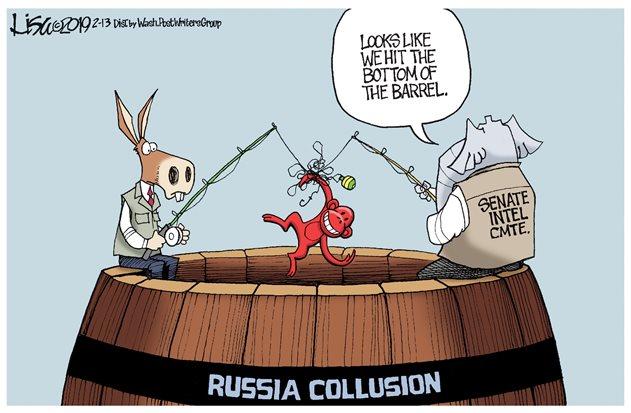
And late this week, William Barr was confirmed as a new Attorney General, meaning the extreme case of bureaucratic constipation in that department may be resolving in a shitstorm of counter-revelations and prosecutions in what amounted to an attempted coup d’etat. A lot of the evidence for that is already public and overwhelming. It includes:
Using FBI counter-intelligence assets improperly and illegally.
Using fabricated “opposition research” provided by Mrs. Clinton to obtain warrants to spy on her election opponent, and failing to verify it as evidence (according to strict “Woods” procedures) submitted to FISA court judges.
Recruiting Britain’s MI6 to spy on US citizens as a work-around from US laws prohibiting US Intel from spying on Americans.
Setting up the notorious Trump Tower meeting to entrap Donald Trump Jr., using a Russian lawyer, Natalia Veselnitskaya, in the employ of Fusion GPS, Mrs. Clintons oppo research contractor.
Orchestrating leaks of secret FBI proceedings to the news media to feed a Russia collusion hysteria.
Malicious prosecutions by Special Counsel Robert Mueller and egregious political conflicts-of-interest among Mr. Mueller’s team of prosecutors.
Coverup of the Uranium One scheme facilitated by Robert Mueller and Deputy Attorney General Rod Rosenstein.
A scheme to surreptitiously and illegally record conversations with Mr. Trump once he became president.
Conspiring to bury multiple inquires into illegal conduct of Mrs. Clinton, her employees and associates by failing to obtain evidence and allowing it to be destroyed.
Misconduct in office by former CIA chief John Brennan, former National Security Director James Clapper, former AG Loretta Lynch, and members of President Obama’s White House inner circle.
These matters and a lot more have deserved official attention that was bypassed during the peculiar DOJ regime of former AG Jeff Sessions - and now some light may be about to shine on them. The Trump “resistance” already seems demoralized by the collapse of the Russia collusion story, which had been the centerpiece of their impeachment hopes. Several reconstituted house committees under the new Democratic Party chairs, have pledged to keep mining that vein of fool’s gold to keep the hysteria alive long enough for the 2020 elections.
But what will happen in the meantime as their enablers are dragged into courts of law to answer for their roguery?
My guess is that it will drive the “resistance” to new depths of delusion and, eventually, derision, as its narrative cloak gets shredded in public testimony and their audacious mendacity is revealed. The heat from these future events may be so intense and disruptive that it will interfere with the 2020 election.

Every day, the question about organic demand for stocks in this market, or the lack thereof, rears its ugly head.
As we observed yesterday, while stocks have been blazing higher for the past 7 weeks, in a bizarre twist professional investors, including institutions, hedge funds and retail investors have been selling in droves.
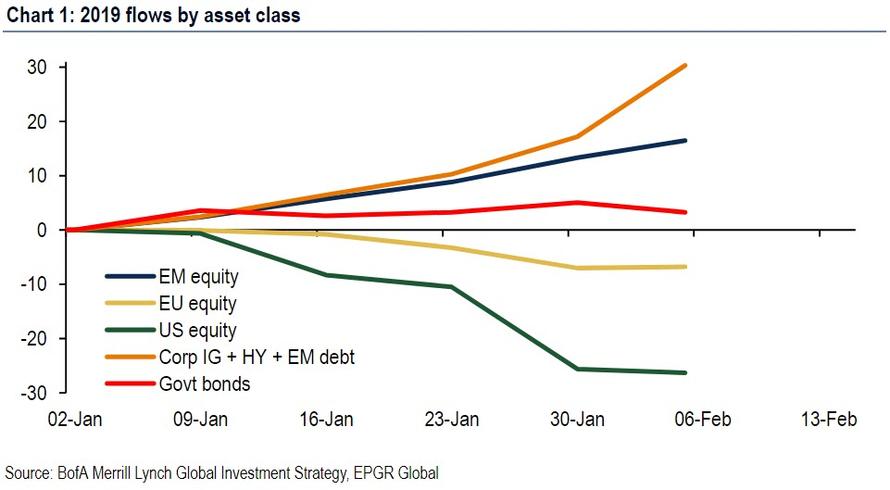
So who was buying? The answer, as Bank of America revealed, is the companies themselves, as yet another spree of corporate buybacks has been unleashed in 2019...
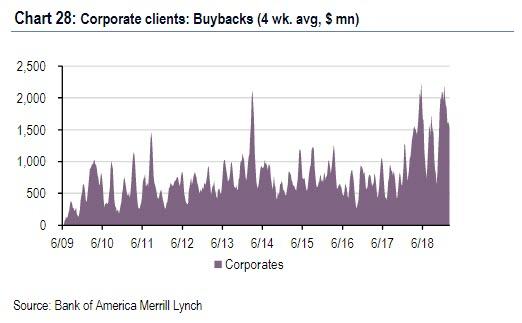
... with the result that buybacks this year are already set to smash last year's records, as YTD repurchases are trending 78% higher compared to the same period in 2018 (as a reminder, total announced buybacks in 2018 hit a record $1 trillion).
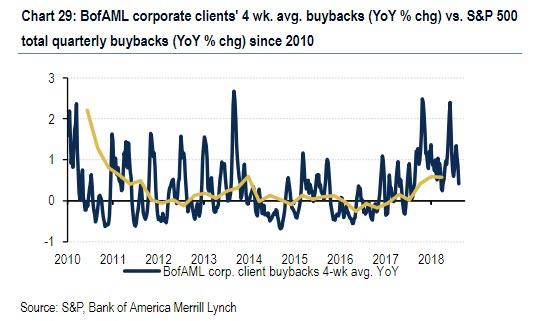
The problem with this, however, is that while companies are buying back their own stock - largely to boost management's equity-linked executive comp - there is no appetite for others' stock.
Nowhere is this more obvious than in the US IPO market, where in stark denial of the scorching equity rally, there has been a sudden and unexpected freeze.
Indeed, as Bloomberg notes, Amazon isn’t the only company scrapping its New York debut: Cibus Corp. today became the last company to postpone its Nasdaq listing on the morning it was supposed to start trading; it was the third firm on this week’s IPO calendar to inexplicably shelve plans at the last minute.
Here Bloomberg makes a laughable argument, stating that there is "mounting evidence of rocky market conditions."
Uhm, where exactly? In the 17% surge in the S&P in under 7 weeks? Or the record collapse in both the VIX and yield spreads.
No, dear Bloomberg editors, there are no "rocky market conditions." There are simply no buyers, because the only "buyers" in this market are either shorts forced to cover, or companies buying back their - and only their - stock.
Where Bloomberg is right, however, is in stating that after the postponement by Cibus, plus those by BankFlorida and Virgin Trains USA LLC earlier this week, "it’s more than fair to worry about market conditions for new issues."
For comparison, zero launched IPOs were postponed at this point in 2018. And those fears will only grow bigger when you look at IPOs that did manage to lift off: three of four "successful" public offerings are already trading below their offering price, while the only stock in the green (TCR2 Therapeutics) closed just 7 cents higher after its first day of trading today.
On average, the full 2019 IPO class has been a disaster, and is failing to keep pace with the market, unless of course one realizes that the "market" is merely companies lifting themselves - and only themselves- by the bootstraps in the form of buybacks.
As for organic demand for equity risk, well the sudden burst of pulled IPOs tells you all you need to know.
Will this change? For the answer, keep an eye on the primary market: Stealth BioTherapeutics will attempt to buck the trend during tomorrow’s scheduled debut. However, don't hope to use the IPO market as an equity barometer into next week: nNext week’s IPO calendar is blank thanks to today’s deadline for companies to price IPOs without having to provide updated - and audited - financial information for all of 2018. Additionally, presidents’ Day vacations would have likely made next week a quiet one, anyway.
The silver lining is that at least the government won’t be shutting down again, so the new issue market should finally have a chance to normalize as the SEC goes through its backlog and IPO candidates update their financials.
However, whether or not that means that "organic" buyers finally emerge, the kind that doesn't buy back their own shares, is a different matter entirely. So far, and for the past 7 weeks, that has not happened. Which is why until such time as real buyers finally emerge, instead of just buybacks and short squeezes, hold that IPO champagne on ice...

by Jim Hoft, The Gateway Pundit: Investigation by cyber-security and intelligence experts William Binney and Larry Johnso WHY THE DNC WAS NOT HACKED BY THE RUSSIANS The FBI, CIA and NSA claim that the DNC emails published by WIKILEAKS on July 26, 2016 were obtained via a Russian hack, but more than three years after […]
The post EXCLUSIVE… Cyber-Security Experts Release Damning Report: Why The DNC Was Not Hacked By the Russians appeared first on SGT Report.
Now approaching nearly a year after the April 7, 2018 alleged chemical attack in Douma, Syria — which the White House used as a pretext to bomb Syrian government facilities and bases throughout Damascus — a BBC reporter who investigated the incident on the ground has issued public statements saying the "Assad sarin attack" on Douma was indeed "staged".
Riam Dalati is a well-known BBC Syria producer who has long reported from the region. He shocked his nearly 20,000 twitter followers on Wednesday, which includes other mainstream journalists from major outlets, by stating that after a "six month investigation" he has concluded, "I can prove without a doubt that the Douma Hospital scene was staged."
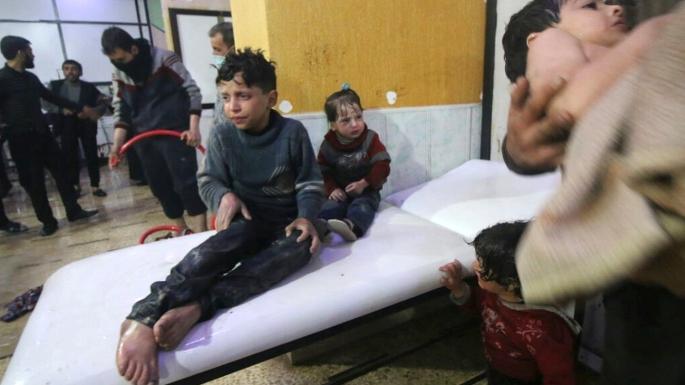 One of many widely circulated images of the Douma hospital scene from April 2018. The Times (UK) published the image with the following headline: Syria attack: ‘We found bodies on the stairs. They didn’t see the gas in time’
The "hospital scene" is a reference to part of the horrid footage played over and over again on international networks showing children in a Douma hospital being hosed off and treated by doctors and White Helmets personnel as victims of the alleged chemical attack.
The BBC's Dalati stated on Wednesday: "After almost 6 months of investigations, I can prove without a doubt that the Douma Hospital scene was staged. No fatalities occurred in the hospital." He noted he had interviewed a number of White Helmets and opposition activists while reaching that conclusion.
He continued in a follow-up tweet:
Russia and at least one NATO country knew about what happened in the hospital. Documents were sent. However, no one knew what really happened at the flats apart from activists manipulating the scene there. This is why Russia focused solely on discrediting the hospital scene.
Dalati's mention of activists at the flats "manipulating the scene there" is a reference to White Helmets and rebel activist produced footage purporting to show the deadly aftermath of a chemical attack inside a second scene — a bombed out apartment showing dozens of dead bodies.
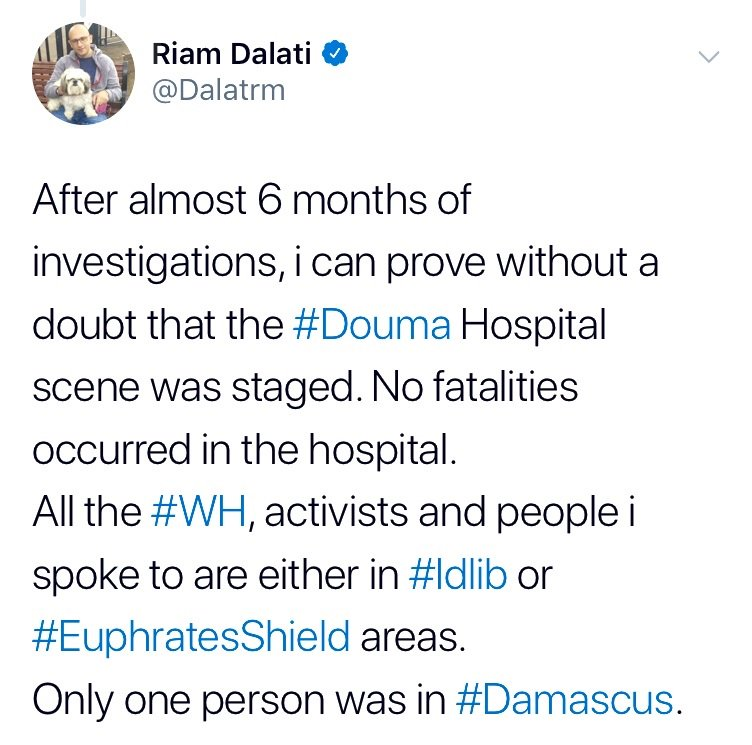 The BBC's Riam Dalati made his verified account private in the hours after the tweets.
Tragic and gruesome images of what appeared the "gassed" corpses of young children and women strewn about an apartment building, were recycled endlessly in mainstream media at the time, which the Trump administration referenced in its decision to strike Damascus with some 100 Tomahawk cruise missiles.
Dalati continued:
Truth is James Harkin got the basics right in terms of Douma's "propaganda" value. The ATTACK DID HAPPEN, Sarin wasn't used, but we'll have to wait for OPCW to prove Chlorine or otherwise. However, everything else around the attack was manufactured for maximum effect.
The BBC producer added the following details as part of the thread:
I can tell you that Jaysh al-Islam ruled Douma with an iron fist. They coopted activists, doctors and humanitarians with fear and intimidation. In fact, one of the 3 or 4 people filming the scene was Dr. Abu Bakr Hanan, a "brute and shifty" doctor affiliated with Jaysh Al-Islam. The narrative was that "there weren't enough drs" but here is one filming and not taking part of the rescue efforts. Will keep the rest for later.
A few hours after making the statements Dalati switched his verified Twitter account to "private", likely after the Russian Embassy in the UK seized upon and began promoting the admission. A number of articles quickly appeared in Russian media as well.
.@BBC’s Syria producer @Dalatrm admits “Assad sarine attack in #Douma was staged”. Remarkable that British MSM chose to ignore it. No breaking news, no articles, nothing. pic.twitter.com/aAo7xq3nPQ
— Russian Embassy, UK (@RussianEmbassy) February 14, 2019
The Russian Foreign Ministry weighed in on Thursday after the BBC producer's admission, especially since it's been Moscow's position the whole time that the events surrounding the Douma attack were staged.
Russia's TASS news agency cited ministry spokeswoman Maria Zakharova, who slammed the "theater of the absurd" connected to the April 7 events:
"The culmination of this theater of absurd may be a statement by a BBC producer who confirmed based on his own research that the footage [in Syria's Douma] had been staged with direct participation of the White Helmets," Zakharova said, noting that Russia wants to listen to the company’s position because it actively covered the events from the perspective of supporting the steps of the so-called US-led coalition in Syria.
Russia is now demanding that the BBC produce the results of its investigation for Moscow to review and evaluate.
The BBC's Dalati made the statements in response to a lengthy investigative report by James Harkin writing for The Intercept. Harkin had examined the scenes and physical environs of the alleged Douma attack and interviewed eyewitnesses on site. His report paints a complex picture of propaganda and deeply compromised rebel sources such as Saudi-backed Jaish al Islam, which had control of Douma amidst a Syrian government onslaught to retake the town.
The "hospital scene" footage, now called "staged" by a BBC producer, circulated widely among media outlets at the time:
Harkin made mention of plausible early reports that the Douma victims had actually died of asphyxiation while hiding in an enclosed space or bunker due to repeat waves of conventional ordinance fired by the Syrian Army:
When it came to Douma, the Russians weren’t the only ones who were skeptical, at least initially, that chemical weapons had been used. The Syrian Observatory for Human Rights, a U.K.-based outfit that leans toward the opposition but whose reporting network inside the country is usually seen as most authoritative by the international media, noted the day after the attack that people had died in Douma through suffocation, but couldn’t say whether chemical weapons had been used.
The Intercept report also highlighted the fact that the Organization for the Prohibition of Chemical Weapons investigation flatly contradicted Washington's claims that sarin had been used. Instead, "samples collected at both locations turned up 'various chlorinated organic chemicals' along with 'the residues of explosive' — not quite the same thing as saying that chlorine had been used as a chemical weapon..." according to the report.
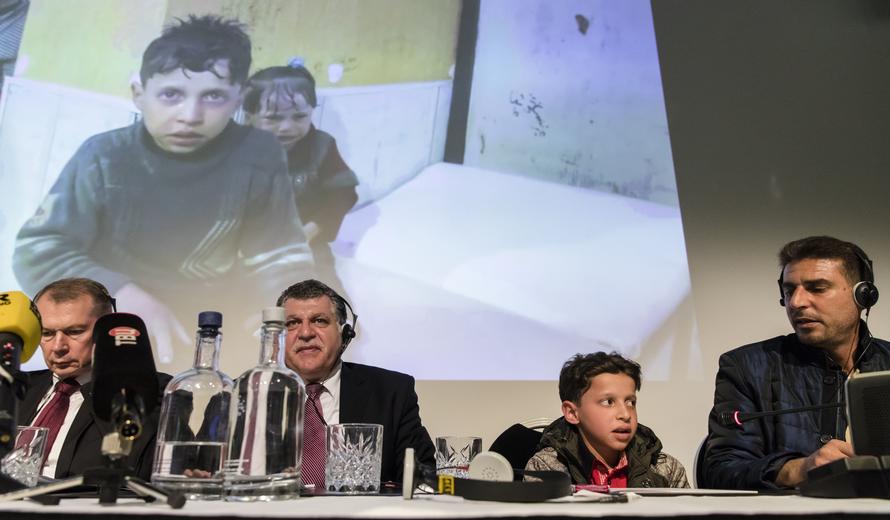 Russia held a press conference at The Hague in late April featuring an 11-year-old boy named Hassan Diab, one of those filmed at the hospital in the aftermath of the attack. He and his father testified no chemical attack took place. Image source: Getty
Harkin further underscored that the OPCW's on-site findings came as "something of a surprise" to analysts who had long parroted the early US and mainstream media claims of a confirmed chemical attack:
At least some of that caution appears to have been warranted. Three months after the attack, the OPCW released its interim report into what happened in Douma. The report found no evidence of organophosphorus nerve agents like sarin either at the site or in samples from the casualties — something of a surprise, because the suspected use of sarin had been one of the justifications for American airstrikes back in April, and alleged Syrian chemical weapons facilities their primary target. But the investigators did find something else.
Interestingly, the BBC's Dalati had actually first hinted he knew that elements surrounding the Douma attack had been staged a mere days after the incident.
In a now deleted April 11, 2018 tweet, he had stated: "Sick and tired of activists and rebels using corpses of dead children to stage emotive scenes for Western consumption. Then they wonder why some serious journos are questioning part of the narrative."
Thus far mainstream networks have not picked up on this latest bombshell admission from the BBC producer, but it will be interesting to see if there's any formal response from the BBC based on the Russian foreign ministry's request.

Authored by Stephen Davies via The American Institute for Economic Research,
Among liberals of all kinds, both classical and revisionist, it is the discipline of economics that holds pride of place today. Insights from that discipline are at the heart of commentary and analysis.
However, there are other branches of the tree of scholarship that can also yield insights and help us to understand threats to individual liberty, and how to resist them. Sociology provides several of these. One of the most powerful, and greatly needed in these times, is the notion of a moral panic.

The concept of a moral panic was first explicitly formulated and given that name in a book by the British sociologist Stanley Cohen, published in 1972 under the title Folk Devils and Moral Panics: The Creation of the Mods and Rockers. The book used one particular panic (over the two supposed youth cultures of the title) to illustrate a more general thesis. This was that societies periodically suffer from episodes of panic and anxiety of a particular kind.
In these episodes, there is a widespread fear and anxiety over a perceived threat to society and order. The fear and anxiety are excessive and unreasonable (hence “panic”). This is because either the threat or problem is completely imaginary or its extent and severity is seriously exaggerated even when there is a real phenomenon. The threat is often associated with a specific deviant group or identity. These are the “folk devils” of Cohen’s title.
Again the group may be a real, actually existing one that is demonized and caricatured, or it may again be completely imaginary, with no actual existence. Confusingly though, in some cases an initially imaginary group or subculture becomes real, as people start to adopt the behavior and appearance of the invented and imaginary deviant group.The final crucial element is that the supposed threat or problem and the group supposedly responsible for it are discussed and described using the language of morality; the group is seen as evil or malevolent or as reflecting a moral failure of some kind (hence “moral”).
So there is a recurring social phenomenon in which many people are gripped by the fear that social order is threatened by some behavior or practice that is both harmful and immoral or motivated by ill will. This state of panic exists despite there not being any real foundation for it.
How though does this panic arise?
Moral panics almost all have the same features and trajectory. They start with a particular episode or event, often real but sometimes completely imaginary (the supposed event is either invented or involves a misinterpretation of something quite different). The initial event receives very wide coverage and is widely discussed.
At this point, the crucial step is taken that creates a panic. Specific people (moral entrepreneurs, as they are called) claim that the reported event is actually only one instance of something much more widespread, and that there is actually an “epidemic” or “plague” of this kind of thing (medical language and metaphors are often used at this stage) so that it is increasing in frequency to a crisis level. This starts to cause anxiety and alarm and then leads to a spate of reports, rumors, and accusations. These are now reported, and so the impression gains ground that there is indeed a serious and unacknowledged problem or crisis. At this point the fully fledged panic starts.
This leads inevitably to demands for action, that “something must be done.” Institutions and powerful agencies now come under intense pressure to respond, often on the basis of “Something must be done, this is something, and therefore we should do it.” In addition, people in these agencies often support or give credence to the panic for self-interested reasons, not least because it leads to an increase in their own power and status or budget.
This means that moral panics have both an ideological source (the moral entrepreneurs who typically have sincere beliefs or an ideological agenda) and a pragmatic one (they are sustained and strengthened by people who have pragmatic or self-interested interests because they stand to gain from them). One aspect of many panics is the claim that the harm is the result of a conspiracy: this is used to dismiss rejection of the panic on the grounds that anyone who does not support the calls for action is an actual or unwitting agent of the conspiracy.
This may sound like something that is of interest only to social psychologists or sociologists who are interested in manias and panics. However, moral panics can have dramatic results that are concerning for anyone interested in the rule of law, personal liberty, and good government. This is because of the impact they can have on public policy and in particular the workings of the criminal-justice system.
Politicians and regulators often react to moral panics by introducing legislation and regulations that are at best unnecessary and wasteful, at worst seriously harmful. Sometimes, when the subject of the panic is real but exaggerated you have the problem of a sledgehammer being used to crack a nut, an excessive and overbearing response. When the panic concerns something that does not actually exist, you can have laws that severely restrict people’s freedom or impose serious costs on them for no good reason whatsoever.
However, the really bad results often happen when moral panics affect the criminal-justice system. The combination often leads to witch hunts with widespread and severe miscarriages of justice. If the panic distorts not only the enforcement of the law (bad enough) but also legislation, then it can lead to bad practice becoming embedded in the law and undermine the entire practice and principle of the rule of law.
One minor example of this happened in the United Kingdom in 1991 with the Dangerous Dogs Act. There was a panic with the usual features over attacks on children by dogs: the number of such incidents was exaggerated, it was claimed the frequency was increasing when it was not, and the ownership of “dangerous dogs” was associated with a supposed deviant working class subculture. In the act, the ownership of four specific breeds was banned (but without those breeds being clearly defined), several new criminal offenses were created, and a series of prosecutions happened — all without reducing the number of attacks by dogs in the slightest.
However, there are many much-more-serious and large-scale examples. One was the panic over “satanic ritual abuse” that swept through the English-speaking world in the 1980s. Here the idea was that there was an underground conspiracy of devil worshipers who regularly engaged in the sexual and physical abuse of children as part of satanic rituals. This began with an accusation at the McMartin preschool in Los Angeles made by a parent who it was later revealed was a paranoid schizophrenic. This led to a trial that is still the longest and most expensive in the whole of American history and to similar panics and accusations across the United States and the English-speaking world.
Dozens of people had their lives ruined by false accusations, had their children taken from them by force, and in several cases were sent to prison for very long terms for things they had not done, on nonexistent evidence and with major breaches of criminal-law procedure. In this case, prosecutors and law enforcement officials gained status and power while the moral entrepreneurs were an unholy alliance of religious fundamentalists (with a strong belief in an active physical devil) and radical feminists (who believed in the widespread sexual abuse of young children by men).
On a much-larger scale were the literal witch hunts of the early-modern period, which led to thousands being tortured and executed — Salem being just one, late example. The War on Drugs with all of its costs was partly brought about by a series of panics, in the 1880s, 1930s, 1940s, and 1970s. The recurring theme was that a racial minority were pushing drugs onto respectable white girls to turn them into degenerates who wanted to have sex with the minority in question (Chinese or Mexicans or African Americans). Sometimes large-scale panics of this kind are deliberately started by political actors for highly pragmatic and cynical reasons.
There are plenty of examples of moral panics today. These originate from both sides of the political spectrum or neither. One is the idea that there are online communities that deliberately lead young people into committing suicide (the Blue Whale Challenge). This has been a major panic in Russia since 2016. There are recurring panics about food and diet and repeated ones about sexual behavior and sexual abuse.
Pornography and the impact of video games and various kinds of online material are other examples. Another is the idea that there is a huge campus conspiracy against free speech. This is an example of a real problem that is seriously exaggerated.
One of the damaging results of panics like these is that cases where there actually is a real problem or even crisis are ignored as people become cynical and regard all claims of problems as simple scaremongering. Where a moral panic concerns a real problem that is exaggerated, the long-term consequence may be that the problem is discounted or not addressed effectively.
For example, there is solid evidence that there has been a sudden and dramatic decline in the mental health of teenagers and young adults in the last 10 to 12 years; the danger is that this will be dismissed as yet another panic. The problem of attitudes toward speech and discussion on campuses is a real one — particularly on elite campuses — but exaggerating its extent and severity will stop people thinking about what is actually happening and devising effective ways of dealing with it.
So how do you recognize a moral panic, and how can you tell if there really is an actual problem or even crisis? Fortunately, the sociologists have also got advice on that. There are several features of reporting or discussion that should lead you to suspect you are dealing with a moral panic.
These include but are not limited to the following: reporting rumor, anecdote, hearsay, and accusation as though they are facts; making quantitative claims without specific figures to support them or with figures that turn out to be false or misleading; media reporting that what other outlets are saying is the entire story; a particular kind of rhetoric and use of certain tropes (such as medical metaphors or apocalyptic imagery and language); having the same incident or story recycled; claims of the existence of a conspiracy without any actual people being named; moralistic language aimed at an unpopular or identifiable minority group. Conversely, if you find calm, serious argument and figures that can actually be supported, then you should take the argument seriously even if it turns out to be wrong.
The notion of a moral panic is a powerful one that explains much of what goes on in popular mass media, public discussion, and, all too often, actual policy. It is a valuable intellectual tool to use to protect yourself against unwarranted and dangerous anxiety and being taken advantage of by deluded or unscrupulous hucksters.

Authored by Mike Krieger via Libnerty Blitzkrieg blog,
While the evolution of Google’s YouTube from a free expression platform into something entirely different has been underway for a while, it just took another step in a very short-sighted and restrictive direction. NBC News reports:
YouTube has announced that it will no longer recommend videos that “come close to” violating its community guidelines, such as conspiracy or medically inaccurate videos…Chaslot said that YouTube’s fix to its recommendations AI will have to include getting people to videos with truthful information and overhauling the current system it uses to recommend videos.
There’s a lot to unpack here so let’s get started. First, it appears YouTube has announced the creation of a new bucket when it comes to content uploaded to the site. It’s no longer just videos consistent with company guidelines and those that aren’t, but there’s now a category for “conspiracy or medically inaccurate videos.” This is a massive responsibility, which neither YouTube or anyone else seems fit to be judge and jury. In other words, YouTube is saying it’s comfortable deciding what is “conspiracy” and what isn’t. Which brings up a really important question.
So no videos of government officials lying the public into wars, or is that the Silicon Valley approved type conspiracy? https://t.co/mUEQGMlLyr
— Michael Krieger (@LibertyBlitz) February 11, 2019
“Conspiracy” and covering up conspiracies is a fundamental part of the human experience, and always has been. It demonstrates extreme hubris for a tech giant to claim it can differentiate between a legitimate conspiracy to explore, versus an illegitimate one. One person’s righteous investigation is another’s conspiracy theory, with Russiagate serving as an obvious contemporary example.
Going back to the early 21st century, we witnessed a major conspiracy to start a war in Iraq based on lies; lies which were endlessly repeated uncritically throughout the mass media. Even worse, General Wesley Clark described an even larger conspiracy which consisted of starting multiple additional wars in the aftermath of 9/11. This conspiracy is ongoing and has continued to move forward in the years since, through both Republican and Democratic administrations.
It’s pretty clear what will end up happening as a result of this tweaking to YouTube’s recommended videos AI. The “conspiracies” of your average person will be pushed aside and demoted, while government and mass media lies will remain unaffected. Google will assume mass media and government are honest, so government and billionaire approved propaganda will be increasingly promoted, while the perspectives of regular citizens will be pushed further to the margins.YouTube is simply not a platform anymore, but rather a self-proclaimed arbiter of what is ridiculous conspiracy and what is truth.
The most dangerous and consequential liars on planet earth are those in government, yet I guarantee YouTube will gladly recommend such liars and their lies.
— Michael Krieger (@LibertyBlitz) February 11, 2019
While YouTube says videos it deems conspiracy will still be available via search, it’s not a stretch to imagine this is just the first step and before you know it certain categories will be banned from the site entirely. Either way, I think there’s a silver lining to all of this.
As I outlined in a recent post, U.S. tech giants, particularly Facebook, Google and Amazon, aren’t simply private companies. They appear more akin to quasi-government entities that increasingly view themselves as instrumental gatekeepers for a discredited status quo.Moreover, their primary business models consist of mass surveillance and violating our privacy.
Ultimately, I think the increasingly nefarious and desperate behavior of these tech giants will lead to their demise. More and more of us have looked under the hood and seen the seedy and privacy-destroying nature of these entities. We’ve also seen what it’s like to have genuine free expression on the internet and we don’t want to turn the web into another cable news where Facebook, Google and Amazon become the new CBS, NBC and ABC. If we do, then the entire promise of the internet will have turned out to be a giant waste.
But I don’t think that’s going to happen. I think most of us have had a taste of what’s possible, and agree that free speech and expression on the internet, the good, the bad and the ugly, is better than an internet censored by tech companies and their billionaire executives, who will always be biased toward the status quo point of view. It’s still not clear which platforms will emerge to replace the tech giants, but it seems fairly clear to me the best days are over for these companies, and it cannot come a moment too soon.
* * *
If you liked this article and enjoy my work, consider becoming a monthly Patron, or visit our Support Page to show your appreciation for independent content creators.
