Wednesday, January 4, 2017

Sugar Scandal — Industry-Biased Study Questions Validity of Sugar Guidelines

ORIGINAL LINK

By Dr. Mercola

Research spanning many decades shows excess sugar damages your health, yet the sugar industry successfully buried the evidence and misdirected the public with faux science.

According to the sugar industry, sugar is harmless and may even be an important part of a healthy diet. To this day, they're promoting the myth that saturated fat is to blame for weight gain and ill health, not sugar, along with the thoroughly debunked calories-in, calories-out (energy balance) theory.

Fortunately, the truth is emerging and taking hold, and some great books have been written exposing the history and extent of the cover-ups. Two examples are science journalist Gary Taubes' book, "The Case Against Sugar," and Marion Nestle, Ph.D.'s, "Soda Politics."

Sugar Industry Has Influenced Health Recommendations for Decades

Dr. Cristin Kearns, a dentist and fellow at the University of California, San Francisco (UCSF), also made headlines with her Journal of the American Medical Association (JAMA) Internal Medicine paper,1 which details the sugar industry's historical influence on dietary recommendations.2,3,4,5,6,7

Evidence has also emerged showing how the sugar industry influenced the scientific agenda of the National Institute of Dental Research, which back in 1971 created a national caries program — again downplaying any links between sugar consumption and dental caries.8

In 2012, Taubes and Kearns co-wrote "Big Sugar's Sweet Little Lies," an exposé featured in Mother Jones.9

"For 40 years, the sugar industry's priority has been to shed doubt on studies suggesting its product makes people sick. On federal panels, industry-funded scientists cited industry-funded studies to dismiss sugar as a culprit," they wrote.

To combat the flow of industry-funded misinformation, dozens of scientists at three American universities banded together to create an educational website called SugarScience.org,10 aimed at making independent sugar research available to the public.

Recent media reports have also revealed devastating evidence showing a Centers for Disease Control and Prevention (CDC) executive aided a Coca-Cola representative in efforts to influence World Health Organization (WHO) officials to relax recommendations on sugar limits.11

The damning email correspondence between Coca-Cola and the CDC was obtained by the nonprofit consumer education group U.S. Right to Know (USRTK).12

New Sugar Limits Put Junk Food Industry in a Pickle

For the first time ever, the 2015-2020 Dietary Guidelines for Americans recommends limiting the amount of sugar you eat to 10 percent of your total daily calories.13 For a 2,000 calorie diet this amounts to 10 to 12 teaspoons, or just over the amount found in one 12-ounce can of regular Coke.

Based on the evidence from some studies, even this amount can trigger health problems, but it's certainly better than no limit at all. Other health organizations have gone even further.

For example, the National Institutes of Health (NIH) now recommends kids between the ages of 4 and 8 limit their added sugar to a maximum of 3 teaspoons a day (12 grams). Children aged 9 and older should stay below 8 teaspoons.

The American Heart Association (AHA) recommends limiting daily added sugar intake to:14,15,16,17,18,19,20

  • 9 teaspoons (38 grams) for men
  • 6 teaspoons (25 grams) for women
  • 6 teaspoons (25 grams) for toddlers and teens between the ages of 2 and 18
  • Zero added sugars for kids under the age of 2

Twenty-five grams of sugar per day is my recommended limit for men and women alike, with the added caveat that if you have insulin or leptin resistance (overweight, diabetic, high blood pressure or taking a statin drug), you'd be wise to restrict your total fructose consumption to as little as 15 grams per day until you've normalized your insulin and leptin levels.

Not surprisingly, these new recommendations — along with the new requirement to declare the total amount of added sugars on food labels — place the sugar and processed food industries in a tight spot and threaten profits.

Industry-Funded Study Claims War on Sugar Waged With 'Low-Quality' Evidence

The junk food industry's answer? Create another study to refute the validity of the recommended limits on sugar.21,22,23,24 As reported by CBS:25

"The study26 from McMaster University claims that the evidence for prior knowledge in how sugar intake is proportionate with weight gain, across nine public health guidelines, is 'low-quality.'"

In conclusion, these industry-funded science reviewers found that:

"Guidelines on dietary sugar do not meet criteria for trustworthy recommendations and are based on low-quality evidence. Public health officials (when promulgating these recommendations) and their public audience (when considering dietary behavior) should be aware of these limitations …

At present, there seems to be no reliable evidence indicating that any of the recommended daily caloric thresholds for sugar intake are strongly associated with negative health effects.

The results from this review should be used to promote improvement in the development of trustworthy guidelines on sugar intake."

Who Funded This Scientific Review and Why?

The review was funded by the North American branch of the International Life Sciences Institute (ILSI), a trade group representing the Coca-Cola Company, Dr. Pepper Snapple Group, the Hershey Company, Mars, Nestlé, PepsiCo and many others.

In an accompanying editorial,27 Dr. Dean Schillinger, professor of medicine in residence at UCSF and chief of the UCSF Division of General Internal Medicine, along with Kearns, note that ILSI has a history of opposing sugar limits. This in and of itself raises questions about the findings. Moreover, as reported by Medscape:28

"The editorialists also take issue with some of the premises of the review. One is that the authors cite inconsistency among recommendations made between 1995 and 2016 as a basis for needing a new review of guidelines. 'One would expect recommendations spanning more than two decades to evolve as scientific knowledge evolved,' Schillinger and Kearns write …

Schillinger and Kearns say using the AGREE II measure is problematic to assess guideline quality because it is designed for clinical-practice guidelines in treating illness. Dietary guidelines are meant to gauge risk of consumption at a population level, they write, 'not to evaluate interventions to reduce consumption.' The authors, using that tool, downgraded the trustworthiness of guidelines."

'Trust Us, We're Impartial'

Ironically, the only "limitation" listed for this study29 was that "The authors conducted the study independent of the funding source, which is primarily supported by the food and agriculture industry." Essentially, what they're saying is that, yes, the study was funded by the food industry, but you can trust the results because we made sure we stayed completely impartial.

I don't know about you, but I don't find that particularly convincing. Moreover, a corrected version of the disclosure statement reveals that ILSI did review and approve the scope of the protocol for the study.30 AP News also found that one of the review's authors, Joanne Slavin, Ph.D., a professor at University of Minnesota, had received undisclosed funding in the amount of $25,000 from Coca-Cola in 2014. Meanwhile, Slavin did disclose a grant from the Mushroom Council.

Slavin defended her decision not to disclose funding from Coca-Cola, saying the grant had been received through the university's foundation and therefore was not subject to disclosure. This is a loophole that researchers appear to use with some frequency to justify non-disclosure of clear conflicts of interest.

She also did not disclose a grant received from Quaker Oats, owned by PepsiCo, nor did she include her work on a 2012 ILSI-funded paper on sugar guidelines. According to AP News, Slavin claims she plans to file an updated disclosure to include all of these conflicts of interest.

Review Shows Massive Research Bias Based on Funding

To help eliminate research bias, Kearns and Schillinger suggest scientific journals should refuse to publish studies funded by the food and beverage industries as a matter of policy, noting that many leading journal editors have stopped accepting studies funded by the tobacco industry. They also suggest that when policy makers are faced with claims that sugar guidelines are based on junk science, they would be wise to consider the source of such claims.

Schillinger and Kearns should know. In November 2016, the pair, along with two other authors, published a paper in the Annals of Internal Medicine titled "Do Sugar-Sweetened Beverages Cause Obesity and Diabetes? Industry and the Manufacture of Scientific Controversy."31 In all, they looked at 60 studies published between 2001 and 2016 to examine the potential links between funding and study outcomes.

"We comprehensively surveyed the literature to determine whether experimental studies that found no association between sugar-sweetened beverages and obesity- and diabetes-related outcomes (negative studies) are more likely than positive studies to have received financial support from this industry," they write.

The results? Of the 60 studies, 26 found no link between sugary drinks and obesity or diabetes, and ALL were funded by the beverage industry; 34 did find a relationship, and only one of these positive studies had received industry funding. In conclusion, they noted that: "This industry seems to be manipulating contemporary scientific processes to create controversy and advance their business interests at the expense of the public's health."

Some of the studies giving sugar a free pass has industry fingerprints clearly visible all over it. For example, one paper32 came to the unbelievable and highly unlikely conclusion that eating candy may help prevent weight gain, as children who eat candy tend to weigh less than those who don't.

The source of the funding reveals the basis for such a bizarre conclusion: the Confectioners Association, which represents candy makers like Butterfingers, Hershey and Skittles. Coca-Cola and Pepsi-backed research has also come to the highly improbable and irresponsible conclusion that drinking diet soda is more helpful for weight loss than pure water.33

Biased Research Used in 'Propaganda War'

As reported by Time magazine:34

"This is not the first time the soda or sugar industry has been criticized for interfering with public health. In October, a study published in the American Journal of Preventive Medicine reported that between 2011 [and] 2015, 96 national health organizations accepted money from Coca-Cola, PepsiCo or both companies.

In 2015 it was revealed that Coca-Cola funded an organization called the Global Energy Balance Network that tried to shift public health messaging away from a focus on diet and onto exercise. 35

'The reality is we are in a public health war with diabetes right now,' says Schillinger. 'In every war there is propaganda. What the public should take away from [these findings] is that we are being played. If you exclude the studies funded by industry and only look at the independently funded studies, it becomes apparent that sugar-sweetened beverages cause obesity and diabetes.'"

One company breaking ranks with its ILSI peers is Mars Inc., which issued a statement saying the paper "undermines the work of public health officials and makes all industry-funded research look bad."36

How Much Sugar Is Too Much?

In 1812, people ate approximately 9 grams of sugar per day.37 That equates to about one can of soda every five days. The National Cancer Institute (NCI) estimates the average American now consumes 15 teaspoons of added sugar per day.38 The CDC puts the average percent of total daily calories from added sugars at about 13 percent.39

As noted by Schillinger,40 if the public were to follow guidelines to restrict sugar to 5 or 10 percent of daily calories, "this would mean that profits for junk food companies would fall by half. So there is both a lot of money and a lot of lives on the line."

You may recognize your cake, candy or sweet treat is loaded with sugar but may not think about your condiments, salad dressings, canned foods and drinks other than sodas. For instance, just 2 tablespoons of barbecue sauce can contain as much as 10 grams of sugar.41 There are also different types of dry and syrup sugars that may go unnoticed as you read the labels. Examples of added sugars you may not be aware of include, but are not limited to, the following:42

Blackstrap molasses

Buttered syrup

Cane juice crystals

Evaporated cane juice

Caramel

Carob syrup

Fruit juice

Honey

Fruit juice concentrate

Brown rice syrup

Corn syrup solids

Florida Crystals

Golden syrup

Maple syrup

Molasses

Refiner's syrup

Sorghum syrup

Sucanat

Treacle

Turbinado

Barley malt

Corn syrup

Dextrin

Dextrose

Diastatic malt

Ethyl maltol

Glucose

Glucose solids

Lactose

Malt syrup

Maltose

D-ribose

Rice syrup

Galactose

Maltodextrin

Castor

With greater media attention and consumer demand, some companies are beginning to make minor changes. For instance, Yoplait reduced their sugar content in the popular strawberry yogurt from 26 grams — 1 gram less than a Snickers bar43 — to 18 grams.44 Still, with a max limit of 25 grams, a single yogurt equates to 72 percent of your daily allotment!

Crush Your Sugar Addiction

Sugar causes very real damage to your body and cells, and the addiction to the substance is also very real. There are several strategies you can use to reduce or eliminate your intake of added sugars, while still enjoying your meals and feeling satisfied after eating.

Knowledge Is Power

Making permanent changes to your lifestyle and nutritional choices is easier when you know the why behind the change. You can see a quick list of the 76 different ways sugar negatively impacts your health in my previous article, "The Truth About Sugar Addiction."

Reduce Your Net Carbs

Sugar is metabolized as a carbohydrate in your body, spiking your blood sugar and insulin levels. Your net carbs are calculated by taking the total grams of carbs and subtracting the total grams of fiber.

By keeping your net carbs below 100 grams per day, and for a healthier diet as low as 50 grams per day, you will reduce your cravings for sweets. If you keep your net carbs at 50 grams or below for a long time, it would be wise to increase it to 100 to 150 grams per day once or twice a week unless you are treating a serious illness.

Eat Real Food

If a food is boxed, canned or bottled, it's likely also been processed and may include added sugar. Whole, organic and non-genetically engineered (GE) foods provide your body with the nutrition you need to function optimally and natural sugars bound to fiber that reduces your net carbs.

Read Labels

On processed foods you do purchase, scour the label for ingredients that represent sugar to evaluate the total amount. The less sugar you eat, the less you'll crave.

Use Safer Sweeteners

Not all sugar substitutes are created equally. Avoid using artificial sweeteners such as aspartame. Safer alternatives include Stevia, Lo Han Guo (also spelled Luo Han Kuo), and pure glucose (dextrose). Contrary to fructose, glucose can be used directly by every cell in your body and as such is a far safer sugar alternative. It will however raise your net carb intake.

Reduce the Sugar You Add Gradually

If going cold turkey hasn't worked for you in the past, try slowly reducing the amount of sugar you add to your drinks. This helps give your taste buds time to adjust to drinking your favorite tea or coffee without the added sweetener.

Increase Your Healthy Fat Intake at Meals

Fat increases your satisfaction with meals and your food, reducing your craving for something sweet afterward. Avocadoes, coconut oil, nuts and seeds increase your healthy fat content, fill you up and reduce your sweet cravings.

Include Fermented Foods

Fermented foods support your digestive health and improve your gut microbiome, and the sour taste naturally helps reduce your sweet cravings.

Try Turbo Tapping

Emotional and stress eating is not uncommon. Using Emotional Freedom Techniques (EFT) you can address your stress levels and the discomfort you may feel from giving up junk foods in your diet.

Turbo tapping is a form of EFT designed specifically for sugar addiction and is well worth a try if you're struggling to give up soda and other sweets.


Related Articles:

 Comments (9)


via IFTTT

Tuesday, January 3, 2017

Scientists have finally discovered why consuming red meat causes cancer

ORIGINAL LINK

Until recently, the reason WHY red meat causes cancer hasn’t been understood. But this breakthrough changes everything…Many people grew up being urged to eat pork, beef, and dairy products for their health, but in recent years have received advice to cut back on animal products – especially red meat. According to a number of studies, the consumption of red meat is linked with increased risk for cancer(s), atherosclerosis (heart disease), stroke, Alzheimer’s, and even Type II ...

via IFTTT

When America Was Still The Land Of Opportunity

ORIGINAL LINK

Submitted by Simon Black via SovereignMan.com,

Last week during a long overdue vacation, a close friend of mine recommended reading the autobiography of Rich DeVos called Simply Rich.

DeVos is a billionaire entrepreneur who started countless ventures during his nine decades on this earth.

Back in the 1946, for example, DeVos started an airline… virtually overnight.

He just bought an airplane and started flying people around. No rules. No regulations.

They didn’t even have an airport. The local airfield north of Grand Rapids, Michigan, where they were based, hadn’t been completed yet.

As DeVos recounts in his book, “We put pontoon floats on our plane and took off and landed on the Grand River, which ran along the airfield.”

His first office at the airfield was an old chicken coop that he found, washed in the river, and re-painted.

The following year he and his partner opened up one of Michigan’s first “Drive Through” restaurants at the airfield, catering to passengers, workers, flight students, and spectators who came by in the evenings just to marvel at the planes.

Again, no rules. No regulations.

They just saw an opportunity and went for it.

DeVos started another business selling ice cream; another offering fishing excursions on Lake Superior; and another delivering trucks cross-country.

The truck delivery business was one of the more interesting ones; it started when he was just a kid– someone asked him to drive two pickups from Grand Rapids to Bozeman, Montana.

There were no hotels or motels… or even interstates back then.

So DeVos and his friend had to zig-zag their way across corn fields to get there, sleeping on haystacks each night along the way.

The book is a hell of an adventure– a reminder of how free and unencumbered things used to be.

Back in America’s heyday, people succeeded based on their hard work, ingenuity, and willingness to take action.

They didn’t have to spend three years filling out paperwork so that some government bureaucracy could justify its existence.

It was an environment that created unparalleled opportunity and prosperity which, candidly, have long since faded.

Today there are rules for everything; in fact, just this morning, the US federal government published an astonishing 709 pages of new regulations.

And that’s just for today. They publish new regulations every single business day. So tomorrow there will be even more.

These rules make it more difficult to produce, to start a business, to sell a product or service to a willing consumer.

And these rules carry costs, whether it’s in paying a fee, filling out paperwork, etc.

So just imagine the effect that literally decades worth of rules and regulations has had on US productivity (which is now noticeably contracting, even according to government data.)

It’s also worth noting that roughly 30% of occupations in the Land of the Free now require some sort of government license.

In its study “License to Work”, the Institute for Justice reports that 45 out of 50 of the largest cities in the United States have put up substantial obstacles to prevent budding entrepreneurs from selling food from street carts.

A manicurist in Alabama requires 163 days of training, while a shampoo specialist at a Tennessee hair salon must undergo 70 days of training, take two exams, and pay $140 in fees to obtain a license.

Hawaii requires fire alarm installers to undergo a whopping four years of training, pass two exams, and pay $380 in fees to obtain a license.

And a tree trimmer in California must also undergo four years of training, pass two exams, and pay $851 in fees to obtain a license.

It’s absurd.

Nothing that Rich DeVos his partner accomplished in their teens and 20s is even legal anymore.

It makes me think about all the people today who will never have the chance to realize their full potential thanks to the mountain of regulations blocking their way.

This is an important point to understand.

Looking at the data– the incredible overregulation, $20 trillion in debt, insolvent pension funds, etc., it’s painfully obvious that the US is past its prime and holding back millions of people from achieving greater prosperity.

Rich DeVos started so many businesses back in the 1940s because the government stayed out of the way and enabled hard-working risk takers to succeed.

Today the government spends $2 billion to build a website and churns out hundreds of pages of regulations each day.

And this trend gets worse each year.

Understanding this simple reality doesn’t mean that you’re pessimistic, unpatriotic, or expecting the end of the world.

It just makes you rational.

Things change. That’s the bottom line.

The US is still a fantastic place. But it’s no longer the same Land of Opportunity it was when Rich DeVos was getting started.

As I’ve summarized before, the US is a great place to consume… but an increasingly difficult place to PRODUCE.

That imbalance has serious long-term consequences, which we are only starting to experience.

Do you have a Plan B?


via IFTTT

The War Against Alternative Information

ORIGINAL LINK

Submitted by Rick Sterling via Strategic-Culture.org,

The U.S. establishment is not content simply to have domination over the media narratives on critical foreign policy issues, such as Syria, Ukraine and Russia. It wants total domination. Thus we now have the “Countering Foreign Propaganda and Disinformation Act” that President Obama signed into law on Dec. 23 as part of the National Defense Authorization Act for 2017, setting aside $160 million to combat any “propaganda” that challenges Official Washington’s version of reality.

samantha-power-300x200.jpg

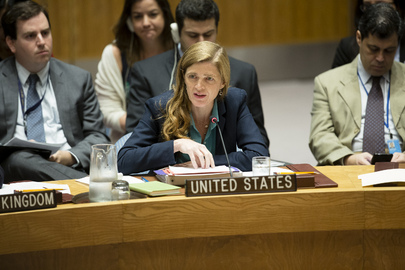
Samantha Power, Permanent Representative of the United States to the UN, addresses the Security Council meeting on Syria, Sept. 25, 2016. Power has been an advocate for escalating U.S. military involvement in Syria. (UN Photo)

The new law mandates the U.S. Secretary of State to collaborate with the Secretary of Defense, Director of National Intelligence and other federal agencies to create a Global Engagement Center “to lead, synchronize, and coordinate efforts of the Federal Government to recognize, understand, expose, and counter foreign state and non-state propaganda and disinformation efforts aimed at undermining United States national security interests.” The law directs the Center to be formed in 180 days and to share expertise among agencies and to “coordinate with allied nations.”

The legislation was initiated in March 2016, as the demonization of Russian President Vladimir Putin and Russia was already underway and was enacted amid the allegations of “Russian hacking” around the U.S. presidential election and the mainstream media’s furor over supposedly “fake news.” Defeated Democratic presidential nominee Hillary Clinton voiced strong support for the bill: “It’s imperative that leaders in both the private sector and the public sector step up to protect our democracy, and innocent lives.”

The new law is remarkable for a number of reasons, not the least because it merges a new McCarthyism about purported dissemination of Russian “propaganda” on the Internet with a new Orwellianism by creating a kind of Ministry of Truth – or Global Engagement Center – to protect the American people from “foreign propaganda and disinformation.”

As part of the effort to detect and defeat these unwanted narratives, the law authorizes the Center to: “Facilitate the use of a wide range of technologies and techniques by sharing expertise among Federal departments and agencies, seeking expertise from external sources, and implementing best practices.” (This section is an apparent reference to proposals that Google, Facebook and other technology companies find ways to block or brand certain Internet sites as purveyors of “Russian propaganda” or “fake news.”)

Justifying this new bureaucracy, the bill’s sponsors argued that the existing agencies for “strategic communications” and “public diplomacy” were not enough, that the information threat required “a whole-of-government approach leveraging all elements of national power.”

The law also is rife with irony since the U.S. government and related agencies are among the world’s biggest purveyors of propaganda and disinformation – or what you might call evidence-free claims, such as the recent accusations of Russia hacking into Democratic emails to “influence” the U.S. election.

Despite these accusations — leaked by the Obama administration and embraced as true by the mainstream U.S. news media — there is little or no public evidence to support the charges. There is also a contradictory analysis by veteran U.S. intelligence professionals as well as statements by Wikileaks founder Julian Assange and an associate, former British Ambassador Craig Murray, that the Russians were not the source of the leaks. Yet, the mainstream U.S. media has virtually ignored this counter-evidence, appearing eager to collaborate with the new “Global Engagement Center” even before it is officially formed.

Of course, there is a long history of U.S. disinformation and propaganda. Former CIA agents Philip Agee and John Stockwell documented how it was done decades ago, secretly planting “black propaganda” and covertly funding media outlets to influence events around the world, with much of the fake news blowing back into the American media.

In more recent decades, the U.S. government has adopted an Internet-era version of that formula with an emphasis on having the State Department or the U.S.-funded National Endowment for Democracy supply, train and pay “activists” and “citizen journalists” to create and distribute propaganda and false stories via “social media” and via contacts with the mainstream media. The U.S. government’s strategy also seeks to undermine and discredit journalists who challenge this orthodoxy. The new legislation escalates this information war by tossing another $160 million into the pot.

Propaganda and Disinformation on Syria

Syria is a good case study in the modern application of information warfare. In her memoir Hard Choices, former Secretary of State Hillary Clinton wrote that the U.S. provided “support for (Syrian) civilian opposition groups, including satellite-linked computers, telephones, cameras, and training for more than a thousand activists, students and independent journalists.”

Call4NoFlyZone-300x225.jpg

A heart-rending propaganda image designed to justify a major U.S. military operation inside Syria against the Syrian military

Indeed, a huge amount of money has gone to “activists” and “civil society” groups in Syria and other countries that have been targeted for “regime change.” A lot of the money also goes to parent organizations that are based in the United States and Europe, so these efforts do not only support on-the-ground efforts to undermine the targeted countries, but perhaps even more importantly, the money influences and manipulates public opinion in the West.

In North America, representatives from the Syrian “Local Coordination Committees” (LCC) were frequent guests on popular media programs such as “DemocracyNow.” The message was clear: there is a “revolution” in Syria against a “brutal regime” personified in Bashar al-Assad. It was not mentioned that the “Local Coordination Committees” have been primarily funded by the West, specifically the Office for Syrian Opposition Support, which was founded by the U.S. State Department and the U.K. Foreign and Commonwealth Office.

More recently, news and analysis about Syria has been conveyed through the filter of the White Helmets, also known as Syrian Civil Defense. In the Western news media, the White Helmets are described as neutral, non-partisan, civilian volunteers courageously carrying out rescue work in the war zone. In fact, the group is none of the above. It was initiated by the U.S. and U.K. using a British military contractor and Brooklyn-based marketing company.

While they may have performed some genuine rescue operations, the White Helmets are primarily a media organization with a political goal: to promote NATO intervention in Syria. (The manipulation of public opinion using the White Helmets and promoted by the New York Times and Avaaz petition for a “No Fly Zone” in Syria is documented here.)

The White Helmets hoax continues to be widely believed and receives uncritical promotion though it has increasingly been exposed at alternative media outlets as the creation of a “shady PR firm.” During critical times in the conflict in Aleppo, White Helmet individuals have been used as the source for important news stories despite a track record of deception.

Recent Propaganda: Blatant Lies?

As the armed groups in east Aleppo recently lost ground and then collapsed, Western governments and allied media went into a frenzy of accusations against Syria and Russia based on reports from sources connected with the armed opposition. CNN host Wolf Blitzer described Aleppo as “falling” in a “slaughter of these women and children” while CNN host Jake Tapper referred to “genocide by another name.”

default-1_0-300x151.jpg

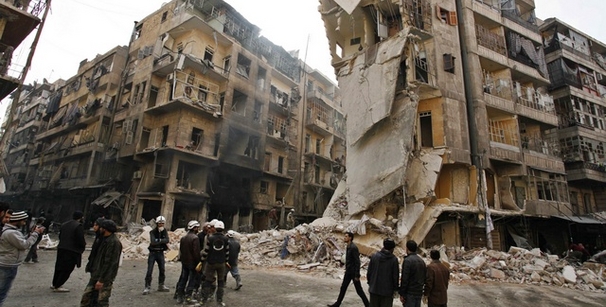
War damage in the once-thriving Syrian city of Aleppo

The Daily Beast published the claims of the Aleppo Siege Media Center under the title “Doomsday is held in Aleppo” and amid accusations that the Syrian army was executing civilians, burning them alive and “20 women committed suicide in order not to be raped.” These sensational claims were widely broadcast without verification. However, this “news” on CNN and throughout Western media came from highly biased sources and many of the claims – lacking anything approaching independent corroboration – could be accurately described as propaganda and disinformation.

Ironically, some of the supposedly “Russian propaganda” sites, such as RT, have provided first-hand on-the-ground reporting from the war zones with verifiable information that contradicts the Western narrative and thus has received almost no attention in the U.S. news media. For instance, some of these non-Western outlets have shown videos of popular celebrations over the “liberation of Aleppo.”

There has been further corroboration of these realities from peace activists, such as Jan Oberg of Transnational Foundation for Peace and Future Research who published a photo essay of his eyewitness observations in Aleppo including the happiness of civilians from east Aleppo reaching the government-controlled areas of west Aleppo, finally freed from areas that had been controlled by Al Qaeda’s Syrian affiliate and its jihadist allies in Ahrar al-Sham.

Dr. Nabil Antaki, a medical doctor from Aleppo, described the liberation of Aleppo in an interview titled “Aleppo is Celebrating, Free from Terrorists, the Western Media Misinformed.” The first Christmas celebrations in Aleppo in four years are shown here, replete with marching band members in Santa Claus outfits. Journalist Vanessa Beeley has published testimonies of civilians from east Aleppo. The happiness of civilians at their liberation is clear.

Whether or not you wish to accept these depictions of the reality in Aleppo, at a minimum, they reflect another side of the story that you have been denied while being persistently force-fed the version favored by the U.S. State Department. The goal of the new Global Engagement Center to counter “foreign propaganda” is to ensure that you never get to hear this alternative narrative to the Western propaganda line.

Even much earlier, contrary to the Western mythology of rebel “liberated zones,” there was strong evidence that the armed groups were never popular in Aleppo. American journalist James Foley described the situation in 2012 like this:

james-foley-isis-300x200.jpg

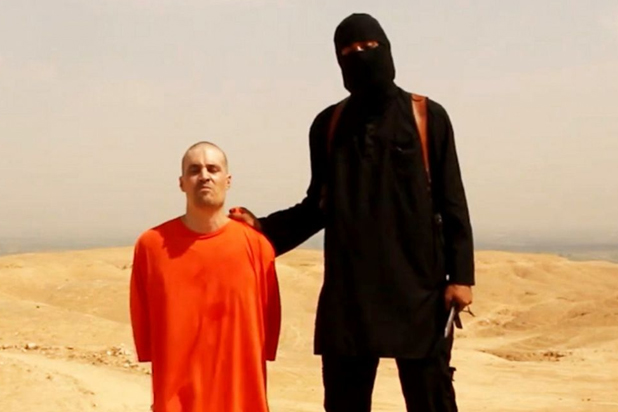
Journalist James Foley shortly before he was executed by an Islamic State operative

“Aleppo, a city of about 3 million people, was once the financial heart of Syria. As it continues to deteriorate, many civilians here are losing patience with the increasingly violent and unrecognizable opposition — one that is hampered by infighting and a lack of structure, and deeply infiltrated by both foreign fighters and terrorist groups. The rebels in Aleppo are predominantly from the countryside, further alienating them from the urban crowd that once lived here peacefully, in relative economic comfort and with little interference from the authoritarian government of President Bashar al-Assad.”

On Nov. 22, 2012, Foley was kidnapped in northwestern Syria and held by Islamic State terrorists before his beheading in August 2014.

The Overall Narrative on Syria

Analysis of the Syrian conflict boils down to two competing narratives. One narrative is that the conflict is a fight for freedom and democracy against a brutal regime, a storyline promoted in the West and the Gulf states, which have been fueling the conflict from the start. This narrative is also favored by some self-styled “anti-imperialists” who want a “Syrian revolution.”

The other narrative is that the conflict is essentially a war of aggression against a sovereign state, with the aggressors including NATO countries, Gulf monarchies, Israel and Jordan. Domination of the Western media by these powerful interests is so thorough that one almost never gets access to this second narrative, which is essentially banned from not only the mainstream but also much of the liberal and progressive media.

For example, listeners and viewers of the generally progressive TV and radio program “DemocracyNow” have rarely if ever heard the second narrative described in any detail. Instead, the program frequently broadcasts the statements of Hillary Clinton, U.S. Ambassador to the United Nations Samantha Power and others associated with the U.S. position. Rarely do you hear the viewpoint of the Syrian Ambassador to the United Nations, the Syrian Foreign Minister or analysts inside Syria and around the world who have written about and follow events there closely.

“DemocracyNow” also has done repeated interviews with proponents of the “Syrian revolution” while ignoring analysts who call the conflict a war of aggression sponsored by the West and the Gulf monarchies. This blackout of the second narrative continues despite the fact that many prominent international figures see it as such. For example, the former Foreign Minister of Nicaragua and former President of the UN General Assembly, Father Miguel D’Escoto, has said, “What the U.S. government is doing in Syria is tantamount to a war of aggression, which, according to the Nuremberg Tribunal, is the worst possible crime a State can commit against another State.”

In many areas of politics, “DemocracyNow” is excellent and challenges mainstream media. However in this area, coverage of the Syrian conflict, the broadcast is biased, one-sided and echoes the news and analysis of mainstream Western corporate media, showing the extent of control over foreign policy news that already exists in the United States and Europe.

Suppressing and Censoring Challenges

Despite the widespread censorship of alternative analyses on Syria and other foreign hotspots that already exists in the West, the U.S. government’s new “Global Engagement Center” will seek to ensure that the censorship is even more complete with its goal to “counter foreign state and non-state propaganda and disinformation.” We can expect even more aggressive and better-financed assaults on the few voices daring to challenge the West’s “group thinks” – smear campaigns that are already quite extensive.

MS69tqLX_400x400-300x300.jpg

The “White Helmets” symbol, expropriating the name of “Syria Civil Defense.”

In an article titled “Controlling the Narrative on Syria”, Louis Allday describes the criticisms and attacks on journalists Rania Khalek and Max Blumenthal for straying from the “approved” Western narrative on Syria. Some of the bullying and abuse has come from precisely those people, such as Robin Yassin-Kassab, who have been frequent guests in liberal Western media.

Reporters who have returned from Syria with accounts that challenge the propaganda themes that have permeated the Western media also have come under attack. For instance, Canadian journalist Eva Bartlett recently returned to North America after being in Syria and Aleppo, conveying a very different image and critical of the West’s biased media coverage. Bartlett appeared at a United Nations press conference and then did numerous interviews across the country during a speaking tour. During the course of her talks and presentation, Bartlett criticized the White Helmets and questioned whether it was true that Al Quds Hospital in opposition-held East Aleppo was attacked and destroyed as claimed.

Bartlett’s recounting of this information made her a target of Snopes, which has been a mostly useful website exposing urban legends and false rumors but has come under criticism itself for some internal challenges and has been inconsistent in its investigations. In one report entitled “White Helmet Hearsay,” Snopes’ writer Bethania Palmer says claims the White Helmets are “linked to terrorists” is “unproven,” but she overlooks numerous videos, photos, and other reports showing White Helmet members celebrating a Nusra/Al Qaeda battle victory, picking up the bodies of civilians executed by a Nusra executioner, and having a member who alternatively appears as a rebel/terrorist fighter with a weapon and later wearing a White Helmet uniform. The “fact check” barely scrapes the surface of public evidence.

The same writer did another shallow “investigation” titled “victim blaming” regarding Bartlett’s critique of White Helmet videos and what happened at the Al Quds Hospital in Aleppo. Bartlett suggests that some White Helmet videos may be fabricated and may feature the same child at different times, i.e., photographs that appear to show the same girl being rescued by White Helmet workers at different places and times. While it is uncertain whether this is the same girl, the similarity is clear. 

The Snopes writer goes on to criticize Bartlett for her comments about the reported bombing of Al Quds Hospital in east Aleppo in April 2016. A statement at the website of Doctors Without Borders says the building was “destroyed and reduced to rubble,” but this was clearly false since photos show the building with unclear damage. Five months later, the September 2016 report by Doctors Without Borders says the top two floors of the building were destroyed and the ground floor Emergency Room damaged yet they re-opened in two weeks.

The many inconsistencies and contradictions in the statements of Doctors Without Borders resulted in an open letter to them. In their last report, Doctors Without Borders (known by its French initials, MSF) acknowledges that “MSF staff did not directly witness the attack and has not visited Al Quds Hospital since 2014.”

Bartlett referenced satellite images taken before and after the reported attack on the hospital. The images do not show severe damage and it is unclear whether or not there is any damage to the roof, the basis for Bartlett’s statement. In the past week, independent journalists have visited the scene of Al Quds Hospital and report that that the top floors of the building are still there and damage is unclear.

The Snopes’ investigation criticizing Bartlett was superficial and ignored the broader issues of accuracy and integrity in the Western media’s depiction of the Syrian conflict. Instead the article appeared to be an effort to discredit the eyewitness observations and analysis of a journalist who dared challenge the mainstream narrative.

U.S. propaganda and disinformation on Syria has been extremely effective in misleading much of the American population. Thus, most Americans are unaware how many billions of taxpayer dollars have been spent on yet another “regime change” project. The propaganda campaign – having learned from the successful demonizations of Iraq’s Saddam Hussein, Libya’s Muammar Gaddafi and other targeted leaders – has been so masterful regarding Syria that many liberal and progressive news outlets were pulled in. It has been left to RT and some Internet outlets to challenge the U.S. government and the mainstream media.

But the U.S. government’s near total control of the message doesn’t appear to be enough. Apparently even a few voices of dissent are a few voices too many.

The enactment of HR5181, “Countering Foreign Propaganda and Disinformation,” suggests that the ruling powers seek to escalate suppression of news and analyses that run counter to the official narrative. Backed by a new infusion of $160 million, the plan is to further squelch skeptical voices with operation for “countering” and “refuting” what the U.S. government deems to be propaganda and disinformation.

As part of the $160 million package, funds can be used to hire or reward “civil society groups, media content providers, nongovernmental organizations, federally funded research and development centers, private companies, or academic institutions.”

Among the tasks that these private entities can be hired to perform is to identify and investigate both print and online sources of news that are deemed to be distributing “disinformation, misinformation, and propaganda directed at the United States and its allies and partners.”

In other words, we are about to see an escalation of the information war.


via IFTTT

Snopes Outed as Unfit to Arbiter 'Truth'

ORIGINAL LINK

By Dr. Mercola

Unless you've been living under a rock or hiding beneath the covers in your bed for the past couple of months, you've undoubtedly heard the war cries against "fake news."

Facebook — being the largest social media site on which news is shared among millions — has vowed to take steps to limit the amount of "misinformation" that can be spread on its site by forwarding suspected fake news stories to fact-checkers like Snopes.1,2,3,4,5

So-called disputed stories would then be "buried" lower in people's newsfeeds. However, while verifying celebrity deaths or disputing urban legends — Snopes' specialty — is a pretty easy task, debating matters about health and nutrition is an altogether different matter.

If Snopes, whose office is reportedly filled with junk food,6 is now the arbiter of truth when it comes to health — you can expect to see massive censorship of natural health and general promotion of industry talking points.

Remember that 90 percent of U.S. media is controlled by six corporations, making it virtually impossible to get any information that is not consistent with their agenda to maximize their profits. The only bastion of hope to find out the truth is the uncensored internet.

It seems these corporations are taking advantage of the current sense of confusion, and are using their existing control to silence disagreement in a manner that strongly reminds me of Senator Joseph McCarthy's efforts in the 1950s to accuse many innocent people of being communists.

The Murky War on Fake News

By definition, fake news stories would be articles that are figments of someone's imagination or contain outright falsehoods. On the one end of clear-cut fake news you have The Onion, a well-known satire site.

On the other, you have RealTrueNews.org, which claims to create intentionally fake stories "to make those who share fake right-wing news … more aware that they're susceptible to stories written in [their] language that are complete, obvious, utter fabrications," The Daily Beast reports.7

In the middle, you have shoddy journalism in general, where bias, corporate and political influence, unreliable sources, malleable ethics and general laziness or plain lack of experience result in a wide array of news of questionable quality and accuracy.

The main difference is that everything in this middle gray-zone usually claims to be based in fact and truth. But is censoring or blacklisting the best way to address so-called "fake news" — especially when a vast majority of it falls in this gray zone?

Of course, people are also allowed to express their opinions (ideally, journalists should make such statements clear), which cannot be arbitrated as true or false per se. As recently noted by NSA whistleblower Edward Snowden, the solution to fake news is teaching people critical thinking — not censoring what they read.8 

"The problem of fake news isn't solved by hoping for a referee but rather because we as participants, we as citizens, we as users of these services help each other.

The answer to bad speech is not censorship. The answer to bad speech is more speech. We have to exercise and spread the idea that critical thinking matters now more than ever, given the fact that lies seem to be getting very popular," Snowden told Twitter CEO Jack Dorsey.

Facebook Clamping Down on Fake News — or so It Thinks

Facebook has announced it will stem the tide of fake news stories — the magnitude of which is estimated to be a fraction of 1 percent of the network's content — by allowing users to flag a post as fake news. Flagged posts would then be handed over to a coalition of fact-checkers.

But who exactly are these fact-checkers, and do they have the appropriate qualifications to arbiter "truth?"

It's difficult for any given individual to determine what is 100 percent accurate without significant personal insight into the topic at hand, and the ability to accurately sort through scientific research, should such a thing be necessary.

Attention to detail, an inquiring mind, and following a thorough process that includes looking at things from many sides would also be helpful. There's also the issue of bias. A professional fact-checker can have none.

With all of that in mind, the coalition of fact-checkers selected by Facebook to police our news feeds — which include Snopes,9 PolitiFact, the Associated Press, FactCheck.org and ABC News — raises concerns.

Most if not all of these organizations tend to political left-leaning bias, as does Facebook, if we're to believe The Washington Post.10

When it comes to fake information, it is ironic that Facebook and Google relentlessly promote "fake" information in the form of advertisements for pharmaceuticals and other businesses — their primary form of revenue earnings. Will Snopes also be verifying the validity of their promoted advertisements?

It seems nearly every ad they perpetuate contains "fake" information, yet they have no concerns raking in the cash by promoting pharmaceutical and other industry perspectives.

The Twisted People Facebook Entrusts With Controlling What You Read

The danger of giving certain entities the power to tag a news story as "fake" or "real" is clearly demonstrated by recent revelations about Snopes.11 After Facebook announced Snopes would be used to fact-check stories, The Daily Mail12 questioned Snopes' façade as a paragon of truth.

Snopes was created in 1995 by Barbara and David Mikkelson to explore the truth and fiction behind myths and urban legends (see video above). According to the Daily Mail's investigation into the company, the couple posed as "The San Fernardo Valley Folklore Society" when they first started — a society that, in fact, does not exist as a legal entity.

David has admitted they created the fake society, with official-looking stationary and all, "to help make the inquiries seem more legit." The Mikkelsons divorced in 2015, but are still locked in a heated legal battle over corporate and private funds. Barbara claims David embezzled $98,000 of company money, allegedly spending it on "himself and prostitutes," and used corporate funds for his personal use, including attorney's fees, without consulting her.

David, on the other hand, claims he's been underpaid, and is demanding an "industry standard" rate of at least $360,000 per year. He's currently making $240,000 a year from Snopes. He also accuses Barbara of taking millions of dollars from their joint bank accounts to buy property. According to the Daily Mail, David's attorneys have also "blasted Barbara as 'a loose cannon who simply must have her way.'"

Who Are Snopes' Fact-Checkers?

According to the featured report, David's new wife, Elyssa Young — a former escort, self-proclaimed "courtesan" and porn actress who ran for Congress in Hawaii as a Libertarian in 2004 — is now employed as a Snopes administrator. Despite that, David claims Snopes still has no political leanings.

Young is also said to maintain a website that offers her escort services, although "it is unclear if she is still working as one," the Daily Mail notes. Another former sex-blogger known as "Vice Vixen" (real name Kimberly LaCapria) is one of Snopes' main contributors.

According to her blog — which she describes as being focused on "naughtiness, sin, carnal pursuits and general hedonism and bonne vivantery" —  she has performed her Snopes duties while smoking pot. In all, Snopes is said to have six employees "scattered across the U.S."13

Snopes Unfit to Arbiter News

Ironically, as noted by the Daily Mail, "The two also dispute what are basic facts of their case — despite Snopes.com saying its 'ownership' is committed to 'accuracy and impartiality.'" They even had a fall-out over the arbiter they'd appointed to settle David's income dispute. " … [M]eaning that arbiter cannot even agree on its own arbiter," the Daily Mail notes. The Daily Mail contacted both David and Barbara for comments and confirmation of their disputes. According to the article:

"David said he was legally prohibited from discussing his ex-wife's allegations. 'I'd love to respond, but unfortunately the terms of a binding settlement agreement preclude me from publicly discussing the details of our divorce,' he said. Barbara Mikkelson said: 'No comment.'"

Forbes contributor Kalev Leetaru got a similar response. He writes:14

"When I first read through the Daily Mail article I immediately suspected the story itself must certainly be 'fake news' … if any of the claims were true … companies like Facebook would not be partnering with them … Thus, when I reached out to David Mikkelson … for comment, I fully expected him to respond with a lengthy email in Snopes' trademark point-by-point format, fully refuting each and every one of the claims in the Daily Mail's article and writing the entire article off as 'fake news.'

It was with incredible surprise therefore that I received David's one-sentence response which read in its entirety 'I'd be happy to speak with you, but I can only address some aspects in general because I'm precluded by the terms of a binding settlement agreement from discussing details of my divorce.'

This absolutely astounded me. Here was one of the world's most respected fact checking organizations, soon to be an ultimate arbitrator of 'truth' on Facebook, saying that it cannot respond to a fact checking request because of a secrecy agreement. In short, when someone attempted to fact check the fact checker, the response was the equivalent of 'it's secret.'

It is impossible to understate how antithetical this is to the fact checking world, in which absolute openness and transparency are necessary prerequisites for trust. How can fact checking organizations like Snopes expect the public to place trust in them if when they themselves are called into question, their response is that they can't respond?"

New York Times Shows Disappointing Lack of Care

Did you know that anyone, regardless of background, can be hired by Snopes? Indeed, the company does not have any set professional requirements for fact-checkers. Disturbingly, David has admitted they do not even have a standardized procedure for conducting the actual fact-checking.15,16  

Surprisingly, not everyone appears to care about the integrity of fact-checkers. The New York Times17 published a puff piece in Snopes' defense, side-stepping any and all concerns raised by the Daily Mail and Forbes — a strange choice after its November 13 promise to:18

"…[R]ededicate ourselves to the fundamental mission of Times journalism … to report America and the world honestly, without fear or favor, striving always to understand and reflect all political perspectives and life experiences in the stories that we bring to you … to hold power to account, impartially and unflinchingly."

Snopes is about to be given the power to decide what's true and what's not, yet The New York Times doesn't raise or answer a single question about its lack of professional requirements or fact-checking procedures. How can that be? Personally, I'm dismayed by it. If you agree, I suggest letting The New York Times know they're already falling behind on their promise to "report … honestly, without fear or favor."

Snopes Is Just Another Voice for the Status Quo

A perfect example of why Snopes should have nothing to do with arbitrating health news is its "debunking" of safety concerns about aspartame.19 This case also demonstrates the insidious and dangerous effect of bias, which can come from the very highest levels. Snopes bases its decision on the 1999 testimony of David Hattan, Ph.D., acting director of the Division of Health Effects Evaluation in the U.S. Food and Drug Administration (USFDA) Center for Food Safety and Applied Nutrition.

Clearly, he is a person of authority. And yet he's wrong. Entire books have been written delineating the cover-up and political shenanigans that allowed aspartame on the market and has kept it there ever since, despite warnings from scientists both before and after its release. Reputable scientists have also refuted a number of Hattan's comments, such as the idea that aspartame may only cause problems in individuals with a rare genetic disorder.

At the very least, Snopes would need to read the books and review the aspartame research that shows harm, and there are many such studies. Instead, they took the easy way out. As a result, a lot of people are not properly forewarned and may be hurt.   

Ditto for Roundup. On November 16, 2016, Snopes looked into claims made by Food Babe that the FDA might have shut down its residue testing of glyphosate due to complaints from Monsanto. "False," Snopes declared. Ironically, the page declaring that no corporate influence played a role, AND that "the broad scientific consensus is that [glyphosate] is not a risk," contains a prominent ad for the Bayer-Monsanto merger.

This clearly demonstrates the danger of having advertisers. Even if they don't tell you what to say, their ad makes it appear as though they most likely did. In this case, the nail in the proverbial coffin is a Twitter exchange20 that clearly shows the fact-checker for Snopes, Alex H. Kasprak, got his information about glyphosate's safety from Kevin Folta.

Folta, a University of Florida professor and a vocal advocate of genetically modified organisms (GMOs), who vehemently denied ever receiving any money from Monsanto, was caught lying about his financial ties to the company in 2015. In fact, the evidence suggests he purposely solicited the funds with intent to hide the source.

Everyone knows that with the money comes influence, and Folta himself promised a "return on investment" in writing. This just goes to show that part of fact-checking is background-checking your sources as well, and considering the many different angles available.

What About Mainstream Media Flubs?

A number of people have also questioned how mainstream media would be dealt with in this war on fake news, and rightfully so. As noted by The Daily Beast:21

"Mike Cernovich, who popularized the #HillarysHealth hashtag during the presidential election, helping to spread various theories about her rumored ailments, told The Daily Beast that other news outlets, which have reported things that turned out to be false, should also perhaps be banned.

'Where are the weapons of mass destruction? Should The New York Times be banned from Facebook?' Cernovich said in a direct Twitter message to The Daily Beast referencing erroneous reporting about the lead-up to the Iraq War.

'Rolling Stone created a nationwide hysteria surrounding the University of Virginia. Rolling Stone created a rape hoax. Should Rolling Stone be banned from Facebook? Should the so-called journalists who linked to the hoax article be banned from Facebook? …

Sometimes people are wrong. Being wrong is different from spreading fake news. If a person is legitimately trying to reason her way to the truth, even if misguided, then she is not spreading fake news — even if it seems 'kooky' to outsiders … The entire media enterprise has become dishonest. We define one another based on … a bad judgment call or two … In that regard, all of media is fake news.'"

We Should Be More Concerned About Algorithms Filtering Our Reading Material

Forbes' contributor Jordan Shapiro takes it a step further, calling the "fake news" scare a case of fake news. His excellent article, which I recommend reading in its entirety, reads in part:22 

"Don't worry about fake news. The whole scare is, itself, fake news. Don't believe a word of it. Could it be that the news media is still trying to distract us from their own poor performance? After all, if inaccuracy makes a thing 'fake,' then all the pundits' and pollsters' pre-election day predictions were pretty bad offenders.

Or perhaps we should define fake news as the process of intentionally producing false stories for rhetorical reasons, in order to persuade people to shift perspectives. Which would make most of the advertising industry guilty …

While well-meaning people run around trying to protect children (and gullible adults) from so-called 'fake news,' anyone … who actually leans totalitarian must be ecstatic … Once the citizenry accepts the conceit that some news is 'real' (and therefore, good) while other news is 'fake' (and therefore, bad) they'll voluntarily submit to censorship. Freedom of the press can easily be replaced by sanctioned propaganda …

[T]he real problem is not falsehoods or inaccuracies, but rather that everything about the popular landscape of digital media currently encourages us to see the world the way we want it to be. Combine that with an education system which pays little more than lip service to critical thinking … and you end up with a population that's been encouraged to live with poor vision … Democracy's biggest threat is not tyrants, but rather citizens who are satisfied with their own limited view of reality."

We are all flawed individuals with our own perspectives and biases. To suggest that any person or group of people could be put in charge as "arbiters of truth" is a dangerous and inevitable path towards censorship.

Google and Facebook's foundations were built upon crowd-sourcing free thoughts and actions. It now appears their creative beginnings are transforming into a censorship authority that controls what information may be viewed by the public. We all find our inner truths differently, and to allow Snopes and similar groups to become the internet's watchdogs will result in biased censorship and will be a devastating mistake for Facebook and Google.


Related Articles:

 Comments (28)


via IFTTT

Monday, January 2, 2017

It’s A Legitimate Scientific Hypothesis: Are We Living In A Giant Computer Game Simulation?

ORIGINAL LINK

As another year far into the millennium comes to a close, many may be reflecting on how different our future turned out from how we once imagined it would be. Contrary to the many movies, books, and personal speculations on the future, we have no flying cars and no robot servants, no time travel or warp speed. And yet, so much has changed, but we simply didn’t see the technology coming.

And though we can only make grandiose and educated guesses on what the future holds, we at least know what’s going on right now. And that’s the most important of all.

But what if we don’t actually know our reality? What if, despite everything we know, every way in which we’ve lived our lives, we are merely just a computer game simulation? Could it be that every person and thing in the cosmos is a really character in a massive computer game? How would we even know? Though it may sound like another idea best left for the creatives of the world, it’s actually a legitimate scientific hypothesis.

Researchers have been mulling over the possibility all year long. One of the biggest arguments for the simulation hypothesis came from University of Oxford philosopher Nick Bostrum in 2003. Bostrum posed the idea that members of an advanced civilization with massive computer power may choose to generate simulations of their ancestors. They could potentially be able to run multiple simulations at one time, and most of the minds contained therein would eventually be artificial ones, as opposed to the original ancestral minds. Statistics say we would most likely be the simulated minds.

As times goes on, we learn more and more about the universe, and it seems that the more we figure out, the more likely it can be assumed it’s all based on mathematical laws. “If I were a character in a computer game, I would also discover eventually that the rules seemed completely rigid and mathematical,” noted Max Tegmark, a cosmologist at the Massachusetts Institute of Technology (MIT). “That just reflects the computer code in which it was written.”

Our virtual reality is further supported by the ideas from information theory that continue to show up in physics. “In my research I found this very strange thing,” explained James Gates, a theoretical physicist at the University of Maryland. “I was driven to error-correcting codes—they’re what make browsers work. So why were they in the equations I was studying about quarks and electrons and supersymmetry? This brought me to the stark realization that I could no longer say people like Max are crazy.”

High-profile advocates continue to bring this idea to the fore. Technology entrepreneur Elon Musk said that the odds are “a billion to one” against us living in “base reality.”

Google’s machine-intelligence mastermind Ray Kurzweil said that “maybe our whole universe is a science experiment of some junior high school student in another universe.”

How are we supposed to react to the idea that, very possibly, at least according to several physicists, reality as we know it is a lie? How do we wrap our heads around the idea that our Universe isn’t real, but instead a giant simulation? Maybe we don’t need to. Maybe, dare I say, it doesn’t even matter.

The bottom line is, why worry, when it is likely to be extremely difficult, or even impossible, to find enough valuable evidence to prove we are in a simulation.

It’s also important to note that, if we are living in a giant simulation, we have been programmed to function within the rules of the game, so we wouldn’t know the difference anyway.

“There is, however, a more profound reason why perhaps we should not get too worried by the idea that we are just information being manipulated in a vast computation. Because that is what some physicists think the ‘real’ world is like anyway,” explained Philip Ball for BBC.

Ball also brings up the point that, even though people like Elon Musk are considering this theory, he most likely doesn’t view everything around him, including his friends and family, as characters of a computer game.

“Partly, he does not do so because it is impossible to hold that image in our heads for any sustained length of time. But more to the point, it is because we know deep down that the only notion of reality worth having is the one we experience, and not some hypothetical world ‘behind’ it,” Ball noted.

Perhaps we shouldn’t care simply because it cannot be proven at this time that comprehending this reality would change our thoughts or actions. And without this link, our reality can only continue to be meaningful in the way that we know it, real or not.

But, if we are indeed living in one, what happens when we become self-aware? What happens when we become aware of the matrix? Interesting to think about.

Picture Source.


via IFTTT

Indian Banks Slash Interest Rates As Cash Shortage Leads To Manufacturing Contraction, Economic Shockwaves

ORIGINAL LINK

Over 50 days after Indian Prime Minister Narenda Modi stunned India's population when he announced on November 8 he would unexpectedly eliminate 86% of the existing currency in circulation in what was supposed to be a crackdown on the shadow economy, but instead has resulted in a significant hit to the broader, cash-based economy, overnight we noted the first official confirmation of how substantial the impact of Modi's demonetization has been, when the Nikkei India Manufacturing Purchasing Managers Index printed at 49.6 in December, the first contraction reading since December 2015, as the war on cash crippled demand.

india%20pmi_0.jpg

According to the report, output and new orders fall for first time in one year; companies reduced buying levels and payroll numbers; Input cost inflation accelerated, while charges rose at softer rate.

Commenting on the report, IHS Markit economist Pollyanna De Lima said that “having held its ground in November following the unexpected withdrawal of 500 and 1,000 bank notes from circulation, India’s manufacturing industry slid into contraction at the end of 2016. Shortages of money in the economy steered output and new orders in the wrong direction, thereby interrupting a continuous sequence of growth that had been seen throughout 2016. Cash flow issues among firms also led to reductions in purchasing activity and employment.

Looking at the upcoming timeline of cash exchanges, she noted that "with the window for exchanging notes having closed at the end of December, January data will be key in showing whether the sector will see a quick rebound.

As Bloomberg added, other recent data also mirror the stress. Motorcycle maker Bajaj Auto Ltd.’s total sales slipped 22 percent in December, the steepest fall in at least 21 months. Motorcycle sales, a key indicator of rural demand, declined 18%. India’s biggest automaker by volume, Maruti Suzuki Ltd., reported a 4.4 percent drop in domestic December sales, the first decline in six months, while overall sales fell 1 percent from a year earlier.

A continued slowdown will strip India of its position as one of the world’s fastest-growing big economies and risk a political backlash against Modi. On Wednesday another key economic report is due, when the Service PMI data is due before focus shifts to the government’s first official growth estimate for the year through March.

India’s economy, which until recently was expected to be the world's fastest growing, large economy, outpacing China...

India%20GDP_0.jpg

... is now expected to grow 6.9% in the year through March, according to a consensus estimate. That’s well below the 7.3% predicted by a survey in November and the previous year’s 7.6% actual expansion. At this rate of deterioration, China, and its "goalseeked" 6.5% annual growth rate may soon regain the top spot among world economies.

Meanwhile, in an attempt to offset the slowing economy as a result of the Prime Minister's unprecedented demonetization gamble, overnight Indian banks, led by market leader State Bank of India, announced sharp cuts to their lending rates after the recent surge in deposits as ordinary Indians brought their cash to the bank for "safekeeping", raising hopes that lower borrowing costs will help spark credit growth in Asia's third-largest economy.

On Sunday, State Bank of India, India country's biggest lender by assets, said it had cut its so-called marginal cost of funds-based lending rates (MCLR) by 90 bps, while unveiling new products for mortgage loans, one of the fastest-growing areas. Other lenders including Punjab National Bank, Union Bank of India, Kotak Mahindra Bank and Dena Bank followed suit and also cut their lending rates by 45-90 basis points across tenures. Analysts expect more lenders to follow suit.

Banks have received 14.9 trillion rupees ($219.30 billion) in old 500, and 1,000 rupees notes from depositors since Modi's cash overhaul. That had raised expectations banks would have room to cut lending rates, which is seen as vital to increase credit growth and spark a revival in private investments.

Cited by Reuters, Arundhati Bhattacharya, chairman of SBI, said at a news briefing on Monday, the rate cuts were intended to "jump start" credit growth and could raise it by 100-200 bps in the year ending in March. Even if accurate, it remains to be seen if such credit growth will have an offsetting impact on economic growth.

SBI now expects credit growth for 2016/17 fiscal year to be 8-9%, Bhattacharya said, still lower than the lender's previous formal guidance of 10-12% growth. Any signs of a revival in credit could ease some of the worries from Modi's move, which has sparked a severe cash shortage that has paralyzed parts of the economy.

The rate cuts also come after Modi on Saturday warned banks to "keep the poor, the lower middle class, and the middle class at the focus of their activities," and to act with the "public interest" in mind.

Modi's comments were made in a special New Year's eve speech in which he defended his ban on higher-value cash notes and announced a slew of incentives including channeling more credit to the poor and the middle class.

Some have expressed optimism that the combined impact of banks cutting lending rates and subvention provided by the government to small businesses is likely to help turn around growth faster than expected in the next fiscal year," said Saugata Bhattacharya, chief economist at Axis Bank, the third-biggest Indian lender. Many others remain skeptical.

For now, however, the immediate impact was on Indian Bonds, which rose after SBI's interest cutting announcement, pushing the yield on the sovereign note due September 2026 to 6.4% from 6.51%. If anything, this is the latest sign that in a world drowning in leverage, and whose economy is priced to perfection, any ongoing "tightness" and rising rates, will only lead to adverse consequences not only in Emerging Markets, but developed ones as well.


via IFTTT

"Russia is not the Soviet Union, this is not the Cold War, and Moscow is not looking for world domination."

ORIGINAL LINK

For the American press and many partisans, one of Donald Trump's very gravest sins is his "bromance" with Russian leader Vladimir Putin. It's a sure sign of The Donald's stupidness, ignorance, naiveity, or flat-out lack of any moral seriousness that he seems to be OK with the Russians grabbing Crimea, edging its way into Ukraine, helping an even-bigger POS, Bashar al Assad, in Syria, and even "hacking" an election (or maybe not).

These are all serious actions and worthy of argument, analysis, and sharp disagreement. But the presumption of most of Trump's critics (they exist on the right, too) when it comes to his Putinphilia is the unexamined equation of today's Russia and the Soviet Union. Just like the Soviets, this unspoken argument goes, Russia is bent on world domination or, at the very least, regaining the contours of its former empire of Soviet republics and effective control of countries in the Baltics and Eastern Europe.

Against such a dire and unexamined starting point, Washington Post Moscow Bureau Chief David Filipov has written an important article worth reading. After recounting the very good year that Putin had in 2016 (brokering a cease-fire in Syria, winning praise from President-elect Trump, getting his "man" elected in the U.S., high-though-not-stellar approval ratings at home), he reminds us:

Russia is not the Soviet Union, this is not the Cold War, and Moscow is not looking for world domination. Putin's goal is limited to reducing U.S. influence while ensuring Russia's vital interests, and the power he can project is still limited by a weak economy and a global reach that pales in comparison to that of the United States.

He can't act anywhere he wants, he can't do it alone, and a lot still depends on whether and how far President-elect Donald Trump decides to go along with him.

Filipov notes that Russia's economy is still in the shitter and highly dependent upon energy exports. Even though Putin has a personal rating in the 80s, only around half of the country thinks it is heading in the right direction and all sorts of structural reforms of the public sector and the economy have stalled or failed miserably. The typical Russian household is spending more than half its money on food and groceries for the first time in seven years and Russian GDP has declined from a peak of $2.2 trillion in 2013 to just $1.3 trillion, which works out to a second-world per-capita figure of $9,000. Putin recently refused a plan from his military to re-establish naval bases in Cuba and Vietnam, at least in part because of the cost.

Filipov concludes:

Putin has succeeded because he only picks fights with the United States when Russian vital interests are at stake and Russia has a reasonable chance of prevailing, said Simon Saradzhyan, founding director of the Russia Matters Project at Harvard's Belfer Center for Science and International Affairs.

Saradzhyan argues that the primary consideration here is whether the United States is willing to commit its full might: In Ukraine, U.S. vital interests were not at stake, and ultimately, he said, the Obama administration decided they were not in Syria, either.

"Soviet leaders sought to counter the United States everywhere and anywhere," Saradzhyan said. "Putin has a much more limited outlook shaped by capacities of his country's economy, demographics and other components of national might."...

Even as Putin steams into 2017 at the height of his power, the question is what happens to Russia's standing the moment Trump takes control of the world's most powerful nation. While Moscow is likely to continue to push to expand its influence where it can at the expense of the United States, co-opting the new administration — for example, in the fight against terrorism — wherever it is feasible, Putin is unlikely to act in a way that openly challenges the new U.S. president.

Read the whole thing.

This is, to be sure, a generous reading of Putin's actions, but it's also a fair one. Most important, it forces Americans to break with the Cold War lense through which we continue to view geo-politics. But we're not in the Cold War anymore and we need to think very differently about foreign policy (first and foremost, we need to stop equating foreign policy with military interventionism). Filipov's analysis helps to do that and it also implies that Donald Trump, for all of his doltishness, may well be more strategic than most of his critics (including GOP neoconservative types) give him credit for. After all, Europe can and should take of itself pretty well. It's a rich, well-defended part of the world. When it comes to expanding its influence, China is much more of a rising power in military, economic, and scientific terms and however much it cuts against 70 years of anti-Soviet animus, it may make sense for the United States to build a stronger alliance with Russia as a way of helping to modulate China's hard and soft powers (this is simply reversing one of the main goals of Nixon's opening up China in the early 1970s).

I'm fond of saying that the 21st century has not yet quite begun yet, that we are essentially still stuck in a "long 20th century" and all that implies for politics (chief among the implications is dwindling enthusiasm for either major party, as they reflect fewer and fewer Americans' dreams, hopes, and anxieties). Foreign policy and especially U.S. military interventions have been an almost unbroken string of unmitigated disasters since 9/11. We need to start thinking of different ways of approaching the world, including our longtime arch-nemesis Russia and exactly what America's role in the world can and should be. It's proving very hard for conventional right- and left-wingers to do so, partly because they use supposedly abstract principles mostly as a means only of securing short-term political advantage. Hence, conservatives were mostly aghast that President Obama dare relax restrictions against Cuba, as if our embargo would suddenly start working in its sixth decade. And liberals, who became increasingly antagonistic to George W. Bush's war machine over time, are now vastly disturbed when the U.S. sits out Syria or Crimea and cheered the utterly indefensible intervention in Libya.

But if we believe that we should only intervene militarily when serious national interests are at risk, we're going to be doing a whole lot less intervening with guns and tanks and soliders. And we're going to be trading more in things like food, energy, and culture than in "arming" moderate rebels. These should not be seen as the signs of a "weak" country but of a self-secure one and if Donald Trump of all people turns out to be the vehicle by which the United States actually stops being the world's policeman, we should at least have the gratitude to tip our hats to him.


via IFTTT