Monday, June 15, 2020

College chief aims at 'hate speech,' hits First Amendment

ORIGINAL LINK


A college president is being called out for violating the First Amendment in his effort to combat "hate speech."

Jay Clune of Nicholls State University recently sent an email to students and faculty affirming the school's "solidarity with our Black community."

"Nicholls will not tolerate any form of hate speech," he said. "Free speech does not protect hate speech."

The problem with that statement, points out the Foundation for Individual Rights in Education, is that it's not true.

"It’s a common refrain – that the First Amendment doesn’t protect hate speech," said Adam Steinbaugh, who wrote to Nicholls in behalf of FIRE. "The problem is, that’s wrong. Some hateful expression is not protected because it falls into one of the other exceptions to the First Amendment, but there is no categorical ‘hate speech’ exception. Everybody has their own definition of ‘hate speech,’ and a university president should not mislead students and faculty about what the Constitution permits him to do."

Clune threatened "the swiftest, harshest action allowed by law if any member of our campus community is found acting or communicating in a manner that does not support our values."

He condemned "racist, hateful, and hurtful language."

Fire told Clune that his email actually is "a roadmap to violating the well-established First Amendment rights of Nicholls State students and faculty."

"It has long been settled law that the First Amendment is binding on public colleges like Nicholls State," the letter explained. The university's actions "must be consistent with the First Amendment."

The Supreme Court has determined that speech cannot be banned "simply because it offends others, on- or off-campus."

"This core First Amendment principle is why the authorities cannot prohibit the burning of the American flag – or, for that matter, the Confederate flag."

FIRE commented: "While Nicholls State is free to 'encourage the expression of free thoughts and ideas,' the First Amendment forbids it from drawing a line between speech it views as acceptable ('thoughts and ideas') and expression 'contrary to the values' of university administrators."

The First Amendment allows restrictions on "true threats" and "fighting words," but "the Supreme Court has repeatedly held that expression does not lose First Amendment protection solely because some, or even many, deem it to be hateful."

"If the state could punish expression it deems to be hateful, it would imperil a broad range of political speech, and would unquestionably be used against those a 'hate speech' exception would be intended to protect," the letter said.

FIRE warned, "Your assertion that the First Amendment does not protect 'hate speech' is wrong, and it will have an unconstitutional chilling effect on protected expression, particularly given that you coupled that erroneous assertion with a promise to enforce it to the 'harshest' extent."

wnd-donation-graphic-2-2019

The post College chief aims at 'hate speech,' hits First Amendment appeared first on WND.


via IFTTT
InoreaderURL: SECONDARY LINK

Redefining 'sex' expected to hit sports, schools, health care, speech

ORIGINAL LINK


Redefining the word "sex" in the Civil Rights Act, as the Supreme Court did Monday, will have "far-reaching consequences" regarding bathrooms, schools, women's sports and much more, wrote Associate Justice Samuel Alito in dissent.

The 6-3 majority opinion, written by Neil Gorsuch, said, "An employer who fires an individual merely for being gay or transgender violates Title VII."

Critics, including Mat Staver of Liberty Counsel, argued the opinion "departs from the clear language of Title VII and is no less than legislation from the bench."

Alito pointed out that more than 100 federal laws prohibit discrimination because of sex.

Now, men who say they are women have a legal basis to demand permission to use restrooms, lockers and shower rooms designated for women.

"For some, this may simply be a question of modesty, but for others, there is more at stake. For women who have been victimized by sexual assault or abuse, the experience of seeing an unclothed person with the anatomy of a male in a confined and sensitive location such as a bathroom or locker room can cause serious psychological harm," he said.

Further, female athletes may be forced to compete against students "who have a very significant biological advantage, including students who have the size and strength of a male but identify as female."

In housing, colleges could be sued if they refuse to assign students of the opposite biological sex as roommates.

Religious groups are not necessarily protected, either, he said.

"If a religious school teaches that sex outside marriage and sex reassignment procedures are immoral, the message may be lost if the school employs a teacher who is in a same-sex relationship," Staver said.

In health care, "transgender employees have brought suit … to challenge employer-provided health insurance plans that do not cover costly sex reassignment surgery."

And regarding freedom of speech, it now could be a "punishable offense" for someone not to use someone's "preferred pronoun."

There's even a threat to

"By equating discrimination because of sexual orientation or gender identity with discrimination because of sex, the court's decision will be cited as a ground for subjecting all three forms of discrimination to the same exacting standard of review," he wrote.

The opinion addressed three cases before the court brought by people alleging they were dismissed because they were gay or transgender.

The majority opinion acknowledge that "homosexuality and transgender status are distinct concepts from sex."

But it concluded it didn't matter that the original law didn't mention them.

Alito noted Congress repeatedly has considered adding sexual orientation and gender identity protections to the law but has refused each time.

Writing a separate dissent, Justice Brent Kavanaugh, wrote: "Like many cases in this court, this case boils down to one fundamental question: Who decides? Title VII of the Civil Rights Act of 1964 prohibits employment discrimination 'because of ' an individual's 'race, color, religion, sex, or national origin.' The question here is whether Title VII should be expanded to prohibit employment discrimination because of sexual orientation. Under the Constitution’s separation of powers, the responsibility to amend Title VII belongs to Congress and the president in the legislative process, not to this court."

He charged that other judges were usurping the role of Congress.

"The best way for judges to demonstrate that we are deciding cases based on the ordinary meaning of the law is to walk the walk, even in the hard cases when we might prefer a different policy outcome," he said.

"A plain reading of federal employment law is clear that it refers to biological male and female. The implications of today’s opinion could be far reaching, particularly with regard to ‘gender identity’ in sports and public accommodations," Staver said. "The original intent and meaning of the law is clear, and the common sense reading of ‘sex’ as male and female is made even more obvious by Congress repeatedly refusing to amend the law. When Congress refuses to amend its own law, courts have no authority to rewrite the law. Yet, that is what the majority of the Supreme Court did today."

Diane Gramley, president of the American Family Association of Pennsylvania, said: "Title VII of the Civil Rights Act of 1964 prohibits employment discrimination on any of five specified grounds: 'race, color, religion, sex, national origin.' In 1964 everyone knew, as anyone with any common sense today knows, there are only two sexes -- male and female and a Supreme Court decision will never change that. In 1964 the supporters of Title VII never intended for sexual orientation and gender identity -- both relatively new terms -- to be included. These six are not lawmakers, yet they have taken on that role. They have unconstitutionally redefined the language of a decades old law."

Penny Nance, CEO of Concerned Women for America Legislative Action Committee, said: "The majority of the court has effectively destabilized protections for women in federal law with this ruling. Today they invite federal lawsuits in every other area of federal law where the word ‘sex’ appears. Women will need to redouble their efforts to retain the protections that have cost us so much throughout the years. And that is exactly what we will do.

"The protections based on ‘sex’ in federal law were specifically enacted to protect women and strengthen justice, not threaten it because of the beautiful differences between males and females. But today, the court erases that and envisions a world where fundamental truths can be twisted to mean whatever the ‘woke’ culture of the times dictates.

"Worse, the court majority diminishes what it means to be a woman and the status and dignity of being female. This is not a left or right issue. Concerned Women for America rallied in front of the Supreme Court alongside radical feminists who boldly stood to ask the court to stand strong for women and not deviate from the truthful application of the word ‘sex’ in federal law.”

Family Research Council President Tony Perkins said: "The core issue before the court in this case was whether it is within the legitimate power of judges to suddenly redefine the meaning of words and rewrite a 55-year-old statute. Sadly, the court answered in the affirmative.

"Allowing judges to rewrite the Civil Rights Act to add gender identity and sexual orientation as protected classes poses a grave threat to religious liberty. We've already witnessed in recent years how courts have used the redefinition of words as a battering ram to crush faith-based businesses and organizations," concluded Perkins.

Peter Sprigg, FRC's senior fellow for policy studies, said, "When Congress prohibited employment discrimination based on 'sex' in the Civil Rights Act of 1964, both their intention and the plain meaning of the word indicated that they were prohibiting discrimination against an individual because the person is biologically male or biologically female.

"We are disappointed the Supreme Court chose to radically re-write the statute by expanding its meaning to cover 'gender identity' and 'sexual orientation.' The failure of LGBT activists to achieve their goals through the democratic process is no excuse to simply bypass that process and obtain their goal by judicial fiat instead," said Sprigg.
wnd-donation-graphic-2-2019

The post Redefining 'sex' expected to hit sports, schools, health care, speech appeared first on WND.


via IFTTT
InoreaderURL: SECONDARY LINK

Chinese Scientist Escorted Out Of Canadian Biolab Sent Deadly Viruses To Wuhan


"We have a researcher who was removed by the RCMP from the highest security laboratory that Canada has for reasons that government is unwilling to disclose. The intelligence remains secret.

ORIGINAL LINK

Interview Most Foul


Imagine this: A so-called presidential historian for a major television network publishes an interview in the most famous newspaper in the world with the most famous singer/songwriter in the world, who has recently written an explosive song accusing the U.S.

ORIGINAL LINK

‘I Am Really Scared’: Seattle Resident Living on the Border of CHAZ Speaks Out

ORIGINAL LINK

A Seattle resident who lives next to the Capitol Hill Autonomous Zone (CHAZ) spoke with the Daily Caller in an exclusive interview about life on the edges of the commune.

The man, pseudonymously called “Brandon” had his face blurred-out and his voice disguised. He says he’s been terrified since the protests began, with violent armed protesters outside his home every night. He says his “own government”, who he supported and voted for has abandoned its constituents.

“I’m scared,” he said. “I’ve been scared every day since Sunday, and I haven’t gotten a lot of sleep. For the first time in my life in Capitol Hill, I hear gunshots every single night. I’ve heard people screaming every single night outside. And they’re not protest screams…I’ve also heard screams of terror.”

He describes a coordinated battle that raged on all night long in front of his house between protesters and police and how one protester with a megaphone was telling the cops to commit suicide over and over again, sounding like “the Devil”.

Last Monday, the Seattle Police union had published an open letter online, saying they’d been given instructions to guard the police precinct but that they were not allowed the use of weapons and were being forced to flee their station.

Brandon says he was so “torn-up” by that letter that he called the office of Washington State Governor Jay Inslee and was greeted by a pre-recorded message that ran for several minutes, telling him “how to report non-essential businesses, like hair salons for being open.”

Finally getting through to a staffer, he noticed that the local Antifa leader had just tweeted that the cops were “gone” and “It’s gonna be fun!” Brandon asked the staffer, “What if this was your home and your neighborhood?” and the staffer replied, “Don’t make it personal.”

Brandon says that the national media has not been portraying the situation accurately. He says that when the TV crews come in and tour the CHAZ, “like it’s a music festival and they look at the snack carts and the street art and they tell me it’s ‘calm’.

“How privileged could you be? Because you’re not here with no first responders, you’re not here seeing graffiti, saying ‘666’ everywhere. You’re not here, with 50 shops boarded-up and gone forever.”

He describes how a friend of his has been banned from a local bar, accused of being “racist” with no explanation and called police for him to be ejected.

The interviewer asks Brandon, “So, they called the police – but don’t they not want police?” and he replies, “I don’t know…I just don’t understand anymore, because they did call the police on him and they took his photos off of social media and sent it to other bars around here. When we tried to go to another bar, the same thing happened. They already knew about him.

“They’re cross-banning you and nobody will tell you why…If you ask, ‘What did I say that was racist?’ they won’t tell you. If you ask, ‘What did I do that was wrong?’ they won’t tell you.”

After posting pictures of his neighborhood’s ravaged businesses to social media, he received messages from Antifa that he was “very bold” and that his posts could be perceived as a “shot across the bow”.

So, he doesn’t feel safe and he has to leave. “But I don’t feel safe to move now because they’re right outside my door!”

The protesters are exercising their free speech but they don’t want to let him exercise his. “I am peaceful and I peacefully protested for George Floyd because he was killed and it’s wrong and I was out there. This is different.

“What I would say to Mayor Durkan is, ‘Please tear down these barricades and let people protest peacefully. Let us have our first responders back…we want to be able to get cars through here. We want to be able to go to the pharmacy. We want these businesses to be able to open again. They don’t know how to pay rent. They don’t know how to get paychecks around here…

“It will never go back to normal. This is not civil unrest. This is some anarchist homegrown movement and they get bold when the mayor tells them it’s ‘The Summer of Love.’ Why would it ever be different?

“…What I want to say to the media is… ‘Come here and I will walk you through here at night and you can see it for yourself. You can see that we don’t have the right to vote for stuff here, anymore. You can see the demands, where they say they want the pensions taken away from every police officer in Seattle.

“We have snack carts and we have art. And people watch Netflix and they eat dinner – but they took our rights away and that’s not OK.”

Alexandra Bruce

Contributed by Alexandra Bruce

Contact


via IFTTT
InoreaderURL: SECONDARY LINK

Memories of eugenics president erased from USC campus

ORIGINAL LINK

The past week has seen statues and monuments whose subjects were linked to racism defaced or destroyed in the UK, UK and Australia. The memory cleansing movement also reached the University of Southern California (USC), with a slightly different twist.

The USC President, Carol Folt, swiftly removed the name and bust of her one of her predecessors, Rufus Von KleinSmid, from a prominent historic building on the campus. She was responding to years of agitation to expunge memorials to Von KleinSmid.

In his day, Von KleinSmid was a prominent figure in the United States. He began his career as a professor of education and psychology. In 1914 he became president of the University of Arizona, and moved from there to USC in 1921. He was president of USC for 25 years until 1947.

On his watch, USC experienced a huge expansion and slowly became the major university that it is today. Von KleinSmid was awarded a National Institute of Social Sciences Gold Medal in 1942 and was honoured by 20 national governments for his achievements.  

Unfortunately, USC’s president was also an ardent eugenicist. He co-founded the Human Betterment Foundation in 1928, a Pasadena-based think-tank which promoted compulsory sterilization for the improvement of the species. Dr Folt described him as “an active supporter of eugenics [whose] writings on the subject are at direct odds with USC’s multicultural community and our mission of diversity and inclusion.”

There’s no doubt that Von KleinSmid’s views are not acceptable in polite company nowadays. A brief glance at a pamphlet which he wrote in 1913 yields such gems as:

We must all agree that those who, in the nature of the case, can do little else than pass on to their offsprings the defects which make themselves burdens to society, have no ethical right to parenthood. To deny them this privilege is, in the language of John Harris, “no infringement of liberty, it is a curtailment of unbridled license which is a disgrace to our civilization (?) and to our vaunted Christianity. ”

Or

The average worth of the individual to society is constantly lowered because of both the lack of productiveness among the worthy, and the fecundity of the defective. There can be no question of the outcome of the tragedy when society must depend finally upon an average ability too feeble to stand upon its own feet. It is estimated that one million of our population are incarcerated in public institutions, while three times that many, through their own incapability, pull a dead weight against society’s progress.

So there’s no point in denying that Von KleinSmid was a eugenicist, although he could argue in his defense that progressive American intellectuals before World War II shared his views — people like birth control activist Margaret Sanger, African-American rights activist W. E. B. Du Bois, inventor Alexander Graham Bell, botanist Luther Burbank, President Theodore Roosevelt, Supreme Court justice Oliver Wendell Holmes Jr and others too numerous to list here.

This is just a small incident in the wider movement to purge the US of racism. But it raises a few questions. Von KleinSmid’s sentiments are echoed every day by gynaecologists advising pregnant mothers to abort their Down syndrome child. In fact, a discrete investigation at the USC Keck School of Medicine might be in order if the university wants to purge itself of eugenics.

Isn’t it better to ask how eugenics has evolved rather than to expunge it from the public record? And damnatio memoriae (the Roman habit of rubbing out inscriptions and beheading statues) seems an odd way to obliterate interest in eugenics, which actually seems to be growing by leaps and bounds.

As we all have heard many times, “Those who cannot remember the past are condemned to repeat it”.

Interestingly, this is the best-known maxim of the Spanish-American philosopher, novelist and Harvard professor George Santayana – who was — yes, you guessed it — a eugenicist! “Some races are obviously superior to others,” he wrote in his highly praised five-volume 1906 book The Life of Reason. It figures: all that remembering-the-past stuff had fried his brain.

So what do we do now?

Here’s a suggestion. Forget it; forget everything. Just make it up as we go along. That way, when we do end up repeating the atrocities of the past, no one will notice.

The post Memories of eugenics president erased from USC campus appeared first on MercatorNet.


via IFTTT
InoreaderURL: SECONDARY LINK
An Insight Into How Globalists Think, Courtesy Of The Trilateral Commission


When the term ‘globalist‘ is used by alternative analysts, it usually encourages the mainstream press to denounce it as an anti-semitic trope which is concentrated on the belief that a select group of the jewish presuasion – dubbed ‘the elite‘ – control the world from the shadows.

ORIGINAL LINK

An Insight Into How Globalists Think, Courtesy Of The Trilateral Commission

ORIGINAL LINK
An Insight Into How Globalists Think, Courtesy Of The Trilateral Commission Tyler Durden Mon, 06/15/2020 - 02:00

Authored by Steven Guinness,

When the term ‘globalist‘ is used by alternative analysts, it usually encourages the mainstream press to denounce it as an anti-semitic trope which is concentrated on the belief that a select group of the jewish presuasion – dubbed ‘the elite‘ – control the world from the shadows. Failing that, the media will pigeonhole it as an abstract expression that has no defined definition.

The truth is that the reason the media does not want to engage with the concept of globalism is precisely because it can be defined to both institutions and the individuals that inhabit them.

To illustrate this, let’s use the Trilateral Commission as a specific example.

I last wrote about the Trilateral Commission in February when I discussed how the organisation was in the process of reforming itself. Back in the summer of 2019, they published a brochure called ‘Democracies Under Stress: Recreating the Trilateral Commission to Revitalize Our Democracies to Uphold the Rules-Based International Order‘. Within the brochure they spoke about ‘rediscovering their roots‘, ‘sharpening‘ their mission, and the need for ‘rejuvenating‘ their membership. All of this was predicated on a goal of upholding the ‘rules based global order‘ and meeting the ‘challenges‘ of the 21st century.

It was around this time that the Trilateral Commission held its 2019 Plenary Meeting in Paris in the middle of June. During this event the North American Chairman of the Commission, Meghan O’Sullivan (who is also on the board of the Council on Foreign Relations), spent a few minutes talking about the institution and the role it intends to play from here on in.

Here is a direct quote from O’Sullivan’s monologue, which can be viewed on the Trilateral Commission’s Youtube channel:

We’re an organisation of people who have close ties to national governments, and often the ideas we debate in private inform our own perspectives and inform our discussions and deliberations and conversations with people in positions of power. That will still be true, but today we need to think about having an impact on the broader debate. We no longer live in a world where governments are the only ones that can influence the future. In fact, increasingly, we have to think about other entities as being the real engines of change, and be that corporations or universities or even individuals. We need to think about how to shape the conversation, how to bring those groups in, to have investment in and commitment to solutions.

O’Sullivan concluded by saying:

And we need to move ahead, whether or not we’re able to get our governments to agree with our prescriptions and recommendations.

This is in concurrence with what the United Nations Secretary General Antonio Guterres said at the World Economic Forum in January 2020. When talking about his belief that global problems must be met with global solutions, Guterres commented:

Sometimes we manage, sometimes we fail, but one thing you can be absolutely sure – we will not sit quietly expecting a consensus of the international community to solve the problems we have been discussing.

The implication of O’Sullivan’s and Guterres’s words primarily suggest one thing, and that is that the organisations they represent are not going to wait forever for national legislatures to implement solutions for global crises. What they appear to be saying is that if government’s cannot be galvanised into action by ratifying into law initiatives like the United Nations’ Sustainable Development Goals (also known as ‘The Green New Deal‘), then the only other option is to set about doing it ourselves.

O’Sullivan muses that governments are no longer the only bodies that can ‘influence the future‘, and now is the moment where consideration must be given to ‘other entities as being the real engines of change‘. According to her this could be a mix of corporations, universities and individuals.

For starters, corporations and universities are not accountable to the electorate. But institutions like the Trilateral Commission are heavily populated by figureheads from multi nationals and the education sector.

Behind the scenes they are helping to formulate policies with the aim of them being carried through to national administrations for implementation. For an overview of how the Commission operates, I would recommend reading a copy of ‘Trilaterals Over Washington‘, a two volume book written in the late 1970s by researchers Antony Sutton and Patrick Wood. Here, the authors describe the composition of the commission and break down the power structure into three parts: The Operators, The Propagandists and Technicians, and the Power Holders. I briefly described each process in an article published back in 2018 (Order Out of Chaos: A Look at the Trilateral Commission).

O’Sullivan clearly states that the Trilateral Commission has ‘close ties‘ to national governments, and that private debate within the Commission is informing their own perspectives as well as informing ‘our discussions and deliberations and conversations with people in positions of power‘. This will continue, but it is no longer enough. Now they want to start having a bigger impact on the ‘broader debate‘.

By ‘broader debate‘, I would argue that O’Sullivan means you and I. The next logical step if you are the Trilateral Commission is to try and gain majority consent on the reforms they want to see enacted.

How can they begin to do that? Let’s be clear that membership of the Commission is not permitted for politicians who are in government. When co-founder of the institution Zbigniew Brzezinski entered Jimmy Carter’s administration in 1977, he renounced his direct affiliation with the Commission. But that did not mean Brzezinski was no longer in broad agreement with the objectives of the group. Indeed, after Brzezinski left official office, he returned to the folds of the Commission.

As I have pointed out before, the current leader of the opposition Labour Party in the UK, Keir Starmer, is an active member according to the June 2020 membership roster. This is a fact that is not mentioned on Starmer’s own website, his official parliamentary web page or in the national media.

When he was campaigning to be Labour leader in February 2020, Starmer’s connection to the Commission was kept suppressed. Evidence of this came in mid February when his campaign team was forced to deny that they had illegally accessed Labour party membership data. The matter was raised on a live BBC leadership debate show hosted by Victoria Derbyshire, where one member of the studio audience suggested that the reason Starmer was not facing an official investigation was because of his membership of the Trilateral Commission. Starmer very quickly brushed off the claim, and Derbyshire just as quickly moved on to another member of the audience.

This was an ideal opportunity to question Starmer on his involvement in the Commission – to ask what it is and how it may or may not influence his political beliefs and motivations. Instead, the BBC chose to ignore the issue.

Starmer may be in opposition, but his membership is relevant because the Commission is informing debate and is seeking to influence national administrations to adopt globally devised initiatives. Starmer is part of that process.

And it should be stressed again – out of 650 members of parliament, Starmer is the only one who was invited into the Commission (membership is by invitation only). Perhaps this is because of his legal prowess, as from 2008 to 2013 he was the Director of Public Prosecutions, the third most senior prosecutor for England and Wales.

Should Starmer ever make it as far as Prime Minister, he will vacate his position at the Trilateral Commission. What he likely won’t relinquish is his loyalty to the Trilateral cause.

At this point, a fair question to ask is what authority does the Trilateral Commission possess that allows them to believe that they could bypass national governments in pursuit of global objectives? After all, this is a commission that is not elected but has within its ranks men and women who are elected at the national level. It is a commission that is dominated by corporate interests and is privately funded. At a special event in 1998 to mark 25 years of the Trilateral Commission, a list of financial supporters from 1973 to 1998 was published to show names such as Exxon Corporation, AT&T Foundation, The Coca-Cola Company, The First National Bank of Chicago, Morgan Stanley & Co and Goldman Sachs. A list for the present day is not readily available.

From analysing the Commission’s communications, my concern is that the language has now shifted from an emphasis on national administrations to implement reforms to the global institutions seeking to do it themselves. This is global governance in all but name.

With the onset of Covid-19, the rhetoric has intensified substantially on the necessity for governments to rally behind initiatives like the Sustainable Development Goals and enforce them into national law. And if they don’t? Well, we will seek to do it without you is the message. As Meghan O’Sullivan admits, ‘we need to move ahead, whether or not we’re able to get our governments to agree with our prescriptions and recommendations.


via IFTTT
InoreaderURL: SECONDARY LINK

Sunday, June 14, 2020

Making Sense Of An Increasingly Insensible World

ORIGINAL LINK
Making Sense Of An Increasingly Insensible World Tyler Durden Sun, 06/14/2020 - 09:20

Authored by Chris Martenson via PeakProsperity.com,

Creating purpose and fulfillment within a failing system...

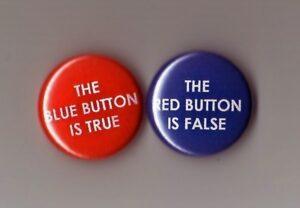
What the heck is going on?

I hear this a lot these days. Developments are happening too quickly to process for many folks, creating a persisting cloud of confusion.

Even focusing down on any particular single event often gets nowhere because so much of what’s going on simply makes so sense

Take for example, the W.H.O. which as recently as two weeks ago recommended that only sick people should wear masks.  What? We’ve known for months that people can spread Covid-19 when they are asymptomatic.  How can a ‘sick person’ wear a mask if they are sick but even they don’t know that? It just makes no sense.  What is even going on?

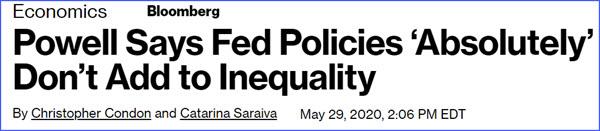
Or take Jerome Powell, Chair of the Federal Reserve, who defiantly declared that the Federal Reserve “absolutely does not” contribute to the wealth inequality gap:

(Source)

Say what?

The Fed is busy buying distressed financial assets for far more than they are worth from the largest and wealthiest of stock and bondholders.  That absolutely contributes to inequality.

So does juicing the stock market, or ““market”” as I like to term it (because it’s so distorted it needs two sets of quote marks).

So does appointing Blackrock – the world’s largest private asset manager – to select which private assets should be bought with the freshly-invented currency emanating from the Fed’s electronic printing presses.  Should we really be shocked to learn that Blackrock chose their own distressed assets, like the junk bond fund JNK, for the Fed to buy first?

It’s a bald-faced lie for Jay Powell to claim anything other than the Fed is the #1 contributor to inequality.  And that’s by a country mile.

So does Powell even think he can state such an obvious untruth and be taken seriously? And why does no one in the media seriously challenge him on this?

What the heck is going on?

The US government is supposed to be an open-book affair.  The public has both an interest and a right to know what’s going on with its money.

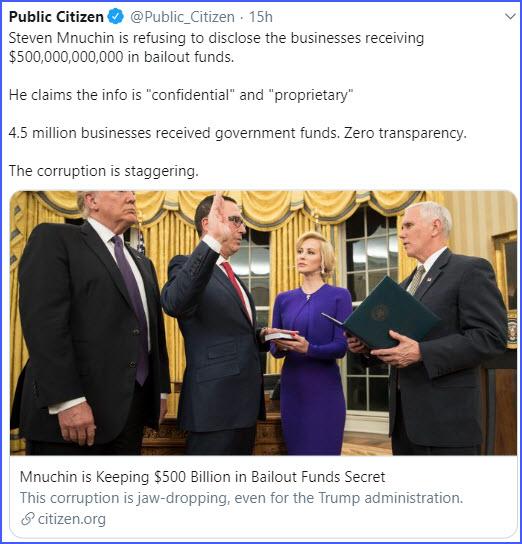
Yet somehow, US Treasury Secretary Steven Mnuchin believes that $500 billion in recent bailout funds shoveled out the door to US corporations both can be and needs to be kept secret:

How is this even possible?  How can anybody, let alone a sitting US Treasury Secretary think that it’s okay to keep $500 billion in fund disbursements a secret to the public? What the heck is going on?

At least this hasn’t entirely escaped everyone’s notice:

But ask the average person on the street? 99 out of 100 won’t have a clue this is going on.

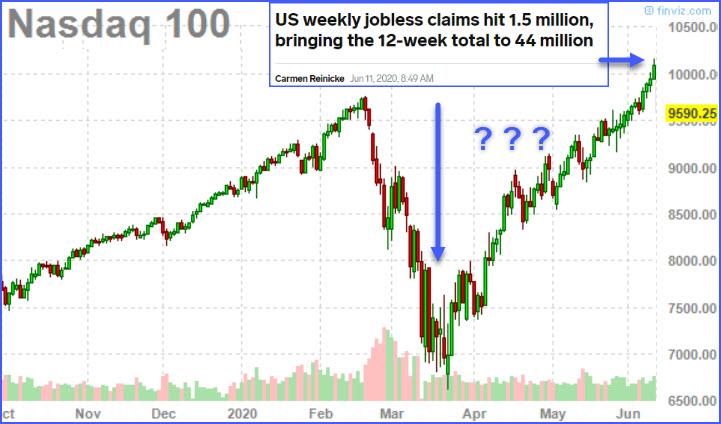
Look, in the US alone, 44 million people have applied for jobless claims over the past 12 weeks.  Over that same time period, thanks to the efforts of Jay Powell and the Federal Reserve, the Nasdaq 100 powered to brand new all-time highs:

The economy as measured by GDP is thought to have plunged anywhere from 15% to 50% during the quarter…and stocks were not just stable, but positively euphoric over those same 12 weeks, as if gleefully celebrating the largest loss of jobs in US history.

What the heck is going on?

What Comes Next

These and dozens of other weird, backwards, and truly unnatural acts are piling up; each difficult to understand on its own. But taken together, they reveal a current era of great uncertainty and upheaval.

There’s really no other explanation other than something has broken and it scares The Powers That Be to the point that they are wildly flailing about with increasing desperate policies, lies, and extreme actions that would have been unthinkable just a few months ago.

So, here we are.

The important question to ask yourself at this time is: What am I going to do about it?

For my part, I think that this current shock to the world economic system is too great to simply paper over.  The loss of economic activity as measured by the demand destruction for oil, which remains down some -20% to -25%, suggests very large future disruptions the economy and, more generally, our way of life.  Supply chains will run short of critical supplies and suddenly-blocked money conduits in the financial system imply a cascade of defaults are yet to come.

Nobody is smart enough to figure out in detail what any of that means. It’s just too huge and too complex.

So, what to do about it?  You become more resilient.  If you’re unsure if your paycheck is secure, you save money, begin thinking about ways to trim expenses, and fire up alternative income streams.  Just in case.

If you can’t be certain that the stores will always be stocked with food, you build up a deep pantry and start a garden.  Just in case.

If you doubt the ability of the Federal Reserve and Congress to ‘get it right’ you buy gold, invest in your home, and develop a buy list to execute if or when ‘they’ dial up the deficits, debt levels and money printing to even more ludicrous levels.  Just in case.

If you’ve been relatively isolated but want a community to enrich your life in good times and support you in bad ones, you dedicate more of your waking hours to doing things with and for your neighbors to strengthen those social bridges.  Just in case.

Here’s the thing: nobody knows what’s going to happen next.  Our economy, our machinery of state, and our global supply chains are all interconnected complex systems.   Such systems have two features:

  1. they are inherently completely unpredictable, and
  2. they have emergent behaviors

An emergent behavior is something that arises out of the conditions of the system.  Because humans are complex systems, we can use them as an example.

Put one set of humans in a desert with scant resources on and you’ll get one set of languages, culture, art, technology, and beliefs.

Pick up those same humans, drop them onto a lush and moist prairie and eventually you’ll get an entirely different set of languages, culture, art, technology, and belief systems.  The complexity of the ecology and the human species will yield different results under different circumstances.

Even though you know everything there is to know about humans, you cannot possibly predict what will emerge.  You can only observe these things as they emerge.

Similarly, our economy and its key derivatives — such as technology and systems of production and distribution — have emerged from the combined actions of billions of people using immense amounts of fossil fuel energy.

What can we expect from our new reality now that tens of millions of formerly-productive people aren’t working? Nobody knows because it’s unpredictable.  At the same time oil consumption, our primary energy input, is down by a shocking -20%.  What does that mean in terms of changes in behaviors and goods produced? Nobody knows.  We can only observe what emergent activity happens (or ceases to happen) next.

Here’s another thing to know about complex systems – perhaps the most important feature: they owe their complexity to the flows of energy through them.  More energy and they can become more complex.  Less energy and they become less complex, they simplify.

In economic terms, a reduction in energy throughput might manifest as a far simpler arrangement of fewer people working at fewer types of jobs.  Or it might mean fewer sorts of goods being produced and reduced services to choose among.  Again, we can’t know the future details; but the broad strokes can be defined — and ‘simpler’ is one of those broad strokes that comes along with a -20% drop in oil consumption.

Which is why because I cannot predict the outcome, I prepare.

As I’ve mentioned numerous times before, driven by a growing internal anxiety of the increasingly insensible developments around us, I purchased a 182-acre property earlier this year. One I’ve been hard at work restoring into a productive and highly-sustainable family homestead.

It’s time to reveal what I’ve been up to.

In Part 2: Building The Foundations Of  A Resilient Life, I give you a tour of the specific projects and installations my fiancee Evie and I have been busy with this hectic spring. An important goal of mine as we work to fully activate this property’s potential is to produce a body of “how to” content to help guide you and anyone else interested in making their home more resilient.

It’s the only way I know how to make sense out of today’s increasingly insensible world.

Click here to read Part 2 of this report (free executive summary, enrollment required for full access).


via IFTTT
InoreaderURL: SECONDARY LINK

25,000 More Store Closures Expected As Pandemic-Fueled "Retail Apocalypse" Rolls On


The one discussion bulls chose to ignore while equity markets soar to new highs is the permanent economic damage story due to months of coronavirus lockdowns.

ORIGINAL LINK