
In February, US Covid guru Anthony Fauci predicted the virus was ‘akin to a severe flu’ and would therefore kill around 0.1 percent of people. Then fatality rate predictions were somehow mixed up to make it look ten times WORSE.
ORIGINAL LINK

Seeking Truth in a World of Propaganda. Links do not necessarily indicate agreement with stories or perspectives.
“Those who are able to see beyond the shadows and lies of their culture will never be understood, let alone believed, by the masses.” - Plato


A new report by the Pew Research Center found that a majority of young adults — 52% — lived with one or both of their parents in July. Pew’s analysis of monthly Census Bureau data notes that this is higher than any previous measurement.
For purposes of this report, Pew defined a “young adult” as anyone that is in the 18 to 29-year-old age bracket.
At this point, 26.6 million young people are living with their parents. We have never seen a number this high, although Pew suspects that the level may have been higher during the Great Depression of the 1930s…
“Before 2020, the highest measured value was in the 1940 census at the end of the Great Depression, when 48% of young adults lived with their parents,” says the report, published Friday. “The peak may have been higher during the worst of the Great Depression in the 1930s, but there is no data for that period.”
In any event, what we are witnessing right now is extremely alarming.
Many tend to think of young people that live with their parents as lazy or unproductive, but that is not necessarily the case. Many of them were working extremely hard to make it on their own, and as Jeremy Sopko has pointed out, “nobody wants to be living at home with mom and dad”…
‘For the most part, nobody wants to be living at home with mom and dad,’ Jeremy Sopko, CEO of Nations Lending Corporation, a mortgage lender told the Huffington Post.
‘It’s a difficult situation that’s been exacerbated by the pandemic and it may take years, if not the better part of a decade, for younger demographics to recover and be financially stable enough to leave home.’
And many parents may not be too thrilled to have their adult children living at home either.
But at this point we need to realize that times have fundamentally changed.
As economic conditions become even rougher, we are going to increasingly see situations where multiple generations are living under one roof, and there is nothing wrong with that. Having each generation live separately in different homes is a relatively modern phenomenon, and it has been made possible by our incredible affluence. But as the economy continues to collapse, survival is going to take precedence over convenience.
All over the nation, family is going to have to take care of family. None of us can possibly take care of everyone out there that is hurting, but if we all take care of our family members that will make a tremendous difference.
If you have a home, you are going to need to be prepared to take in members of your family and extended family that fall on rough times.
If you don’t have a home, you will need to be humble enough to ask other members of your family or extended family for help if you need it.
I know that a lot of people may not like what I am suggesting, but we have to realize that the old rules don’t apply anymore.
We are in the middle of the worst economic collapse in modern times, and things are going to get much, much worse.
Already, some of the economic numbers that we are seeing are hard to believe because they are so bad.
For example, it is now being projected that 63 percent of all restaurants in New York are “likely to close by the end of the year”…
On Thursday, the New York State Restaurant Association published the results of a survey that found the state’s restaurants are in need of financial support from the government after months of closures during the coronavirus pandemic.
According to the survey, 63.6% of restaurants in New York said they are “likely to close by the end of the year” without a relief package and only 36.4 percent said they are “likely or somewhat likely to remain open.”
63 percent.
How bad do things have to get before the economic optimists will admit that we have a complete and utter economic disaster on our hands?
And the civil unrest that is plaguing major cities all over the country just continues to roll on.
On Sunday, President Trump tweeted out a video of a rioter in Portland that accidentally set himself on fire with a Molotov cocktail…
President Donald Trump ridiculed ongoing protests in Portland by tweeting a video of an activist accidentally setting himself on fire with a Molotov cocktail.
‘These are the Democrats “peaceful protests”. Sick!’ Trump panned on Sunday as he retweeted a clip of the activist and fellow protesters desperately trying to extinguish the blaze engulfing his pants.
This is the kind of civil unrest that I have been warning about for years, and now it is here.
There have been violent protests in Portland for 100 nights in a row, and that streak isn’t going to end any time soon.
And now the presidential election is less than two months away, and many fear that this will take things to an entirely new level. If you would like to read my analysis of what is potentially ahead, please see my recent article entitled “Why We Are Facing The Biggest Election Nightmare In Modern American History No Matter Who Ends Up Winning”.
Things are going to get really nuts in the months ahead, and there will be no going back to the way that things were before.
When things get really difficult for you personally, you may need to move in with your parents or other members of your extended family.
On other other hand, if you are in good shape financially you may need to be the one that takes in members of your family or extended family.
Making it through what is ahead is not going to be easy, and we are all going to need someone to lean on at some point.
***Michael’s new book entitled “Lost Prophecies Of The Future Of America” is now available in paperback and for the Kindle on Amazon.com.***
About the Author: My name is Michael Snyder and my brand new book entitled “Lost Prophecies Of The Future Of America” is now available on Amazon.com. By purchasing the book you help to support the work that my wife and I are doing, and by giving it to others you help to multiply the impact that we are having on people all over the globe. I have published thousands of articles on The Economic Collapse Blog, End Of The American Dream and The Most Important News, and the articles that I publish on those sites are republished on dozens of other prominent websites all over the globe. I always freely and happily allow others to republish my articles on their own websites, but I also ask that they include this “About the Author” section with each article. In addition to my new book, I have written four others that are available on Amazon.com including The Beginning Of The End, Get Prepared Now, and Living A Life That Really Matters. (#CommissionsEarned) The material contained in this article is for general information purposes only, and readers should consult licensed professionals before making any legal, business, financial or health decisions. I encourage you to follow me on social media on Facebook and Twitter, and any way that you can share these articles with others is a great help. During these very challenging times, people will need hope more than ever before, and it is our goal to share the gospel of Jesus Christ with as many people as we possibly can.
The post Over Half Of All Young Adults Are Living With Their Parents – Highest Level In Modern American History appeared first on The Economic Collapse.
The notion that the US will experience a resurgence in COVID-19 cases this fall is almost starting to look like a self-fulfilling prophecy.
A couple of weeks ago, as coronavirus cases were just starting to climb in the state of Iowa, the Daily Iowan, the student newspaper at the University of Iowa, published a harrowing account of one student's trip through the campus quarantine procedure after testing positive for COVID-19 on campus.
The student described confusion and disorder every step of the way, apathetic staff, and substandard living conditions in the "quarantine" dorms. She eventually decided to walk away from it all and return home to Illinois. The student's story wound up in the press after going viral after being shared on student life social media pages.
"I felt like a guinea pig," she told the Daily Iowan.
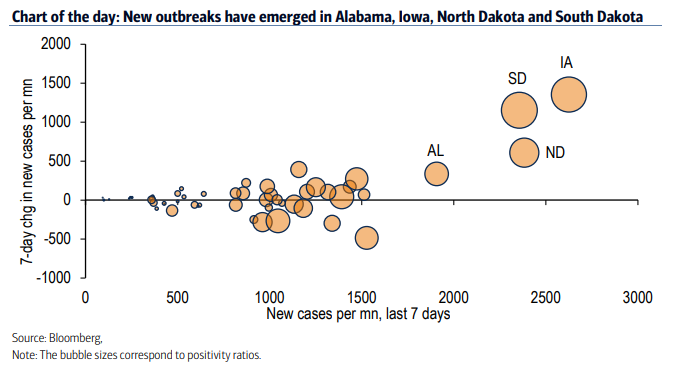
Since then, Iowa has become host to one of the fastest growing outbreaks in the US.
Outbreaks on college campuses have received growing national attention in recent weeks as more universities opt to send students home, despite a growing scientific consensus that sick students would be better off remaining on campus.
Ravina Kullar, epidemiologist and spokesperson for Infectious Diseases Society of America, said schools should quarantine students on campus, and that students shouldn't be sent home.
Amazingly, schools have rejected this guidance seemingly en masse, risking a repeat of one of the dynamics that definitely helped spread COVID-19 across the country. As Bloomberg reports, schools around the country are increasingly sending students home, often due, it appears, to their own inability to effectively execute hastily organized plans to deal with sick students. Instead of taking responsibility and risking more financial losses.
Some schools have seen infection rates north of 1% for their student populations. Ohio State saw 1.6% of students test positive during the latter half of August.
At Ohio State University, President Kristina Johnson sent an email to the more than 60,000 students, faculty and staff Thursday urging them all to “act as though you are positive” going into Labor Day weekend.
Between Aug. 14 and Sept. 1, about 1.6% of the public flagship’s student population — 1,052 students — contracted the disease. Deans “can pretty much trace” the spread from party to party, and the ability of the university to provide in-person education will rely on students’ restraint, Governor Mike DeWine said at a news conference.
“No one is telling students to hibernate for nine months or the whole year,” he said. “Look, this is the reality: If the numbers get too high and the spread is too much, these schools are going to have absolutely no choice but to pull back.”
But will schools simply do the right thing and "pack it in" if things get out of hand. Maybe some will. But that seems like a naive assumption.
Some students were left adrift after schools abruptly quarantined, or closed, their dorms, due to a cluster of infections. Those unable to find an alternative, perhaps an off campus apartment, might be forced to return home and complete their "semester" online.
As classroom doors close, some students are rushing home. Others are looking for off-campus housing. Many students, parents and administrators are frustrated,
After a flight from New York to Denver and a two-hour car ride, Laurie Meehan and her son Christopher, an 18-year-old freshman, arrived at Colorado College on Aug. 16. He and his two roommates tested negative upon arrival, but his dorm was quarantined Aug. 29. He was told this past week that students had to leave university housing by Sept. 20 and now, he’s quarantining alone in a triple room.
Christopher and his parents would like him to stay in Colorado and take advantage of the outdoor activities.
“He and a number of other students are trying to find housing,” said Laurie Meehan, 52. “Some are looking in mountain towns because there are so many rental properties available.”
Administrators across the country are finding that they grossly underestimated students inability to comply with social distancing restrictions, as they pack on campus bars and outdoor 'dartys' - day parties - during Greek Life rush season. Even without sports, the entire point of going to college, for most of these kids (at least the ones majoring in liberal arts) is partying. And that's one thing you can't do online.
The media has responded by selectively shaming students and fraternities and schools. Many have been kicked off campus, or seen their entire semester's tuition seized and been kicked out, for posting on social media about parties that violated school rules.
The reversals have been predictable, said Robert Kelchen, an associate professor of higher education at Seton Hall University in South Orange, New Jersey. “Colleges told their students most of the summer that things would be reasonably close to normal,” Kelchen said.
“They expected college students to stay to themselves or in very small groups of friends. That’s not how the college experience works."
In Tuscaloosa, University of Alabama students packed bars last month after sororities chose their members on their Bid Day, an annual spectacle that involves herds of undergraduate women racing and cheering before large crowds of onlookers.
A few days before students had returned Aug. 23, the school said only 237 of them had tested positive. The number is now more than 1,200. The university had 450 housing units reserved to quarantine students, but exceeded that capacity in less than a week. The school has received 400 reports of students breaking rules about masks and social distancing, and has removed several from class, according to a memo from President Stuart Bell. Officials haven’t suggested sending students home, saying that would spread the virus to their relatives and communities.
Even the "smart" kids have paid little attention to the Rules. The Detroit News found the bars and hotspots in Ann Arbor packed with students, most of whom ignored social distancing rules as they drank and partied into the night.
But UM is hardly alone among Michigan's public schools.
Central Michigan University now has 260 cases traced to the Aug. 17 return of students, including people living in and around the community, according to the Central Michigan District Health Department that serves six mid-Michigan counties.
USA Today has apparently been keeping a close eye out for stories about students being dismissed without a tuition refund for violating COVID-19 rules. Northeastern University dismissed 11 first-year students after they were discovered partying together in a crowded room at the Westin Hotel in Boston on Wednesday night. They will not receive refunds on their payments for the semester. We imagine the private school's budget really needed that extra $1 million in tuition, when the school has an endowment of more than $1 billion.
While it's easy to dismiss this behavior as reckless young people taking dangerous risks, one professor pointed out that depending on young people to behave any differently was a mistake to begin with, and instead of "shaming" them, schools must find a way to roll with it, so to speak.
Universities didn’t acknowledge the inevitable risk that college students take, said Gavin Yamey, a physician and professor of global health and public policy at Duke University in North Carolina.
“Shaming young people for risky behavior at a time when we know they are in young adulthood, when risk taking is at its peak, is an ineffective public health strategy,” said Yamey, who directs Duke’s Center for Policy Impact in Global Health.
After its student newspaper made a stink about the growing number of cases on campus, UNC became the first school in the country to send students home on Aug 17, despite the fact that this strategy has met with no small degree of criticism from epidemiologists. When confronted with a similarly severe outbreak as UNC, Notre Dame took steps to fight the virus, but opted to keep students on campus. That strategy appears to have paid off.
However, the extreme difficulty schools are having containing the virus probably means that President Trump's wish to see college football revived for the fall season probably won't be granted.
The University of Dayton has the highest number of COVID-19 cases of any college in Ohio, and is among the highest in the Midwest, according to a local TV station report, which cited numbers released from colleges and universities covering the last days of August and first of September. As of its latest data on Aug. 31, University had 771 positive cases and had 55 new daily cases.

|
Thank you, Royce M. ($150), for your beyond-outrageously generous contribution to this site -- I am greatly honored by your steadfast support and readership.
|
Thank you, Eliot E. ($5/month), for your superbly generous pledge to this site -- I am greatly honored by your support and readership.
|

No he didn’t. People will often claim there are Twitter direct messages (DMs) of Assange and the right-wing serial liar Roger Stone scheming together in the lead-up to the 2016 election, but the only DMs between Stone and the @WikiLeaks account (presumed but not proven to be Assange) from that time period are WikiLeaks telling Stone to stop falsely claiming that the two have been talking.
Stone had been publicly boasting of having a WikiLeaks back channel (a claim the alleged back channel Randy Credico has always rejected), and when WikiLeaks publicly denied this Stone angrily messaged their Twitter account.
From The Atlantic, where the leaked DMs between Stone and WikiLeaks were first published:
On the afternoon of October 13, 2016, Stone sent WikiLeaks a private Twitter message. “Since I was all over national TV, cable and print defending wikileaks and assange against the claim that you are Russian agents and debunking the false charges of sexual assault as trumped up bs you may want to rexamine the strategy of attacking me- cordially R.”
WikiLeaks — whose Twitter account is run “by a rotating staff,” according to Assange — replied an hour later: “We appreciate that. However, the false claims of association are being used by the democrats to undermine the impact of our publications. Don’t go there if you don’t want us to correct you.”
That’s the only record of any communication between Stone and WikiLeaks prior to the 2016 election: a square refutation of the claim that Stone conspired with WikiLeaks.
With the media poised to pounce on negative Covid headlines at any chance they are given, it is more important now than ever to make sure that those headlines are accurate.
Inaccurate headlines can cause an uproar, as we found out last week when it was falsely reported that an astonishing 30% to 35% of Big Ten college athletes that were positive for Covid also had myocarditis - inflammation of the heart muscle. It was an astonishing figure that may left the world thinking: if 30% to 35% of college athletes were getting it, surely everyone else was, too.
The reports generated sprawling headlines in national media over the next few days, like this one in USA Today:

And this one from the Pittsburgh Post-Gazette:
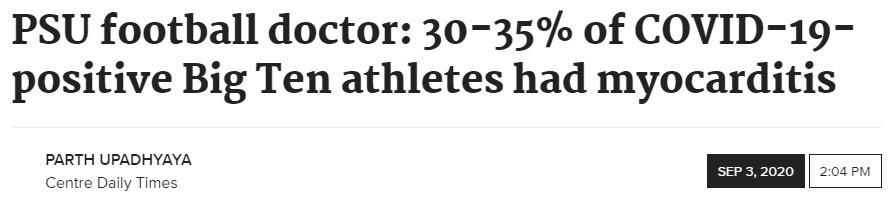
"When we looked at our COVID-positive athletes, whether they were symptomatic or not, 30 to roughly 35 percent of their heart muscles are inflamed ... and we really just don't know what to do with it right now. It's still very early in the infection. Some of that has led to the Pac-12 and the Big Ten's decision to sort of put a hiatus on what's happening," Penn State Doctor Wayne Sebastianelli said on Monday.
Reports like the one in USA Today read: "...cardiac scans of Big Ten athletes who contracted COVID-19 showed '30 to roughly 35 percent of their heart muscles' indicated symptoms of myocarditis."
The figured sounded enormous to us; in fact, we almost did a write up on the headline earlier this week but decided to hold off to see if more information would become available.
And, lo and behold, more information did become available. Turns out the earlier headlines simply weren't true.
In what can only be described as a barrage of corrections from places like The Washington Post and CNN published less than 48 hours from the original report, it was revealed that the doctor was "unintentionally citing outdated numbers".
A spokesman for the school's health department clarified: "During his discussion with board members, (Sebastianelli) recalled initial preliminary data that had been verbally shared by a colleague on a forthcoming study, which unbeknownst to him at the time had been published at a lower rate."
The continued: "Additionally, some have inferred his comments may have related directly to Penn State student athletes. At this time, there have been no cases of myocarditis in COVID-19 positive student-athletes at Penn State."
Regardless, the Big 10 conference has already announced that it would be postponing fall sports as a result of the coronavirus. A conference spokesperson said:
"As time progressed and after hours of discussion with our Big Ten Task Force for Emerging Infectious Diseases and the Big Ten Sports Medicine Committee, it became abundantly clear that there was too much uncertainty regarding potential medical risks to allow our student-athletes to compete this fall."

