We have all heard anecdotes. Now we are finally starting to get some data.
Jean Twenge is a leading researcher studying trends in anxiety and depression among children and teens. She and her colleagues surveyed a demographically representative nationwide sample of 1,523 adolescents between May and July of this year. The results, recently released, are surprising.
For many years, the Centers for Disease Control and Prevention (CDC) has conducted periodic surveys of American adults to gauge the prevalence of anxiety and depression. When the pandemic hit the United States earlier this year, the leadership at the CDC recognised that it would be wise to increase the frequency of those surveys from once or twice a year to twice a month.
The baseline rate of depressive symptoms among American adults in the CDC survey in 2019 was 6.5 percent. The most recent cycle of the CDC survey, which concluded November 23 and involved 61,254 adults nationwide, found a prevalence of 28.6 percent. That’s more than quadruple the 2019 baseline rate.
The CDC page also allows you to break down the results by age. Those results show a trend: among adults, the older you are, the lower the risk of symptoms of depression. For the youngest adults, 18 to 29 years of age, 43.4 percent reported significant symptoms of depressive disorder for the cycle ending November 23. Among the oldest adults, 80 years and older, a comparatively lower rate of 18.2 percent reported significant symptoms of depressive disorder during the same time period.
What about adolescents? If we extrapolate from the CDC results for adults, we might expect to find a rate of depressive symptoms even higher among school-age adolescents than the 43.4 percent rate found among the youngest adults. But that’s not what Twenge and her colleagues found. The rate of depressive symptoms among school-age adolescents surveyed during the pandemic was just 20 percent. That result is not only lower than the rate among young adults age 18 to 29 in the CDC survey; it’s lower than the result from a similar survey of adolescents in 2018, when 27 percent of adolescents reported symptoms of depressive disorder.
In other words, adolescents during the pandemic were actually less likely to report symptoms of depression compared with a comparable cross-section of adolescents two years previously, before the pandemic. What’s going on?
The Importance of Family
Twenge and colleagues asked teens whether their families had become closer during the pandemic. Fully 68 percent of teens said their families had become closer during the pandemic. Among teens who said that their families had become closer during the pandemic, only 15 percent were depressed. Among teens who said that their families had not become closer during the pandemic, 27 percent were depressed.
As a family doctor, I have seen firsthand how teens are coping, or not, with the pandemic. I can tell you in two minutes or less whether a particular teen has become closer to his or her family during the pandemic, or not. Some teens are thriving. They make good eye contact with me in the office. They smile. They may be injured, or physically ill — that’s why they have come in to be seen — but besides their illness or injury, they are doing just fine.
Other teens are sullen, withdrawn, and resentful. Those teens are — in every case, in my experience — teens who have not become closer to their family during the pandemic. Those parents have allowed their kids to hole up in their bedrooms, eating their meals alone, spending many hours a day looking at screens.
In defense of those parents, they may just be following the advice of the New York Times parenting experts, who, early in the pandemic, advised parents to “just give them the screens” because “limits on device time are going out the window.” Those morose teens seem to be happy only when they are on social media apps, or playing video games.
Those teens’ primary attachment is to other same-age peers. The pandemic has turned their world upside down, because their favourite activity — being with their friends — has been severely curtailed by the virus. In my office, when those teens are deprived of their screens, they are silent and unhappy. It’s not unusual for such a teen to stay on his phone throughout the entire visit in the office, unless I ask the kid to put the device away.
The Importance of Sleep
The other piece of the puzzle has to do with sleep. More and more teens are going to bed with their phones. According to the latest comprehensive nationwide survey, 68 percent of teens now keep a mobile device (most often a phone, less often a tablet) either actually in their bed or within easy reach after getting in bed.
In that survey, 58 percent of girls and 41 percent of boys reported waking up to check their mobile device after falling asleep. Checking your mobile device after bedtime has consequences. In a meta-analysis of twenty studies involving a total of 121,072 children and teens, researchers found that kids who used their device after going to bed were more than twice as likely to get inadequate sleep. They were almost three times as likely to be sleepy during the daytime compared to kids who didn’t have a phone in their bedroom.
The same meta-analysis found that just having a phone in a bedroom can disrupt kids’ sleep, even if kids don’t use the phone. Kids who had a phone in the bedroom but didn’t use it were nearly twice as likely to get inadequate sleep and more than twice as likely to be sleepy during the daytime, compared to kids who didn’t have a phone in the bedroom. Some part of your unconscious knows that your phone is there, and that the phone could be activated. That unconscious awareness disrupts your sleep.
In 2018, only 55 percent of teens reported getting seven or more hours of sleep a night. But in the survey conducted by Twenge and colleagues earlier this year, during the pandemic, a whopping 84 percent of teens reported getting at least seven hours of sleep a night. With so many schools conducting classes remotely, kids are sleeping in later. Twenge and colleagues believe that increased sleep is the second major factor accounting for the lower prevalence of depression among teens now compared with 2018.
Lead Your Children Not Into Temptation
The lessons are clear. Use the social-distancing restrictions imposed by the pandemic as a mechanism to bring your family closer together. You may have to be distanced from others, but you can spend more time face-to-face doing family things together. That could be a hike outdoors, or a board game, or just a leisurely supper together. Don’t let your kid hole up in their bedroom with their screens, no matter what the New York Times might advise.
And make sure your kid is getting plenty of sleep each night. That means no phone in the bedroom. When I meet with parents, I advise them to take their kids’ phones from them every night, at 9:00 at the latest, and put the phone in the charger, which should stay in the parents’ bedroom.
During Q&A after one of my presentations, a father raised his hand. “Dr. Sax, I agree with everything you say about the importance of kids getting a good night’s sleep,” he said.
“But I don’t think I need to physically remove the phone from my daughter’s bedroom. My daughter puts her phone in airplane mode every night at bedtime. That way she won’t be interrupted during the night. She uses her phone as her alarm clock. So when her alarm clock app wakes her up in the morning, she switches her phone out of airplane mode and back into regular mode.”
“How do you know she keeps her phone in airplane mode all night long? How do you know she doesn’t switch it back into regular mode during the night?” I asked.
Dad was clearly offended by my question. “Dr. Sax, you’re suggesting that my daughter would lie to me. My daughter would never lie to me.”
“Sir, I don’t know you, and I don’t know your daughter,” I said. “But based on the research, I can tell you that your daughter is more likely to lie to you than to anybody else. Because she doesn’t want to disappoint you. She doesn’t want to let you down.”
Dad muttered something under his breath.
“There’s great wisdom in the Lord’s Prayer,” I continued. “Jesus said ‘Lead us not into temptation.’ He didn’t say ‘Make us strong to resist temptation,’ because Jesus knew the human heart. He knew that if you put temptation before us, we will fall. Don’t put that stumbling block in your daughter’s path.
“This has to be your call, the parents’ call,” I continued, speaking now to the whole group. “It’s not age-appropriate to put this burden — the question of whether or not to have a phone in the bedroom — on the shoulders of your 15-year-old daughter. What’s she supposed to say tomorrow in school when her friend says, ‘I texted you last night at midnight. Why didn’t you answer?’ What’s your daughter supposed to say? Is she supposed to say, ‘I turn my phone off and put it in a different room at bedtime, because having a phone in the bedroom has been shown to disrupt sleep, and researchers have found that sleep deprivation in adolescence is a major risk factor in the etiology of depression’? It’s unrealistic to expect any teenager to talk like that. You must allow your teenager to say, ‘My evil parents take my phone every night at 9:00, and they won’t let me have it back till the next morning!’ You have to be willing to be the ‘evil’ parent, for your kid’s sake.”
The end of the pandemic is now in sight. Let’s hold on to some of the good things we have learned, some of the good habits that we (hopefully) have established. That means no phones in the bedroom. A good night’s sleep. And more time together as a family.
If we can do those things — if the end result of the pandemic is a strengthening of the family — then there may be a silver lining to this cloud.
The Food and Drug Administration (FDA) confirmed that the Pfizer covid vaccine is 95 percent effective, but what does that statement mean? The details of the Pfizer covid vaccine trial can be found here. As was the case in the previous announcement about the vaccine, this “efficacy” figure is misleading. The incidence of covid “cases” in the placebo group was 162 out of 18,325 subjects, or less than 1 percent. The incidence of “cases” in the vaccine group was 8 out of 18,198, or about one-twentieth the incidence of “cases” in the placebo group. The “efficacy” of 95 percent is an odds ratio between groups, but this ratio is comparing two uncommon or rare events. Although the benefit was statistically significant, the number to vaccinate in order to prevent a single “case” was 122, which is not nearly so impressive. For severe cases, the result was not statistically significant due to very small numbers (one severe case in the vaccine group and three severe cases in the control group). Even if these percentages persisted to statistical significance with larger numbers of subjects, the number to vaccinate in order to prevent a single severe case was over nine thousand, which is not impressive at all. There has been no statistically significant mortality benefit to date, and none of the deaths in either group (two in the vaccine group and four in the control group) were associated with covid-19.
Details of Trial
This was a double-blinded randomized control trial with 21,823 subjects in the vaccine group and another 21,828 subjects in the placebo group. Double-blind trials mean that neither the subjects nor the caregivers know whether subjects received vaccine or placebo. Randomized means that the subjects were put into the vaccine or placebo group by chance. The randomization is performed in a manner to balance the vaccine and placebo groups on the basis of significant characteristics such as age, race, and comorbid medical conditions. Subjects could not choose the group into which they would be enrolled.
The primary end point of the trial was the development of a covid case. A case was defined as the presence of one or more symptoms (fever, new or increased cough, new or increased shortness of breath, chills, new or increased muscle pain, new loss of taste or smell, sore throat, diarrhea, or vomiting) followed by a positive polymerase chain reaction (PCR) test for the virus associated with the disease covid-19. No details about the cycle count of the PCR tests were provided. Subjects were instructed to get a PCR test if they developed any of the symptoms. The vast majority of these “cases” would be self-limited with a few days of mild symptoms.
A secondary end point was a “severe” case. A “severe” case required one of the following conditions: clinical signs at rest indicative of severe systemic illness (respiratory rate greater than or equal to 30 breaths per minute, heart rate greater than or equal to 125 beats per minute, arterial oxygen saturation less than or equal to 93 percent at sea level on room air, or hypoxemia defined as a PaO2/FiO2
None of the trial deaths could even be associated with covid-19, let alone attributed to it. At this time, there is no evidence for a mortality benefit from the vaccine.
Some subjects were excluded due to evidence of infection prior to dose 1. Some subjects failed to properly complete informed consent. Some subjects withdrew prior to completing dose 1 and dose 2. Some subjects were excluded due to evidence for infection prior to fourteen days after dose 2. These patients may have been infected before completing treatment. A total of 18,198 subjects were considered free of disease following dose 2 in the vaccine group and another 18,325 subjects were analyzed following dose 2 in the placebo group. The vaccine and placebo groups had similar composition by age, race, and body mass index (BMI). The trial was well designed to detect vaccine efficacy.
What about side effects? Side effects from the vaccine include local reactions from the injections and systemic reactions including fever, fatigue, headache, chills, vomiting, diarrhea, and new or worsened pain in joints or muscles. Of those subjects between ages 18 and 55, 638 (27.8 percent) required the use of antipyretic or pain medication within 7 days of the first injection; 945 (45 percent) required medication after the second injection. Only 332 (14.4 percent) of the control group required medication after the first placebo injection, and 266 (12.6 percent) required medication after the second placebo injection. Somewhat fewer subjects over the age of 55 required medication: 358 (19.9 percent) of the vaccine group required medication after dose 1; 625 (37.7 percent) of the vaccine group required medication after dose 2; 213 (11.9 percent) of the control group required medication after dose 1; and 161 (9.8 percent) of the control group required pain medication after dose 2.
Conclusions
The Pfizer control or placebo population had a 0.8 percent chance of becoming a covid-19 “case” within 105 days. Subjects in the placebo group had a 99.2 percent chance of being covid-19 negative for 105 days. The vaccine reduced that 0.8 percent chance for becoming a covid “case” by 95 percent to 0.04 percent. This is where the 95 percent efficacy figure comes from. On average it took 122 vaccinations to prevent a single “case” of covid-19. It is unclear whether the vaccine will protect against hospitalization. There were more hospitalizations in the control group than in the vaccine group, but the numbers were too small to be statistically significant. If the numeric trends continued for larger numbers of subjects, it would take over nine thousand vaccinations to prevent a single hospitalization. There is no evidence for a mortality benefit from the vaccine at this time. Up to 45 percent of subjects receiving both doses of vaccine will require medication to treat systemic side effects. Based on the evidence to date, I will take my chances with the virus rather than risk the known and unknown side effects of this vaccine.
“As Virus Spreads, C.D.C. Draws Up an Urgent Battle Plan”, reads the headline of a December 4 article in the New York Times by Rony Caryn Rabin and Apoorva Mandavilli.
ORIGINAL LINK Fashion Exec Peter Nygard Arrested Amid SDNY Indictment On Teenage Sex Trafficking, Racketeering ChargesTyler DurdenTue, 12/15/2020 - 17:05
Canadian fashion mogul Peter Nygard has been arrested in Winnipeg under the extradition act after federal prosecutors in New York slapped the 79-year-old with a nine-count indictment in the Southern District of New York. He has been accused of sex-trafficking, racketeering, and sexually assaulting dozens of teenage girls and women.
The arrest follows a February raid on his Manhattan headquarters by the FBI and NYPD, after 10 women accused Nygard of enticing young and impoverished women to his estate in the Bahamas after promising them modeling gigs and cash.
According to NBC New York, "several plaintiffs in the suit said they were 14 or 15 years old when Nygard gave them alcohol or drugs and then raped them."
Fifty-seven women — including 18 Canadians — have joined the lawsuit, which alleges that Nygard used violence, intimidation, bribery and company employees to lure victims and avoid accountability for decades.
Nygard has denied all allegations and blames a conspiracy caused by a feud with his billionaire neighbor in the Bahamas.
Nygard International began in Winnipeg as a sportswear manufacturer. Its website says its retail division has more than 170 stores in North America. -NBC New York
Nygard has been used of using his company, along with birbery of Bahamian officials and "considerable influence in the fashion industry" to recruit victims in the United States, Canada and the Bahamas, and that he plied victims with alcohol and drugs during "pamper parties."
The fashion mogul has racked up decades of sexual misconduct allegations culminating in lawsuits from nine women. According to a February report in the New York Times:
The New York Times detailed how a fight with his wealthy neighbor led to the lawsuit, and also showed a pattern of complaints about sexual misconduct by Mr. Nygard stretching back 40 years.
Nine women in Canada and California, mostly employees, have sued him or reported him to authorities alleging sexual harassment or assault since 1980. In addition, another nine former employees told The Times in interviews that he raped them, touched them inappropriately or proposed sex. -NYT
The Times interviewed the 10 women at the time - most of whom confirmed that Nygard raped them during "pamper parties" in the Bahamas, his home since 1986. The parties, which mostly took place on Sundays at his lavish estate, featured young women who would receive 'pedicures, massages, Jet Ski rides and endless alcohol,' according to the report.
Nygard has denied the charges, claiming that his adversary and neighbor in the Bahamas - hedge-fund billionaire Louis Bacon and his private investigators are behind the charges. Bacon says he wanted to get justice for the women.
See here for more on the spat between Nygard and Bacon.
Meanwhile, Nygard was also investigated in late 2015 and the summer of 2017 on sex-trafficking allegations. He was also probed by the Department of Homeland Security, which investigated him for nine months with no result.
ORIGINAL LINK Joe Biden Warned In 2015 That Son Hunter's New Employer And Burisma Boss Was CorruptTyler DurdenTue, 12/15/2020 - 15:15
In today's episode of 'Things that should have come out during the impeachment,' just-released diplomatic memos reveal that Vice President Joe Biden's office was warned in 2015 that the Ukrainian oligarch who hired his son, Hunter, was deemed corrupt - and that the US Justice Department had gathered evidence to support that conclusion, according to Just The News.
"I assume all have the DoJ background on Zlochevsky," wrote former US Ambassador Geoffrey Pyatt in Kiev in a 2015 letter to Biden's top advisers, referring to Burisma Holdings founder Mykola Zlochevsky.
"The short unclas version (in non lawyer language) is that US and UK were cooperating on a case to seize his corrupt assets overseas (which had passed through the US)," Pyatt added, noting that the asset forfeiture case against the Ukrainian billionaire "fell apart" when individuals in the Ukrainian prosecutor general's office "acted to thwart the UK case."
Talking points
Pyatt's email also includes responses to several talking points Joe Biden's Washington staff crafted, should he be questioned about Hunter's role on the board of Burisma.
"Have you asked Hunter to step down from the board? Has he discussed that with you?" the talking points anticipated being asked.
"I'm not going to discuss private conversations with my family. Hunter is a private citizen and does independent work," the memo recommended the vice president answer.
If pressed by a question asking whether Joe Biden thought "Zlochevsky is corrupt," the talking points suggested the vice president respond, "I'm not going to get into naming names or accusing individuals." -Just The News
As JTN notes, the New York Times published an article days after Pyatt's email suggesting that Hunter's role at Burisma while it remained under a corruption investigation was potentially undercutting US anti-corruption policy.
"Separately, a Russian-backed media outlet in Ukraine had written an even more scathing expose on what it called the "Ukrainian scam of the Biden family." That article sent State officials scrambling to develop messaging for the U.S. government," according to Just The News.
The memos, released last week by Senate committees investigating Hunter Biden, also reveal that the US Justice Department was involved in the 2014 asset forfeiture brought against Zlochevsky in the UK, right as Hunter Biden was hired to sit on the board of Burisma.
Multiple State officials have attested to the awkward appearance of conflict of interest posed by Hunter's position on the board as the United States led efforts to fight corruption in Ukraine. In a September, 2015 speech, Pyatt railed against Ukrainian prosecutors for thwarting the UK asset forfeiture case against Zlochevsky.
Pyatt was recently deposed by investigators for the Senate Finance Committee and the Senate Homeland Security and Government Affairs Committee about the Ukraine controversy. Though his staff had reported an alleged Burisma bribe and believed the Bidens' conduct in Ukraine created an apparent conflict, Pyatt said he never felt compelled to raise such concerns with the vice president.
"So you never gave thought of raising a concern to the Vice President about this board position his son had?" a Senate investigator asked Pyatt during the deposition back in September.
"No," the ambassador answered. "He's the Vice President of the United States, and it would have been wildly out of place for me to raise something like that, especially insofar as it had zero impact on the work that I was doing." -Just The News
Meanwhile, let's not forget that according to evidence from Hunter Biden's laptop published by the New York Post, Biden didn't just know about his son's business dealings in Ukraine and elsewhere, he participated in them.
And Democrats impeached Trump for asking Ukraine to investigate.
A peer-reviewed study by Hooker and Miller in the journal SAGE Open Medicine compared the health outcomes of vaccinated versus unvaccinated children from three large pediatric practices in the United States. The study concluded that unvaccinated children are healthier than their vaccinated peers.
I have now posted over 65 vaccinated/unvaccinated studies on this site. All of them show dramatically better health in unvaccinated children. We have found no studies that show superior health outcomes in vaccinated children.
ORIGINAL LINK
Some people might not be familiar with the verb "to dissemble", but we all need to become familiar with it because there is a lot of dissembling going on. It basically means to deliberately conceal something or obfuscate it, so that one's attention is misdirected or deflected from whatever the Dissembler wishes to obscure. Like the truth. And in this case, the truth about the Nuremberg Code and the protection it provides us from accepting any forced medical procedure or therapy at all.
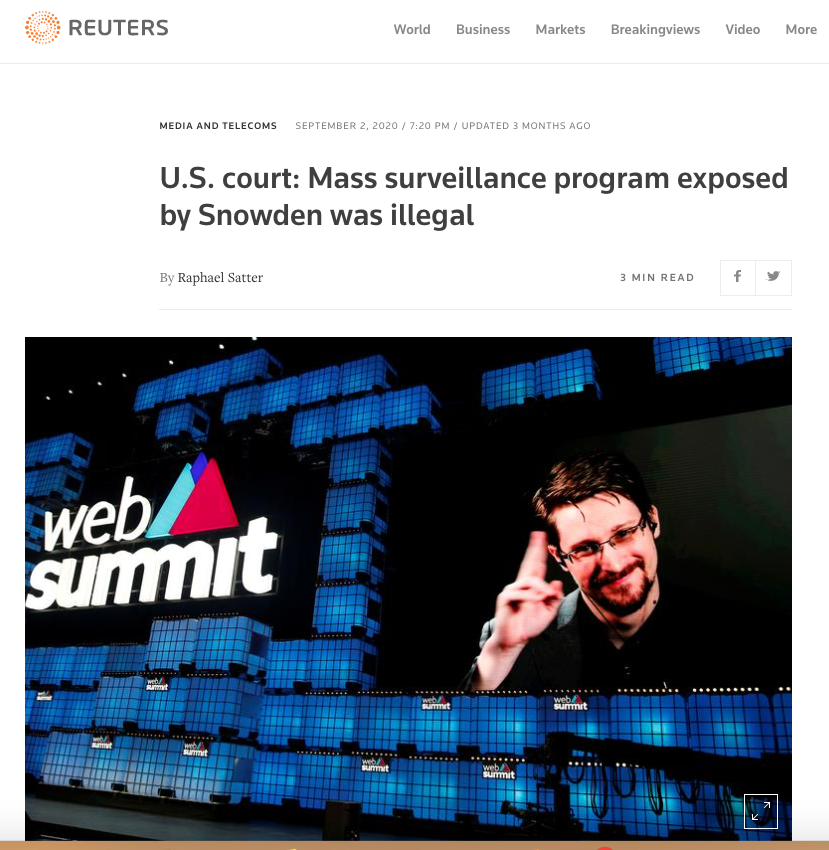
A U.S. appellate court in September unanimously ruled that the NSA’s program of mass domestic surveillance was illegal, as well as likely a violation of the Fourth Amendment’s guarantee against “unreasonable searches and seizures.” The court, and the broader public, knew about this illegal mass surveillance program created by the NSA only because Edward Snowden, while working inside that agency, discovered its existence and concluded in 2012 that the American public has the right know about what was being secretly done to them and their privacy by their own government.
Upon making the decision to blow the whistle on this security state illegality, Snowden delivered the documents relating to that program and other then-unknown systems of mass online surveillance not by dumping them indiscriminately on the internet or selling them or passing them to foreign governments, but by providing them to journalists (including myself) with The Guardian, The Washington Post and other news outlets. The documents Snowden provided were accompanied by requests to report them responsibly. He thus relinquished the power entirely to make decisions about which documents would and would not be published, leaving those decisions exclusively to news outlets.
That meant that Snowden himself never made a single document publicly available; every document that was reported was the result of decisions by newsrooms around the world that their publication would be in the public interest and would not endanger innocent people. That method of whistleblowing chosen by Snowden — patterned after the one Daniel Ellsberg used in 1971 to make the public aware of years of lying to the American public by the U.S. Government about the Vietnam War, when he gave the top-secret Pentagon Papers to The New York Times and asked them to report it in the public interest — enabled journalists to inform the American citizenry about illegal and unconstitutional spying by the U.S. Government in the most responsible manner possible.
Indeed, the very first program we reported — on June 6, 2013 — was the mass domestic spying program which the appellate court just ruled was illegal and likely a violation of the constitutional rights of all Americans. That first article we published revealed a top secret court order under which “the National Security Agency is currently collecting the telephone records of millions of US customers,” and required major telecommunications carriers “on an ‘ongoing, daily basis’ to give the NSA information on all telephone calls in its systems, both within the US and between the US and other countries.”
The months of reporting that followed, all singularly enabled by Snowden’s courageous whistleblowing, triggered so much vital public debate about privacy and mass surveillance, and fostered so many legal and technological privacy reforms around the world, that the reporting earned virtually every award journalism has to give, including the 2014 Pulitzer Prize for Public Service. For those who have not seen it, the 2014 documentary by Laura Poitras about the work Snowden did with journalists, Citizenfour, which received the 2015 Academy Award for Best Documentary, shows much of the Snowden story in real time and can be viewed on YouTube; the feature film “Snowden,” available on Netflix and other platforms, separately explores the trajectory which Snowden traversed from enlisted U.S. Army soldier, CIA contractor and NSA expert to one of this generation’s most consequential whistleblowers.
The recent appellate court ruling in U.S. v. Moalin, issued on September 2, emphasized the U.S. surveillance state’s sustained law-breaking. “The telephony metadata collection program exceeded the scope of Congress’s authorization” and “therefore violated that section of [the Foreign Intelligence Surveillance Act],” the court concluded, referring to the 1978 law requiring the government to first obtain warrants before spying on the communications of U.S. citizens. Though its ruling of illegality meant it was unnecessary to rule definitively on the program’s unconstitutionality, the court nonetheless noted that “the government may have violated the Fourth Amendment” with this spying program and warned of the dangers of “the collection of millions of [] people’s telephony metadata, and the ability to aggregate and analyze it.”
In ruling the NSA’s mass surveillance program illegal, the court noted the indispensable role Snowden played in enabling the protection of Americans’ rights. It was Snowden, explained the court, who “made public the existence of NSA data collection programs.” And, the court added, “Snowden’s disclosure of the metadata program prompted significant public debate over the appropriate scope of government surveillance” and ultimately led to reform: “Congress passed the USA FREEDOM Act, which effectively ended the NSA’s bulk telephony metadata collection program” and which “prohibited further bulk collection of phone records after November 28, 2015.” Moreover, observed the court, it was “news articles in the wake of the Snowden disclosures [which] revealed that the government had been using evidence derived from foreign intelligence surveillance in criminal prosecutions without notifying the defendants of the surveillance.”
This recent ruling is by no means the first time a court or other official body has declared illegal the spying programs which Snowden exposed. In 2015, CNNsimilarly reported that “a federal appeals court ruled on Thursday that the telephone metadata collection program, under which the National Security Agency gathers up millions of phone records on an ongoing daily basis, is illegal under the Patriot Act.” The New York Timesreported in 2014 that “an independent federal privacy watchdog has concluded that the National Security Agency’s program to collect bulk phone call records has provided only ‘minimal’ benefits in counterterrorism efforts, is illegal and should be shut down.” In 2018, The Guardianreported about the British equivalent of the NSA: “GCHQ’s methods for bulk interception of online communications violated privacy and failed to provide sufficient surveillance safeguards, the European court of human rights has ruled.”
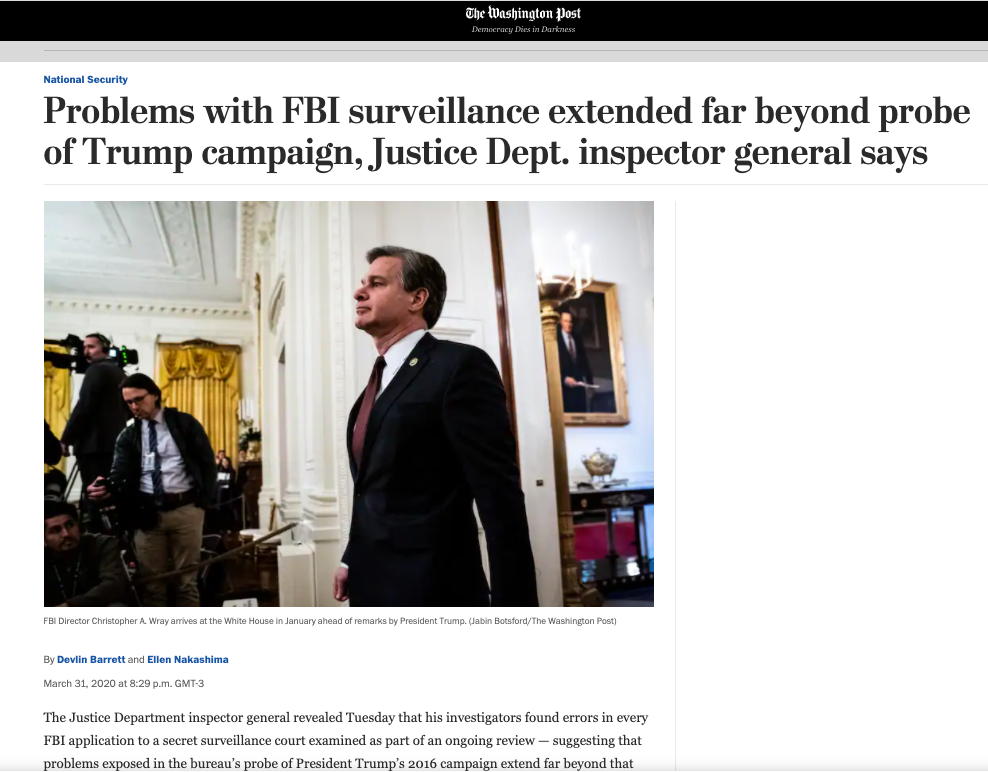
Abuses of power by these agencies continue in full force. More recently, the Justice Department’s Inspector General found in 2019 that the FBI deceived the FISA court with false statements to obtain a warrant to spy on former Trump 2016 campaign official Carter Page. A former FBI lawyer pled guilty to doctoring emails to obtain those spying warrants. A DOJ report found more material errors from the FBI in the spying process in 2019. Late last year, the FISA court itself “issued a strong and highly unusual public rebuke to the FBI” and, the prior year, “found that the FBI may have violated the rights of potentially millions of Americans — including its own agents and informants — by improperly searching through information obtained by the National Security Agency’s mass surveillance program.”
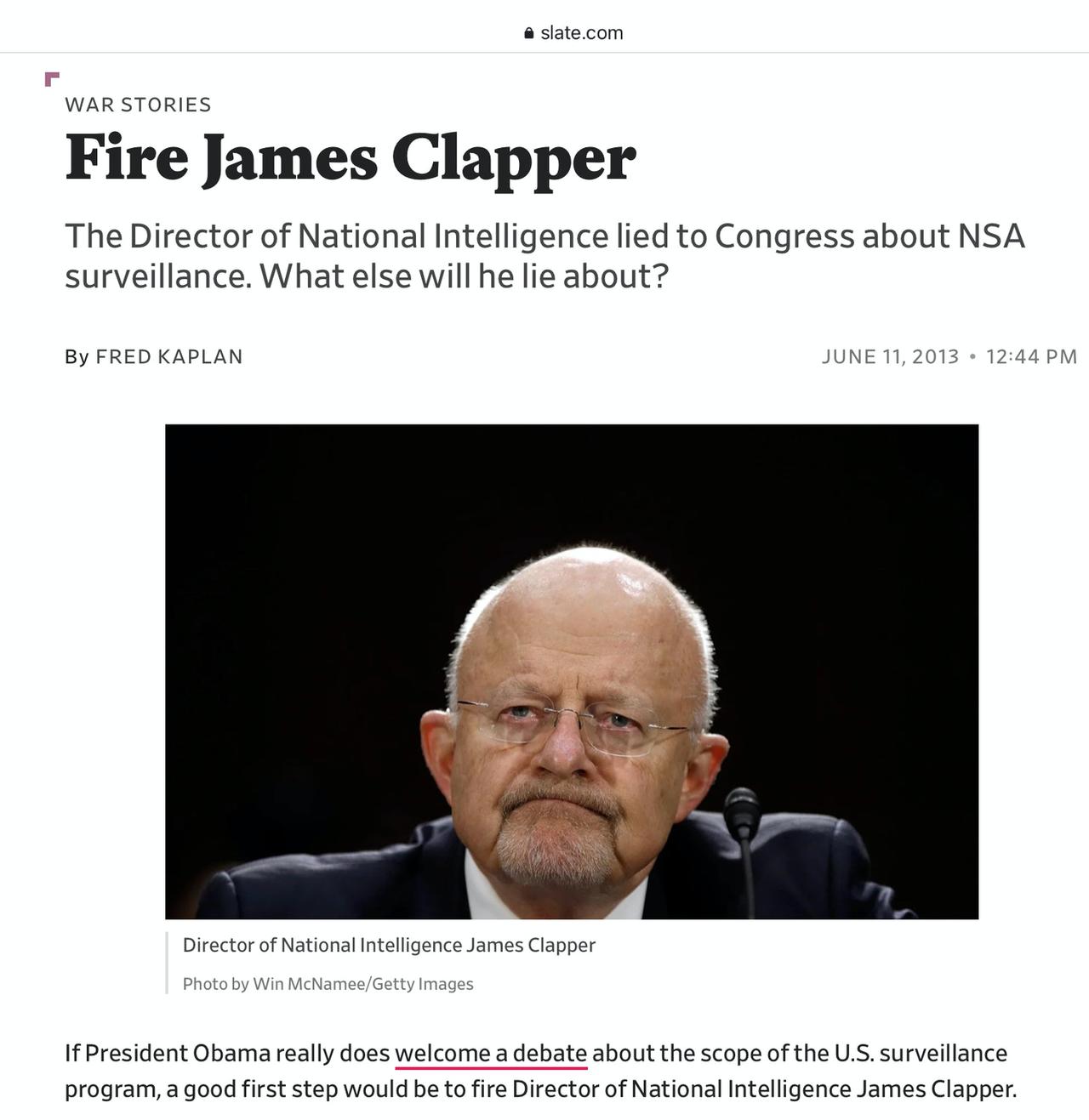
Meanwhile, so many of the arguments against pardoning Snowden’s, and demanding his lifelong imprisonment or exile, have come from the very security state operatives whose crimes he exposed. That includes John Brennan and James Clapper, along with their hawkish and neocon allies such as Susan Rice and Liz Cheney. And to make their case, these Deep State operatives and warmongers rely upon one demonstrable lie after the next. Indeed, it was their blatant lies in the first place that prompted Snowden to knowingly risk his liberty by revealing the existence of these mass surveillance programs.
The first contact Snowden made with a journalist about the possibility of whistleblowing was a pseudonymous email he sent to me in December, 2012. But what solidified with finality his decision to blow the whistle was watching President Obama’s senior national security official, Director of National Intelligence James Clapper, commit a felony when he blatantly lied to the Senate on March 12, 2013, by falsely denying — when asked by Sen. Ron Wyden (D-OR) — that “the NSA collect[s] any type of data at all on millions or hundreds of millions of Americans.”
When Clapper told that lie, Snowden was holding the documents in his hand that proved that the NSA was doing exactly that which Clapper, in his public testimony, denied that it was doing. In other words, he knew for a fact that the senior national security official in the U.S. Government lied to the American people and the Senate about the mass spying they were conducting against Americans. A person in Snowden’s position acting with just and noble motives would be impelled to disclose, not conceal, the truth — and that’s exactly what Snowden did. The real criminals were security state officials like James Clapper for criminally lying to the Senate and his colleagues in the secret surveillance state who illegally spied on entire populations.
But James Clapper was never prosecuted for lying to the Senate. In fact, he did not even lose his job: he served as Director of National Intelligence for another three years, until the end of the Obama administration. And now this proven liar — like so many security state agents — works inside the corporate media, delivering the “news” for CNN. How can anyone justify wanting to see Edward Snowden rot in prison for life while the real powerful criminal whom he exposed, such as James Clapper, go free and thrive? Who besides as craven authoritarian would regard that as a just outcome?
Speaking of proven liars, those who oppose a pardon of Snowden do so by invariably lying about him and what he did. Why would they do that? It’s because the reality is that he acted honorably and for noble ends. So they have to manufacture falsehoods to justify their demands that a hero be punished.
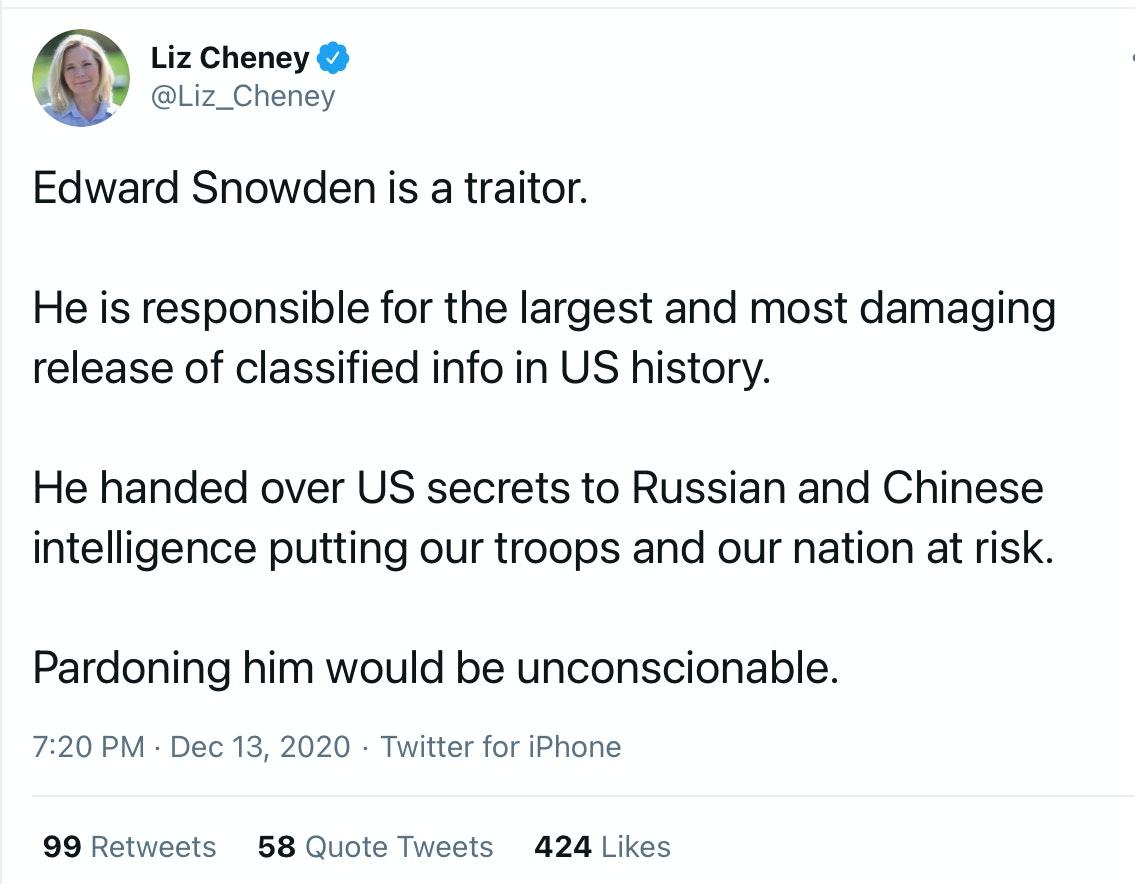
Take, for instance, the completely fabricated accusations voiced Sunday night by Congresswoman Liz Cheney (R-WY), daughter of the former Vice President and key ally of pro-war House Democrats in blocking Trump’s plan to withdraw troops from Afghanistan and Germany. To justify her opposition to a Snowden pardon, she just lied outright:
That Snowden “handed over US secrets to Russian and Chinese intelligence” is every bit as much of a lie as those told by her dad in 2002 about Saddam’s nuclear weapons stockpiles and alliance with Al Qaeda. She just manufactured this accusation out of thin air. Nobody can ever prove a negative — therefore, nobody can proffer dispositive proof that Snowden (or, for that matter, Liz Cheney) did not turn over U.S. secrets to the governments in Beijing and Moscow — but the burden of proof is on those hurling accusations of this sort to produce evidence for it, and she has none. That’s because none exists.
But that does not stop Endless War advocates like Liz Cheney from saying it anyway — precisely because Liz Cheney is a pathological liar who will say anything to manipulate the public, just like her father taught her to do. The same is true of former CIA Director and provenpathological liar John Brennan. On Monday, he echoed the same false allegation as Liz Cheney did, in order to defend James Clapper and attack Senator Paul for advocating a pardon for Snowden:
Jim Clapper has had a lifetime of dedicated & selfless service to America.
Edward Snowden betrayed his country, providing exceptionally sensitive intelligence to China & Russia.
You consistently demonstrate utter ignorance of U.S. national security.
If there is any lesson we ought to have learned over the past two decades, it is that nobody should believe the claims of national security operatives without substantial evidence being presented. For anyone who wants to claim or believe that Snowden handed over secrets to Russia and/or China, you should demand evidence first. Where is it?
What makes this claim even more dishonest is that it exploits the fact that the U.S. Government forced Snowden, against his will, to stay in Russia. Snowden’s original plan, as has been amply documented, was to fly from Hong Kong after providing us with the archive and reviewing key documents, then transit through Moscow on his way to South America, where he intended to seek asylum in Ecuador or Bolivia.
But he was trapped in the Moscow International Airport because the U.S. State Department under John Kerry invalidated his passport while he was in transit, and then-Vice President Joe Biden threatened and coerced every other country considering offering him asylum or allowing him safe passage to South America (as he did with Cuba, which withdrew its offer of safe transit). A 2013NPRheadline tells part of that story: “Biden Asks Ecuador To Deny Snowden Asylum.” That was beforehe obtained asylum in Russia, something he was forced by Obama officials and Biden himself to do.
So U.S. officials first prevented Snowden from leaving Russia, and then, with such audacity and dishonesty, have for years exploited the fact that he’s in Russia to manipulate public opinion and smear him as a Kremlin agent. And, as is true for all such allegations that a U.S. citizen is working for Moscow, the accusation is tossed out routinely without any evidence, because there is none.
Then there’s the allegation that Snowden caused harm to national security or to innocent people, a claim that has been made against every whistleblower for decades who exposes corruption and criminality by the security state. Just as is true of the claim that Snowden sold or provided secrets to the governments of Russia and China, one should not even consider accepting the truth of this claim absent evidence to corroborate it.
Where is this evidence? Who was harmed by this NSA reporting? Not a single example or piece of evidence has ever been furnished in response to those questions, with the defenders of NSA opting to just repeat the accusation over and over in the hope that people will assume that it is true by virtue of is repetition.
But even if such harm could be established, the argument depends upon a complete distortion of the process used by Snowden to blow the whistle on Deep State criminality. Again, there is not one document from the NSA archive that was published because Snowden chose for it to be published. He used the opposite method for whistleblowing: recognizing that he should not have the power as a single individual to make choices about which documents should and should not be published, he instead gave the archive to journalists and asked that we make those decisions editorially, in as responsible a manner possible, guided by the standard journalistic public interest assessment.
That means that if there were documents that people believe should not have been disclosed, the choice to publish those documents rested with the top editors at leading media outlets — The Guardian, The Washington Post, The New York Times, NBC News and other outlets around the world — not with Snowden, who was never even consulted on these choices. Once Snowden realized the magnitude of criminality, deceit and corruption inside the security state, he concluded that the. most just course was to turn over to journalists a massive archive regarding these programs, so that it was not up to him to curate in advance which documents should be seen by the public, but instead leave it to experienced journalists to make those determinations.
Then there’s the claim — based on a substantial set of falsehoods — that Snowden somehow acted improperly by fleeing the U.S. to seek refuge in Russia rather than submitting himself to the U.S. justice system in order to “make his case”, a falsehood-drenched allegation voiced most memorably by Obama national security adviser Susan Rice to Charlie Rose in 2014:
The claim that Snowden should have or could have come back to the U.S. to convince a jury that what he did was justified is nothing short of a lie. Under the archaic statute which the Obama administration aggressively used to prosecute more whistleblowersthan all previous administrations combined — the Espionage Act of 1917 — someone is automatically guilty if they provide classified information to a person who is unauthorized to receive it (including a journalist), and they are absolutely barred even from raising a “justification” defense in court.
In other words, as Susan Rice well knows, Snowden would not be able to return to the U.S. and try to convince a jury of his peers that what he did was justified because the law under which they chose to prosecute him does not allow a defendant even to raise that as a defense. Instead, this old statute ensures a rigged process where a guilty verdict is all but inevitable. That’s precisely why Obama officials and security state operatives use this 103-year-old law — originally designed by Woodrow Wilson to criminalize dissent from U.S. participation in World War I — against whistleblowers who expose their crimes not by acting with foreign governments but with journalists.
Then there’s the reality that — as Daniel Ellsberg argued in aWashington Postop-ed about Snowden’s leaving the U.S., headlined “NSA leaker Snowden made the right call” — those who are now accused of endangering national security have essentially no chance of obtaining a fair trial in the U.S. “The country I stayed in was a different America, a long time ago,” Ellsberg wrote, adding:
I hope Snowden’s revelations will spark a movement to rescue our democracy, but he could not be part of that movement had he stayed here. There is zero chance that he would be allowed out on bail if he returned now and close to no chance that, had he not left the country, he would have been granted bail. Instead, he would be in a prison cell like Chelsea Manning, incommunicado.
He would almost certainly be confined in total isolation, even longer than the more than eight months Manning suffered during her three years of imprisonment before her trial began recently. . . .
Snowden believes that he has done nothing wrong. I agree wholeheartedly. More than 40 years after my unauthorized disclosure of the Pentagon Papers, such leaks remain the lifeblood of a free press and our republic. One lesson of the Pentagon Papers and Snowden’s leaks is simple: secrecy corrupts, just as power corrupts….
But Snowden’s contribution to the noble cause of restoring the First, Fourth and Fifth amendments to the Constitution is in his documents. It depends in no way on his reputation or estimates of his character or motives — still less, on his presence in a courtroom arguing the current charges, or his living the rest of his life in prison. Nothing worthwhile would be served, in my opinion, by Snowden voluntarily surrendering to U.S. authorities given the current state of the law.
The idea that you must meekly submit to the world’s most aggressive Prison State, where the rules are made by the very high officials whose crimes you exposed, is authoritarian dreck.
Snowden well knew, when he decided to inform his fellow citizens of these systems of mass surveillance, that there was a very high probability that he would end up in a maximum security U.S prison for decades if not the rest of his life. That’s precisely what made Snowden’s actions so courageous: how many people would be willing to make that sacrifice? But that does not mean Snowden has some moral obligation to help an unjust state keep him in a cage for life out of vindictive vengeance because he exposed their crimes.
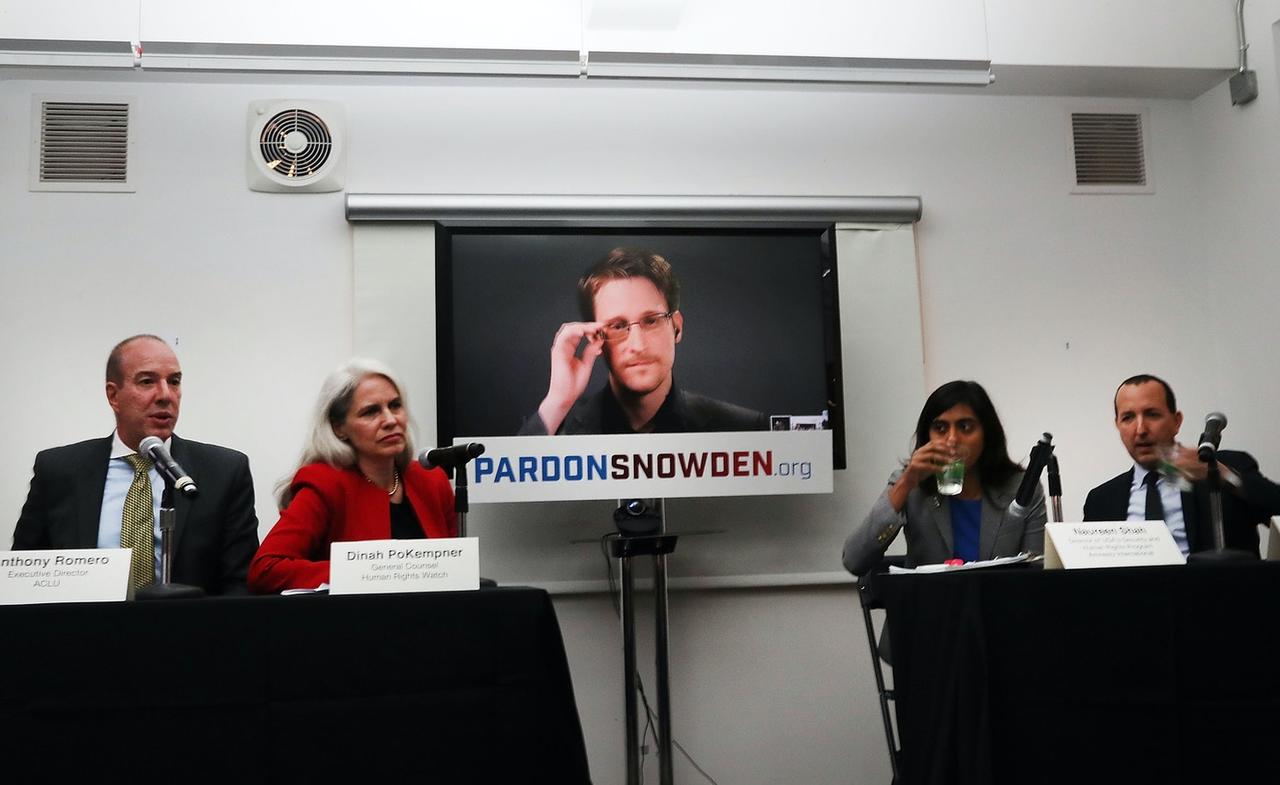
President Trump has, on two occasions, indicated that he was considering the possibility of pardoning Snowden. A pardon is not only just on its own terms but would also be an expression of exactly the reason the U.S. Constitution vests the unilateral pardon power in the U.S. President: to prevent the abuse of the justice system for vindictive ends or to shied abuses of official power by those who operate in the dark (my arguments for why the ongoing attempted extradition and prosecution of Julian Assange is also a massive abuse of power have been set forth in prior articles as well as in a show I produced on the topic).
If Trump follows through on a pardon of @Snowden, it’d be a huge victory against CIA/FBI/NSA abuses.
Even if you’re someone who believes that Snowden ought to be punished in some way — and I am not — he has been. Seven years in exile, separated from your friends, family and fellow citizens, in a country in which you never chose to live and to which you have no connections, is a serious deprivation. That is particularly true now that Snowden’s long-time partner, his American wife Lindsay Mills, announced that the couple is expecting their first child in January, a son who will automatically be a U.S. citizen and who should have the right to live with both of his parents in his country of citizenship.
For decades, it was a staple of left-wing politics that the CIA and the secret security state, long referred to by scholars as the Deep State, pose a grave threat to core democratic values and constitutional rights. Over the last five years, beginning with the 2016 election, the Trump movement and Trump himself has seen up close and personal how easily and casually those powers are abused, and how destructive are the results.
A pardon of Edward Snowden would be one of the greatest blows against Deep State abuse of secrecy and spying power in decades: probably the most significant act since President Eisenhower’s 1961 warnings in his Farewell Address about the growing anti-democratic dangers of the “military industrial complex” or, at the very least, the mid-1970s reforms of the intelligence community.
A pardon of Snowden by Trump would prompt bipartisan cheering across the U.S. and would engender support globally across the ideological spectrum. The only ones angered by it would be exactly those people — John Brennan, James Clapper, Jim Comey, Susan Rice — whose ongoing ability to abuse their spying power against the U.S. population depends upon their vindictive use of the justice system to destroy the lives of those who reveal their crimes.
ORIGINAL LINK Data Shows Fears Of Overwhelmed Medical System Overblown, Ample Hospital Capacity NationwideTyler DurdenMon, 12/14/2020 - 18:00
According to federal government data reported by Just The News, hospitals nationwide have 'considerable space left to deal with both routine medical issues and COVID-19 patients," dispelling fears of overwhelmed medical systems and at-capacity hospitals which have been promoted by the usual media suspects.
For most of 2020, rising positive test results of COVID-19 have brought with them fears of swamped hospitals, overwhelmed medical systems, emergency patients being turned away, and COVID-19 patients being triaged, suffering and dying in hallways and vestibules.
Much of that fear crystallized in the early stages of the pandemic, when parts of the northern Italian medical system were put under significant strain due to a crush of COVID-19 patients. In response, leaders and medical officials around the world suspended elective surgeries and constructed emergency medical facilities to cope with anticipated waves of COVID-19 patients. -Just The News
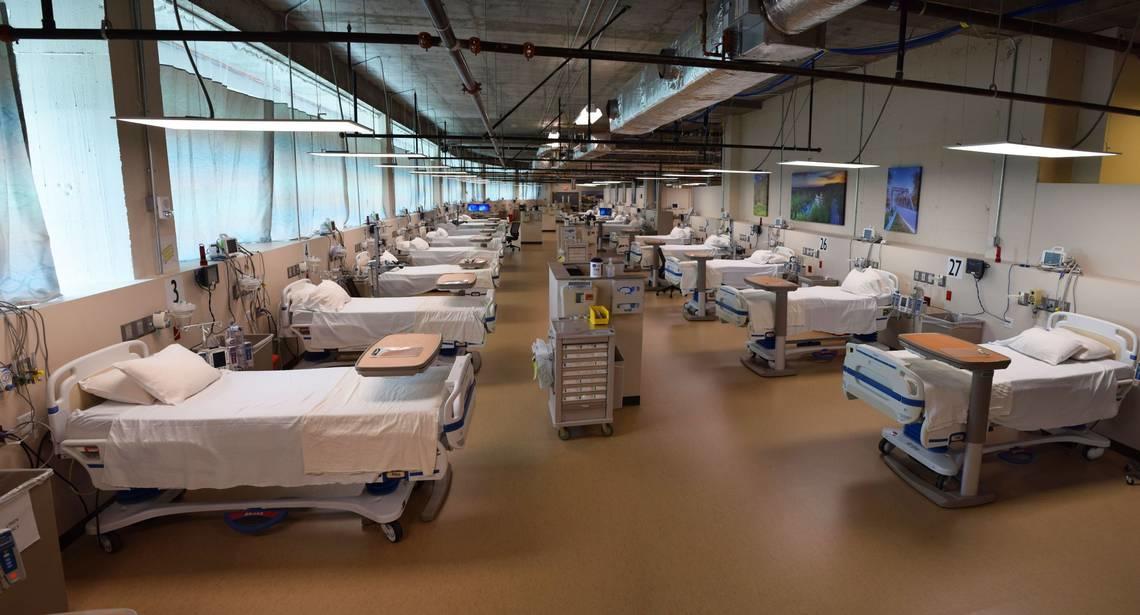
Yet, many care facilities which beefed up resources for a flood of COVID-19 patients have been virtual ghost towns - with some being shuttered for a lack of patients despite millions of dollars devoted to their construction. In Chicago, the city spent $120 million on four facilities which have treated a total of 38 patients.
But what about the second wave?
With 'flu' season entering historically high gear and some facilities across the country reporting difficulty accommodating a large influx of patients due to a dwindling number of beds or scarce resources, federal government data compiled at the state level suggests these reports are largely outliers, and the US has ample space to deal with COVID-19 patients.
The Department of Health and Human Services offers on its website estimates of hospitalization rates across the United States. The data, the department says, is "estimated from hospital submissions, either reported through their state or reported through HHS Protect," which the department describes as "a secure data ecosystem ... for sharing, parsing, housing, and accessing COVID-19 data." (HHS did not respond to queries about any limitations or caveats to the data.)
The HHS numbers belie forecasts of impending collapse of the U.S. medical system. As of Saturday, the department estimated that hospitals nationwide were at about 75% capacity. ICU beds were even lower, at 63.5%. Patients who had tested positive for COVID-19 occupied just under 15% of all beds nationwide.
Even in areas that have recently posted huge surges in positive COVID tests, the numbers were largely similar to the national average: In New York, 76% of hospital beds (and 61% of ICU beds) were taken.
In California, where positive test results have skyrocketed, 76% of inpatient beds were likewise filled (though the ICU numbers were notably higher than New York's, at 79%).
Ohio, which has also seen a surge in positive tests over the last few months, has 71% of inpatient beds taken, and 77% of ICU beds. -Just The News
This is normal
According to Dr. Joanne Roberts, Chief Value Officer at Providence St. Joseph Health System, "a well-functioning hospital probably runs about 85% capacity on an average day," though she notes that COVID-19 can "quickly overwhelm that last 15%" because of how virulent it is, which can in turn send a flood of patients to the hospital at once.
"We've spent a whole lot of energy decreasing the other number of patients as we possibly can," said Roberts, who coordinates the St. Joseph's 51 constituent hospitals across seven states. "trying to do hospital-at-home models, stopping non-urgent procedures that require ICU space. You can't stop emergency. But you can stop some things that are coming into the hospital, say, a knee replacement."
"It's a dance that every one of our hospitals is doing today," she added. "Some are still doing elective procedures, some are not. Because governors have allowed our hospitals to figure that out, we are seeing our hospitals figure that out themselves."
That said, Roberts says none of their 51 hospitals are turning patients away at this time.
"What we have done is we've done some creative bed usage," she told Just The News' Daniel Payne. "We've done some agreements with smaller hospitals that they would send some surgical cases to us in our larger hospitals, and once the patient was stable after surgery, we'd send them back to recover in the smaller hospital."