Source: The evidence is mounting and indisputable that MRNA vaccines cause serious harm including death, especially among young people.
ORIGINAL LINK

Seeking Truth in a World of Propaganda. Links do not necessarily indicate agreement with stories or perspectives.
“Those who are able to see beyond the shadows and lies of their culture will never be understood, let alone believed, by the masses.” - Plato
TRANSCRIPT
Tucker: On Saturday morning, August 10, 2019, Attorney General William Barr was working in his home office, when his chief of staff said Jeffrey Epstein was found dead in his cell in New York City.
Barr was shocked and upset to hear this. His first reaction, as he accounts in his memoir was to worry that some people in America might not buy the idea that Jeffrey Epstein killed himself.
“No one will believe it was a suicide,” Barr fretted to his chief of staff. “There will be conspiracy theories all over the place.”
Now, that’s a pretty odd response, if you think about it. At the time, there was no way that Bill Barr could have known for sure how Jeffrey Epstein died. So you would think, as Attorney General, his first concern will be finding out what actually happened but instead, his first concern was to worry that the public might jump to unapproved conclusions about what happened.
And in some ways, Bill Barr was right to worry. Many Americans did not believe that Jeffrey Epstein had killed himself. Given the strange circumstances of his death, stranger even than most people understood at the time, it was going to take a sustained public relations campaign to convince Americans that Jeffrey Epstein killed himself.
But Bill Barr was willing to make the effort. Two days later, he flew to New Orleans, gave a speech and said this:
Bill Barr: “I was appalled and indeed, the whole Department was, frankly, angry to learn of the MCC’s failure to adequately secure this prisoner. We are learning serious of irregularities at this facility that are deeply concerning and demand a thorough investigation. The FBI and the Office of Inspector General, are doing just that. We will get to the bottom of what happened and there will be accountability.”
Tucker: So the country is skeptical and concerned. Bill Barr is skeptical and concerned. We will get to the bottom of what happened and there will be accountability, he promised that day.
But that turned out to be untrue. Three and a half years after Jeffrey Epstein died, no one has gotten to the bottom what happened that day and there’s been no accountability for it. The only people ever punished for the grotesque malfeasance surrounding Epstein’s death were two low-level guards who fell asleep on duty that night. Both pleaded guilty to falsifying government records.
But last year, with no real explanation, an Obama-appointed judge dropped all charges against both of them. One of the guards may still work for the Federal Government.
As we’re getting to the bottom of what happened, despite many promises, from many various officials, neither the FBI nor the Justice Department’s Office of the Inspector General has ever issued a report how Jeffrey Epstein died. Not a word.
So, once again, three and a half years after one of the most widely covered death of our time, there’s still no answers and there was still no accountability. Why is that?
Well, many reasons probably. One of them is that Washington veteran, Bill Barr, the only man in the modern era to serve as attorney general twice, declared the Epstein case “closed”.
Barr seemed to have good reason for doing that. By end of 2019, Barr writes in his memoir: “I was confident that Jeffrey Epstein committed suicide by hanging himself.”
Now, why did Bill Barr believe that?
Well, the first piece of evidence is this, quote: “The New York City Medical Examiner had conducted an autopsy and ruled that Epstein killed himself by hanging.”
That’s the first piece of evidence. The second is this, it’s a videotape that, quote, “Confirmed the Medical Examiner’s finding. I personally reviewed that video footage,” Barr writes. “It shows conclusively, that between the time Epstein was locked in the cell at 7:49PM on the night of August 9th and the time he was discovered the next morning at 6:30, no one entered his tier.” Endquote.
Therefore, Bill Barr explained, we can know for sure that Jeffrey Epstein killed himself.
In his book, Barr ends this section on Epstein with a self-congratulatory note: “The management changes I made at the time to the federal prison system were good ones and I think the agency is slowly on its way back.”
In other words, “Everything is fine, now. Let’s move on.”
This was enough for most journalists in Washington. Virtually every subsequent news story about Jeffrey Epstein’s death denounced skeptics of the official story as “crazy,” who for whatever reason were engaged in “baseless conspiracy theories”.
What’s amazing, in retrospect is that none of these reporters – veterans at The Washington Post, the Associated Press, NBC News, The New York Times and many others – none of them ever thought to revisit Bill Barr’s assessment of Epstein’s death and measure it against the basic tenets of common sense.
If you did that, you saw what Bill Barr said about Jeffrey Epstein was transparently absurd and very obviously dishonest.
Barr began by claiming that the Medical Examiner who had conducted Epstein’s autopsy had ruled his death as “Suicide”. But that is not true. The initial cause of death following the autopsy was not “Suicide” but quote, “Pending”, which is to say “Unclear”.
The Medical Examiner who performed the autopsy could not say how Jeffrey Epstein died. Forensic pathologist, Michael Baden, who was also present that day came away believing Epstein had been murdered. After reviewing more than a thousand suicides by hanging in New York State, Baden later said he couldn’t find a single neck injury – not one – that matched the injury that Epstein sustained.
“Jeffrey Epstein did not kill himself,” Baden concluded. He was strangled. The physical evidence he saw at the autopsy made that obvious.
But New York State’s Chief Medical Examiner, Barbara Sampson – who was not present at the autopsy – overruled the judgment of those who were. Days later, on the basis of no new evidence or investigation, Barbara Sampson simply declared Jeffrey Epstein’s death a “Suicide”.
That was the City’s official but totally unsupported conclusion, which Bill Barr and many others promptly repeated.
Why did Chief Medical Examiner, Barbara Sampson do that? We don’t know. We called Sampson today to ask her but she hung up on us.
Then, there’s the question of the videotape, which Barr cited. Both cameras trained on the door of Jeffrey Epstein’s cell did not work that night, famously and to this day, no one explained why they didn’t work.
So, the video footage that Bill Barr said he watched didn’t cover Epstein’s cell, just the entrance to the larger cell block. No one came in or out of the tier, Barr said. Therefore, Jeffrey Epstein killed himself.
So, let’s consider that claim rationally. On the night of August 9th, Jeffrey Epstein was being held in the Special Housing Unit of the Metropolitan Correctional Center in Manhattan, the most secure part of the City’s Federal lock-up. It would be physically impossible for a stranger to get in and out of this facility without an electronic pass and without being seen by the countless cameras in place between the street and the locks at the 9th floor of the building.
So, if Jeffrey Epstein was murdered, he was not murdered by an intruder, someone who came into the tier, he was murdered by someone on his own cell block. Obviously.
There were seven other cells and each one housed dangerous criminals. So, if you’re looking for a killer, you would figure out who was in those cells. But no one seems to have thought of that or done it.
The Bureau of Prisons refused to provide us with a list of the inmates on Epstein’s tier. It’s not clear how many were interviewed by investigators, despite that some of them were transferred out of the facility shortly after Epstein’s death. That’s a baffling oversight.
Instead, Attorney General Bill Barr simply assured the country that no one from outside came into Jeffrey Epstein’s tier and declared the case “Solved” – and if you think about that, that’s a remarkable way to assess a potential crime scene, especially when you consider the source.
Bill Barr was not a civilian or a crime novel aficionado. He was the chief law enforcement officer of the United States, he was the nation’s top cop. His job was to solve crimes. And yet, somehow, with all his law enforcement experience, it never seemed to dawn on Bill Barr that if there was a killer, the killer would have come from one of the cells on Epstein’s tier.
And then, further, apparently, no one in the entire FBI suggested this to Bill Barr, as they reviewed the case.
“Excuse me, Mr Attorney General, it doesn’t matter what the camera outside the tier shows, what matters is what happened inside the tier.”
Again, obvious. And yet, apparently, no one at DOJ ever said that to Bill Barr and no one in the media noticed.
It’s all very strange and the story gets much stranger, once you start pressing a little bit. We’ve pressed pretty hard for the last few days on this question, not because we have any special affection for Jeffrey Epstein. We’ve pressed because, you don’t want to live in a country where it’s possible to murder people in Federal lock-up, cover up the killings and then get away with them. That’s scary. That should not be allowed in this or any other civilized place. But in the case of Jeffrey Epstein, it appears that it was allowed.
And on one level you can see why it was. This is one of the those crimes that has no natural constituency pushing to solve it. The only people who liked Jeffrey Epstein was his friends and some of them are clearly happy he’s dead.
Here’s Bill Gates, who spent quite bit of time with Jeffrey Epstein:
Interviewer: “What did you do when you found out about his background?”
Bill Gates: “Well, I’ve said I regretted having those dinners and there’s absolutely nothing new on that.”
Interviewer: “Is there a lesson for you, for anyone else looking at this?”
Bill Gates: “Well, he’s dead, so in general, you always have to be careful.”
Well, he’s dead. Along with his many secrets about me and the rest of our friends. Boo-hoo. We’re so sorry. So, so sorry. You can imagine that Bill Clinton and Prince Andrew and many, many others feel the same way. No one wants to talk about what happened to Jeffrey Epstein because, privately, lot of people are happy about what happened to Jeffrey Epstein.
This week, we called every person involved in the story surrounding Jeffrey Epstein’s death. With very few exceptions, none of them would speak to us. We hung up immediately, others declined all comment.
One of them, the DOJ case officer supposedly assigned to investigate Epstein’s death, refused even to acknowledge that he worked for the Federal Government: “I’m not going to confirm or deny that,” said Mr Lysand Daniel, when we reached him on his cell phone.
“Why is that?” we asked him. “I’m not going to confirm or deny that,” he repeated.
For his part, former Attorney General Bill Barr also turned down our offer to come on tonight. He did not explain why. One person we did speak to at length is Jeffrey Epstein’s brother, Mark, his only living relative. The two were never in business together but Mark Epstein wound up more financially successful even than his famous sibling. So he’s not looking for money from the estate, he is interested in finding out what happened to his brother.
On the basis of those conversations with Mark Epstein, as well as with the criminal defense attorney called David Schoen, who also knew Epstein well and met with him in his cell shortly before he died, here is a list of questions that any honest investigator would want the answers to:
First, why do so many public officials persist in claiming that Jeffrey Epstein attempted suicide in prison once before, on July 23rd, 2019?
Now, that’s a very convenient claim, if you trying to convince people that Jeffrey Epstein killed himself. But there is no evidence that it’s true. In fact, Jeffrey Epstein, himself adamantly denied ever trying to kill himself, in prison or out.
He denied this to his friends, to his lawyers and to prison psychologists. He said, instead that he was injured by another inmate. That’s why he was in a fetal position on the ground.
According to David Schoen, who talked to him shortly after that event, Epstein seemed upbeat, happy and confident of his release from jail but he was very concerned about being hurt by someone in a nearby cell.
And speaking of nearby cells, were the cells on Epstein’s tier locked for the entire night, the night he was killed? We’ve heard from a source that they were not locked, that inmates were able to move from one cell to another, including into Jeffrey Epstein’s cell. Can the Bureau of Prisons give us clarity on this? Can they prove otherwise?
And by the way, who moved Jeffrey Epstein’s body and who gave the order to do that? Epstein was discovered the morning of August 10th by a part-time prison guard called Michael Thomas – who, amazingly was the very same guard who discovered him in a fetal position on the floor after his previous falsely-reported suicide attempt.
But by the time the EMTs arrived, Epstein’s body had been moved to the prison infirmary. That’s a clear violation of federal policy. Who ordered that?
And though Jeffrey Epstein had been dead for at least two hours when the guard found him in his cell, by the time the EMTs arrived, Epstein was clad in a hospital house gown.
That means that somebody for some reason cut away Jeffrey Epstein’s prison uniform and re-dressed his stiffening corpse in new clothes. Why would anyone do that?
And then, to make it even stranger, Jeffrey Epstein’s corpse was intubated. Air was blown into his lifeless lungs. It’s not clear why. Now, there was handheld video of all of this happening. That might explain it but that video has never been released. In fact, authorities will not even acknowledge that it exists. But it does exist.
Nor has the EMTs’ account of what they saw that day, their mandatory so-called “Pre-Hospital Care Report” ever been released. Nor, most strikingly of all, are the photographs of Jeffrey Epstein dead in his cell.
And that means it’s impossible to know the position of his body when it was found or how he died. Was Jeffrey Epstein hanging from a bed sheet, as the authorities insist? They say he was strangled by a ligature of his own making. His neck was bloody but the strip of sheet was not. Or was he killed with the electrical cord from his CPAP machine for sleep apnea? That’s what Dr Baden concluded, because that would be consistent with his actual injuries at autopsy.
These are very basic questions. These are not conspiracy theories. They’re obvious questions. They are the essential questions, in fact, in any legitimate investigation. But apparently, nobody has even tried to answer them.
We dutifully called the Department of Justice today to ask them to explain some of this. They refused, on the grounds that there’s, quote “An active investigation in progress”. But that is a lie. There is no investigation into Jeffrey Epstein’s death.
For moving on four years now, there has never been an investigation into Jeffrey Epstein’s death, the death of an American citizen.
We can only speculate as to why that is but all the explanations are bad and ominous. Maybe someone in the new Republican Congress should look into all of this, not because Jeffrey Epstein was an American hero but because, for once, it would be nice to see the Federal Government forced to tell the truth about something.

Dozens of food processing plants were destroyed and/or damaged last year by "accidental fires." After several months of a lull in mysterious fires rippling through the food industry, the first major one of the new year was reported by NBC Connecticut on Saturday.
More than 100 firefighters battled a massive fire at a commercial egg farm in Bozrah, Connecticut, on Saturday afternoon.
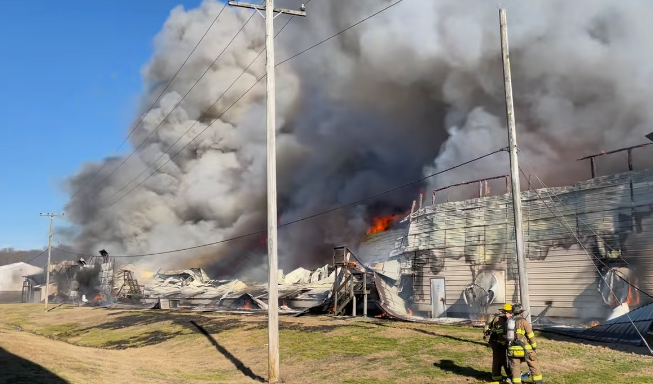
According to Epoch Times, firefighters spent hours extinguishing a 150-foot-by-400-foot chicken coop at Hillandale Farms, which contained about 100,000 chickens.
A Salvation Army canteen truck was on the scene, providing food. According to the Salvation Army, about 100,000 chickens may have died in the fire. It also said that no injuries had been reported.
Here's the video of the fire:
Hillandale Farms is one of the largest suppliers of chicken eggs in the US.

Their eggs are found in major supermarkets.

It's unclear what the fire-damaged Bozrah location will mean for Hallandale Farms' national egg supply chain. The fire comes at a time when the US suffers from a severe shortage of eggs due to bird flu wiping out tens of millions of egg-laying hens.
Egg shortages have been reported at supermarkets nationwide.
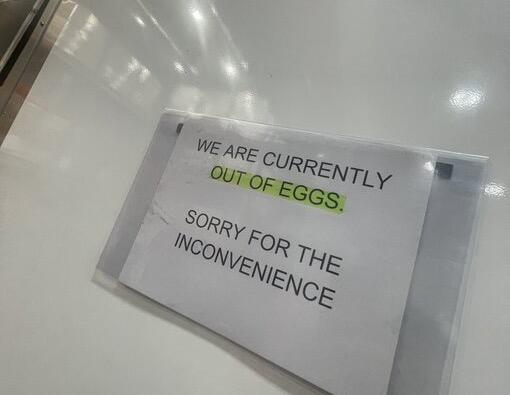
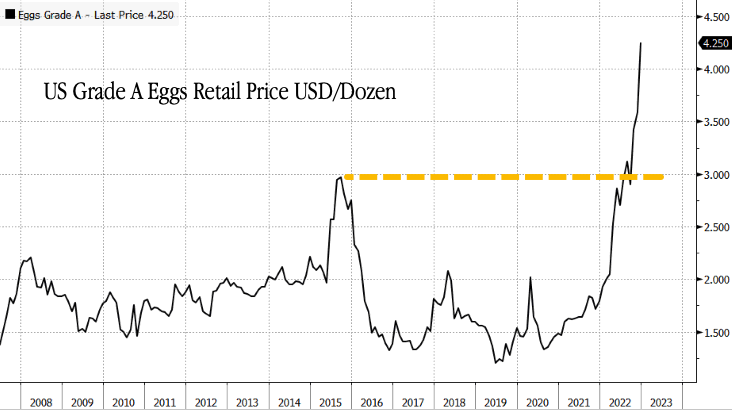
Prices of a dozen Grade A eggs at the supermarket have jumped to astronomical levels.
This could be the start of another string of suspicious fires at food plants. Citing Bloomberg data, news stories for "food plant fire" jumped the most in a decade last year. Odd right?
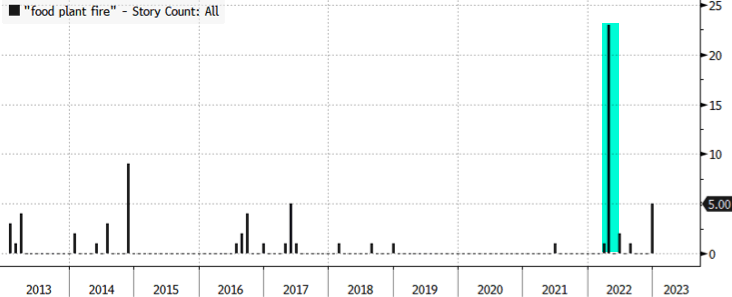
Some have speculated 'food processing plants don't just "accidentally"' catch on fire at the rate seen last year. Others are asking: Is the US food supply chain under attack?
For over a year, we have been dutifully tracking several key datasets within the auto sector to find the critical inflection point in this perhaps most leading of economic indicators which will presage not only a crushing auto loan crisis, but also signal the arrival of a full-blown recession, one which even the NBER won't be able to ignore, as the US consumers are once again tapped out. A month ago we said that in our view "that moment has now arrived"; the latest data from Fitch confirms as much.
But first, for those readers who are unfamiliar with the space, we urge you to read some of our recent articles on the topic of car prices - which alongside housing, has been the biggest driver of inflation in the past 18 months - and more specifically how these are funded by the US middle class, i.e., car loans, and last but not least, the interest rate paid for said loans. Here are a few places to start:
Are We Headed For An "Auto Loan Crisis" As Delinquencies Begin To Rise? - July 7
A Flood Of Repossessed Vehicles Poised To Hit The Used-Car Market - July 25
American Drivers Go Deeper Into Debt As Inflation Pushes Car Loans To Record Highs - Aug 29
Credit Card Rates Just Hit A Record As The Average Car Loan Rises To Fresh All Time High - Oct 9
New-Car Loan-Rates Set To Hit 14-Year High As Affordability Crisis Worsens - Nov 3
So while the big picture is clear - Americans are using ever more debt to fund record new car prices - fast-forwarding to today, we have observed two ominous new developments: the latest consumer credit report from the Fed revealed a dramatic spike in the amount of new car loans, which increased by more than $2,000 in one quarter, from just over $38,000 (a record), to $40,155 (a new record).
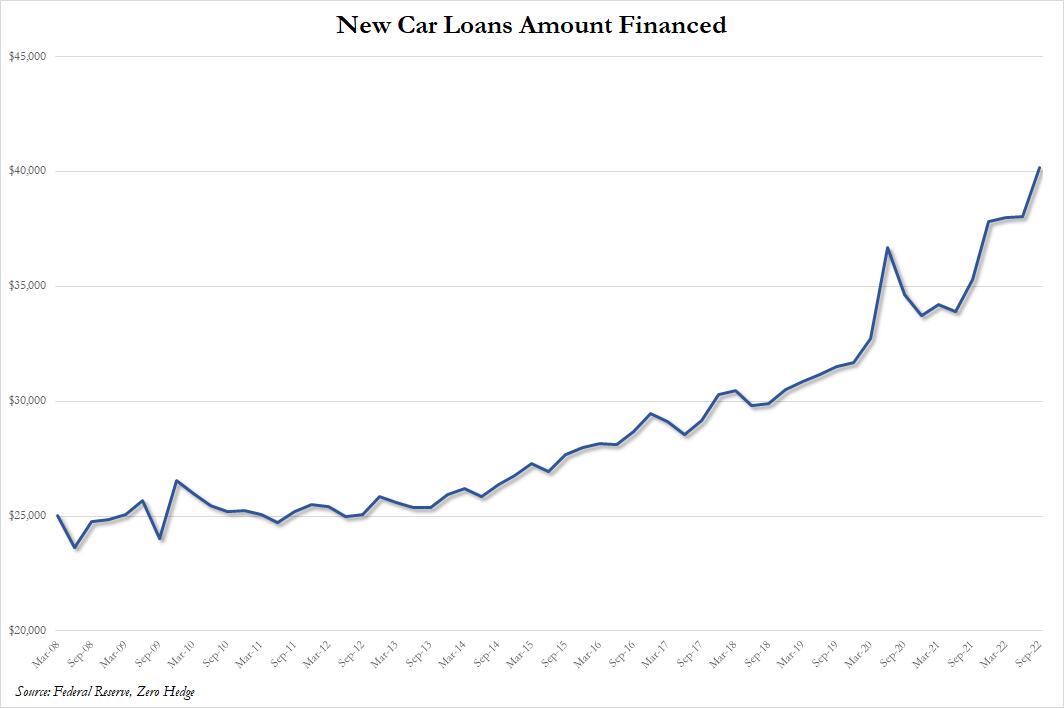
Now this shouldn't come as a shock: a simple reason why new car loans have hit record highs is simply because new car prices have also soared to all time highs, as the next chart shows.
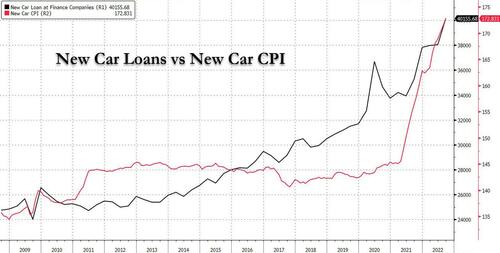
Here we will ignore for the time being cause and effect, or "chicken or egg" questions - i.e., whether record new car prices are the result of easy record credit, or whether record new car loans are simply tracking the explosive surge in car prices, and instead focus on something even more ominous: the explosion in the average interest rate on a new 60 month auto loans: according to Bankrate, as of Jan 27, the number is just over 6.67%, almost doubling since the start of 2022, and the highest in 12 years.
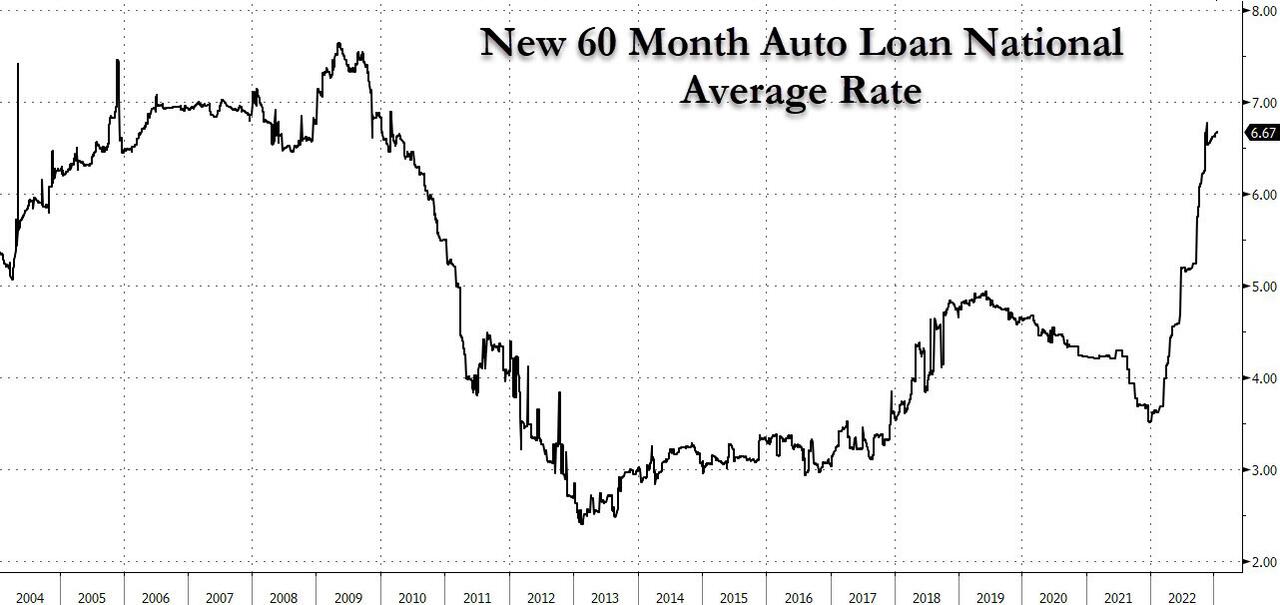
It is this surge in nominal auto debt as well as the unprecedented spike in new auto loan rates, that we believe has finally pushed the US car sector to the infamous Wile Coyote point of no return.
But first lets back up a bit. Recall, on Friday American Express reported blowout earnings, and forecast that revenue and earnings for 2023 will surge well above what analysts estimated after the company saw customer spending on its cards soar to a record in the final three months of the year, a time when the US economy was rapidly sliding into contraction.
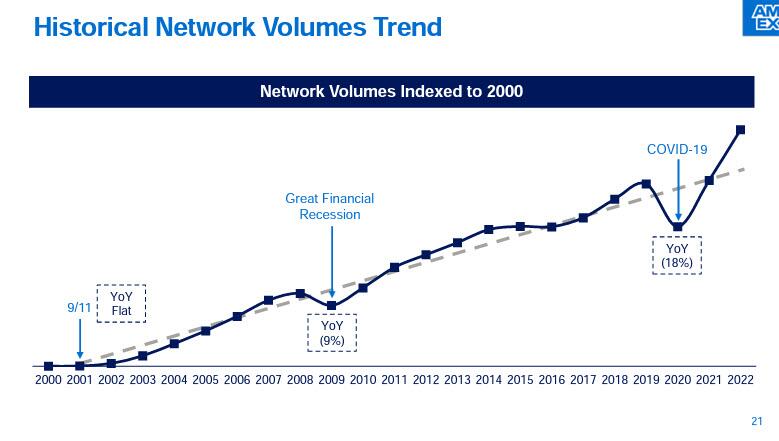
This is hardly a shock: targeting mostly the wealthiest tier of U.S. society, the future is bright for AmEx and its customers who - let's face it - are not seeing a huge hit to their standard of living as a result of soaring prices and interest rates. It is everyone else that is getting hit hard, and it is everyone else that is using cards like Capital One and Discover (which target FICO score about 40-60 lower than AmEx). And readers will recall that it was Discover which two weeks reported that its projected charge off rate for 2023 would more than double from its current 1.82% to as much as 3.90%!

The news hit the stock like a lead balloon, and sparked renewed fears that the bottom and middle-classes are already in recession.
Then again, for those keeping a tab on the latest development in the US car market - where the bulk of consumers use Discover, not AmEx - that's not exactly a shock.
Consider the following: as we first reported a month ago, a soaring number of consumers are falling behind on their car payments - a trend which will only accelerate - in a sign of the strain soaring car prices and prolonged inflation are having on household budgets.
Citing a NBC report, we reported that whereas repossessions tumbled at the start of the pandemic when Americans got a boost from stimulus checks and lenders were more willing to accommodate those behind on their payments, in recent months, the number of people behind on their car payments has been approaching prepandemic levels, and for the lowest-income consumers, the rate of loan defaults is now exceeding where it was in 2019, according to a recent report from Fitch.
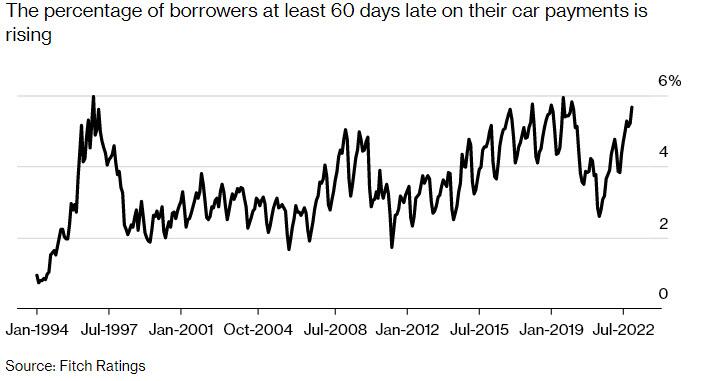
Fast forward to today, when a newer report from Fitch has laid out an even more startling milestone: more Americans are falling behind on their car payments than during the financial crisis. As Bloomberg first observed after skimming the Fitch note, in December the percentage of subprime auto borrowers who were at least 60 days late on their bills rose to 5.67%, up from a seven-year low of 2.58% in April 2021. That compares to 5.04% in January 2009, the peak during the Great Recession, and just a few weeks before the Fed was about to start QE1.
The result, Bloomberg reports extending on our observation from December, is that the number of car repossessions is soaring. Take the case of 21-year-old Kobe Hatch, who walked outside his Chicago home in December and couldn’t find his 2013 Dodge Journey; he immediately knew it had been repossessed for a simple reason: he hadn't made the car payment months.
Without a car, Kobe couldn’t do his job as a delivery driver for Amazon and got fired. Now, he’s struggling to make his rent payments and can’t afford groceries, even with food stamps.
“It’s been very stressful for the past few months,” he said. “Inflation has really taken a toll on people.” And it certainly has, although that doesn't explain why Kobe didn't make his car payments in the first place. Maybe he should have bought a care he could - gasp - afford even in a worst-case scenario. He didn't, but instead of blaming himself it is of course easier to blame inflation.
Hatch is part of a growing cohort of Americans facing auto repossessions, an ominous sign for the US economy. As we first explained in December, during the pandemic, a surge in used car prices forced buyers to take out bigger loans for their vehicles. The monthly payments seemed doable in an era of stimulus checks, a tight labor market and surging stocks, but that’s changed for many people as inflation eats into their budgets and the job market cools.
While few bothered to budget how they would pay for that new car purchased just one year ago at all time high prices, even fewer anticipated a world where spiking rates would make payment on the monthly auto payment virtually impossible. The average new auto loan rate was 8.02% in December, up from 5.15% a year earlier, according to Cox Automotive. The rate is usually much higher for subprime borrowers.
For Hatch, who is subprime, the total monthly bill for his car reached about $1,000, including the cost of insurance, thanks to a whopping 26% interest rate. Even if he can manage to save up enough to get the car back - about $1,100 for the repossession fee - there’s a strong chance he won’t be able to make the payments in subsequent months, especially now that he’s unemployed. Again, maybe Hatch should have bought a used clunker he could afford at the time and make a one time payment instead of diluting his future cash flow stream. Then again, there were iPhones to be bought and countless trinkets that were urgently in need of purchase by Hatch, who looked at that stimmy gravy train and assumed it would never end... well, oops. And in any case this is not an article about personal responsibility which in the US no longer exists but, well, economics 101.
And speaking of economics, the good news is that while the number of vehicle repossessions is still below pre-pandemic levels - at Manheim, the auto auction company, the number of repossessed cars increased 11% in 2022 compared to the prior year, which was still down 26% from 2019 - it is soaring fast and unless something major changes, it will soon overtake most recessionary benchmarks.
When exactly a lender can repossess a car varies by state, but it can happen in many cases as soon as a borrower is in default — often when a payment is not made on time, according to the Federal Trade Commission. Usually, though, it takes two or three consecutive missed payments for a repossession to happen. Once the vehicle is seized, the repossession can affect the borrower’s credit score for as long as it stays on the credit report, usually about seven years, according to Experian.
One such borrower is Josef Fields of Forth Worth, Texas: he, too, fell behind on his car payments and now faces a hit to his credit score. With his monthly bill at $556 for his 2021 Subaru WRX, the 25-year-old was having a hard time figuring out which costs to prioritize. He wouldn't have such a hard time if instead of buying a car which according to carmax costs around $35K now, and cost even more new, had instead purchased, say, a 1998 Hyundai. But, again, this is sadly not an article about personal responsibility and Americans' inability to budget for a downside case. So instead of settling for a cheaper car, Josef is now trying to apply for a hardship program through his bank, but it is too late: he too woke up to an empty driveway a week before Christmas.
Now, the repossession and tow fee will cost him $1,600 — about the total sum he owes in back payments as well. He’s trying to save up for another car but it will likely take a while (just a guess here, but his next car won't be a 1998 Hyundai either, and it won't be too long before it too is repossessed). One positive is that he can walk to his job at the local post office. But whenever he needs to go to the grocery store, he has to ask a friend or take an expensive Uber. We can only assume his net worth will have to get deeply negative before he discovers mass transport.
Fields is worried about how this will affect his financial future, especially his dream to buy a house one day (judging by his track record, any house Josef buys will be greatly overvalued and he will default shortly after). He estimates that the repossession shaved about 40 points off his credit score.
“When it comes to people my age and younger our credit is still new, so it’s more difficult, and then when stuff like this happens, it screws us over for the long run,” he said. Of course, it is always easier to blame "credit" or anything else for that matter, than looking in the mirror and taking responsibility your own sequence of poor choices and decisions, which will have a far more adverse impact "for the long run." But maybe if the lessons is harsh enough there is hope...
For some, however, the only lesson is to try and outsmart the repo man: hardly the best long-term strategy. Take San Antonio native Zhea Zarecor who is currently trying to negotiate with her lender so her 2013 Honda Fit won’t get repossessed. In the meantime, she’s hiding it.
The 53-year-old, who is currently in school for her bachelor’s in information technology (and raking up massive student loans for an education she should have had some 35 years ago) splits the monthly bill for the car — about $178 — with her roommate. But then the roommate lost his job, and with prices for groceries and everyday items increasing, there just wasn’t enough for the car payments.
Zarecor is trying to make extra money with odd jobs like contract secretarial work and participation in medical studies, but it often feels hopeless, she said. “Our money doesn’t go as far as it used to,” she said. “I don’t see prices going down, so the only relief I see is when I get my degree.”
* * *
So what happens next? Well, some, like Cox Automotive, remain optimistic: their analysts (who just may be a little conflicted) forecast that while loan defaults and repossessions will increase from their pandemic lows, long-term through 2025 they predict overall defaults and repossessions will remain at or below historic norms.
Still, the financial squeeze has been particularly difficult for lower-income consumers looking for budget vehicles, which have been particularly hard to find. While in the past, those car buyers would have purchased a used car for $7,000 to $15,000 they are now having to spend $20,000 to $25,000 for the same type of vehicle. Among dealers that cater to subprime and deep subprime consumers, the average listing price on their cars has almost doubled since the beginning of the pandemic, according to the CFPB.
“That near prime and subprime group of consumers, they’re getting hit very, very hard by inflation. That group of people did not have much disposable income. They had to finance a more expensive car and then they got hit with prices going up overall. There’s just a lot of stress,” said Kelly.
Ally Financial, which has a significant share of loans to subprime borrowers, said in its October earnings report that it expects delinquencies to increase to as much as 3.8% compared with 3.1% in 2019. One month ago we said that estimate will prove to be overly optimistic, and today we are getting further confirmation of our skepticism.
As twitter's CarDealershipGuy - who claims to be an anonymous auto-industry CEO and whose analysis has been featured in places like the NY Post and who frequently Tweets about the state of the auto market - laid out a recent blog post, Capital One released its Q4’22 earnings on Tuesday. The company missed revenue targets ($9.04 billion instead of $9.07 billion) and reported a net income of $1.2 billion, which is half of what it was a year ago. Adjusted per-share earnings are at $2.82, which is significantly below analysts' expectation of $3.87.
Along with other banks that are anticipating a downturn in the economy, Capital One has been bulking up their reserves for losses. Banks set aside these funds when credit quality begins to deteriorate, which occurs when past-due accounts or charge-offs start increasing. Capital One’s provision for credit losses increased $747 million to $2.4 billion, which is up $1.4 billion year over year.
One look at the auto lending section of the report, should answer why.
The trends I talked about in my previous newsletters (here and here), credit tightening and rising defaults are all evident. The net charge-off rate for auto loans was 1.7%, up from 0.6% last year. Auto loan originations were at $6.6 billion, down 20% year over year.
From what I see on my dealership floor, I believe that Capital One has taken the most drastic turn in tightening the credit, compared to Ally, Santander, and others.
Our volume with Capital One is down 50% quarter over quarter. To put it simply, we are not putting any business through Capital One because its offerings are not competitive anymore. It feels like the bank intentionally turned off the spigot with originations. Either it is preparing to face significant losses, or the company is just being extra cautious.
The anonymous auto dealer dug deeper and here is what he found out after speaking with a few insiders:
There’s a lot of internal turmoil happening inside the bank. In the words of the person familiar with the situation, never has there been so many high performers moved between divisions. Not just any divisions! Turns out that many leaders are moved from the dealer technology and products division to the “help me catch up” division. This division’s purpose is to work with delinquent customers.
This department has been largely neglected in the past, so why would Capital One suddenly decide to stifle innovation and reshuffle its workforce?
I see it as another affirmation of what to expect from the market in the coming year. Significantly propping the services division by the top automotive lender tells me that delinquencies are rising as consumers are struggling to manage their auto loan payments.
Cox Automotive’s data also supports my thinking: auto loan performance in December deteriorated with loans delinquent by more than 60 days increased by 5.3% and were up 26.7% from a year ago.
Finally, while the existing loan pipeline is bracing for soaring delinquencies and default and catastrophic writedowns, new loan originations have collapsed not only because of higher loan standards but because most Americans suddenly realize they can't afford monthly payments at these rates. “I dare think what happens to people who are signing up for new loans today,” said Ivan Drury, director of insights at car buying website Edmunds. “It’s not going to be better when we see these payments so high.”
As for the repo men, now that is one industry that will be booming all throughout the coming recession. “These repossessions are occurring on people who could afford that $500 or $600 a month payment two years ago, but now everything else in their life is more expensive,” said Drury, “That’s where we’re starting to see the repossessions happen because it’s just everything else starting to pin you down."
Indeed, for those in the repossession business, it’s been almost impossible to keep up with the surge in, well, "new business." Jeremy Cross, the president of International Recovery Systems in Pennsylvania, said he can’t find enough repo men to meet the demand or space to hold all the cars his company has been tasked with repossessing. With the holidays approaching, he’s been particularly busy as people prioritize spending elsewhere, and he’s expecting business to keep up throughout next year and 2024.
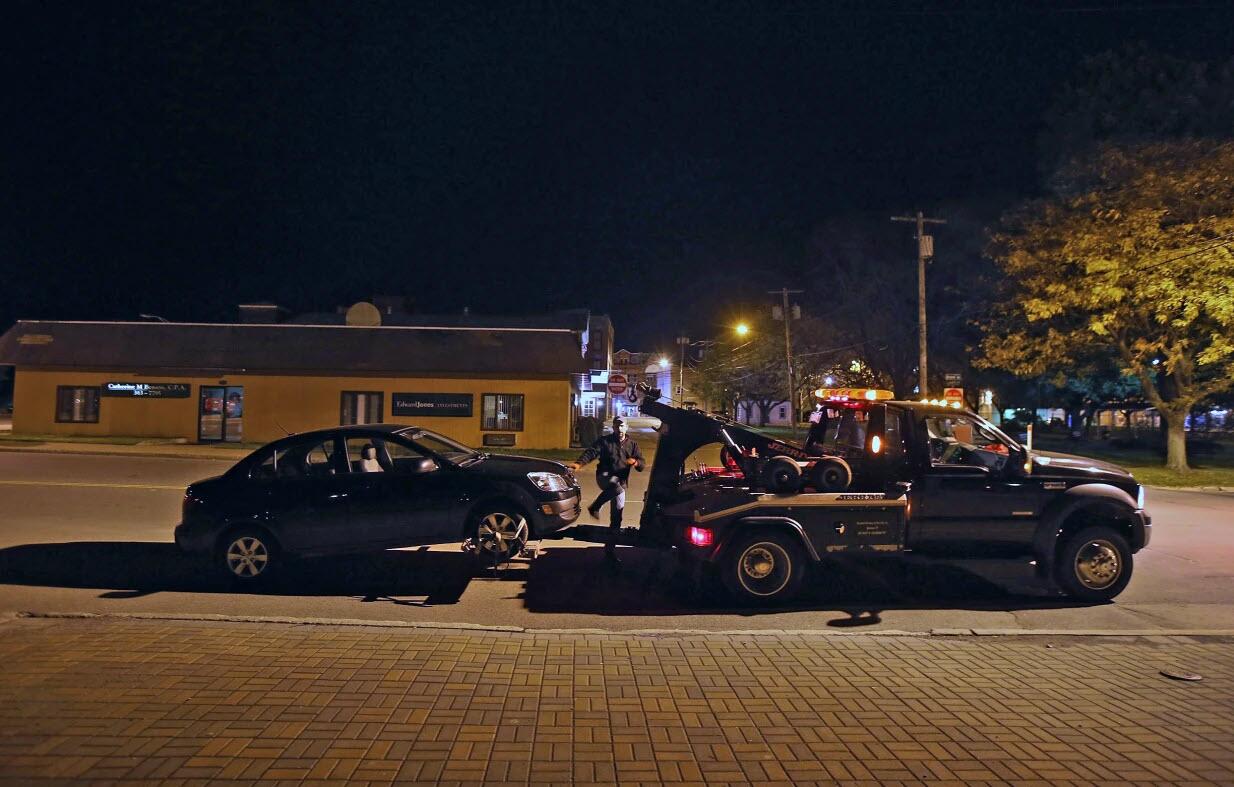 Repo man Todd O'Connor raises a car for towing in Oneida, N.Y., on Oct. 12
“Right now, it’s really the perfect storm,” said Cross. “Over the last two years, vehicle prices were inflated because there was no new car supply, people were still buying like crazy because they had a lot of stay-at-home cash, they had inflated credit scores, so it was like a recipe for disaster.”
I have learned that it is exceedingly important to try to recognize when an outside entity is trying to control you, or scare you. It’s really hard to do, but essential to autonomy, and sovereignty. Divide and conquer is a war tactic and it is very effective when trying to defeat opposition. So the key to defeating them, is to unify. Whenever you see someone trying to break up a band, ask yourself, “What is motivating them to do that?” And really think about their possible motivations.
The levels of deception now are so many, that sometimes I can barely believe what I am seeing or how thick this onion of lies we are all finding ourselves encased in actually is. I find myself literally wondering some days if anything I have ever ‘heard’ is true. On TV. In school. From textbooks. Is it all lies? Is it all the stage of the theatre? Am I simply a fancy black walnut carved wooden figure on this game board being moved around by someone else?
https://substack.com/app-link/post?publication_id=516896&post_id=99454081